
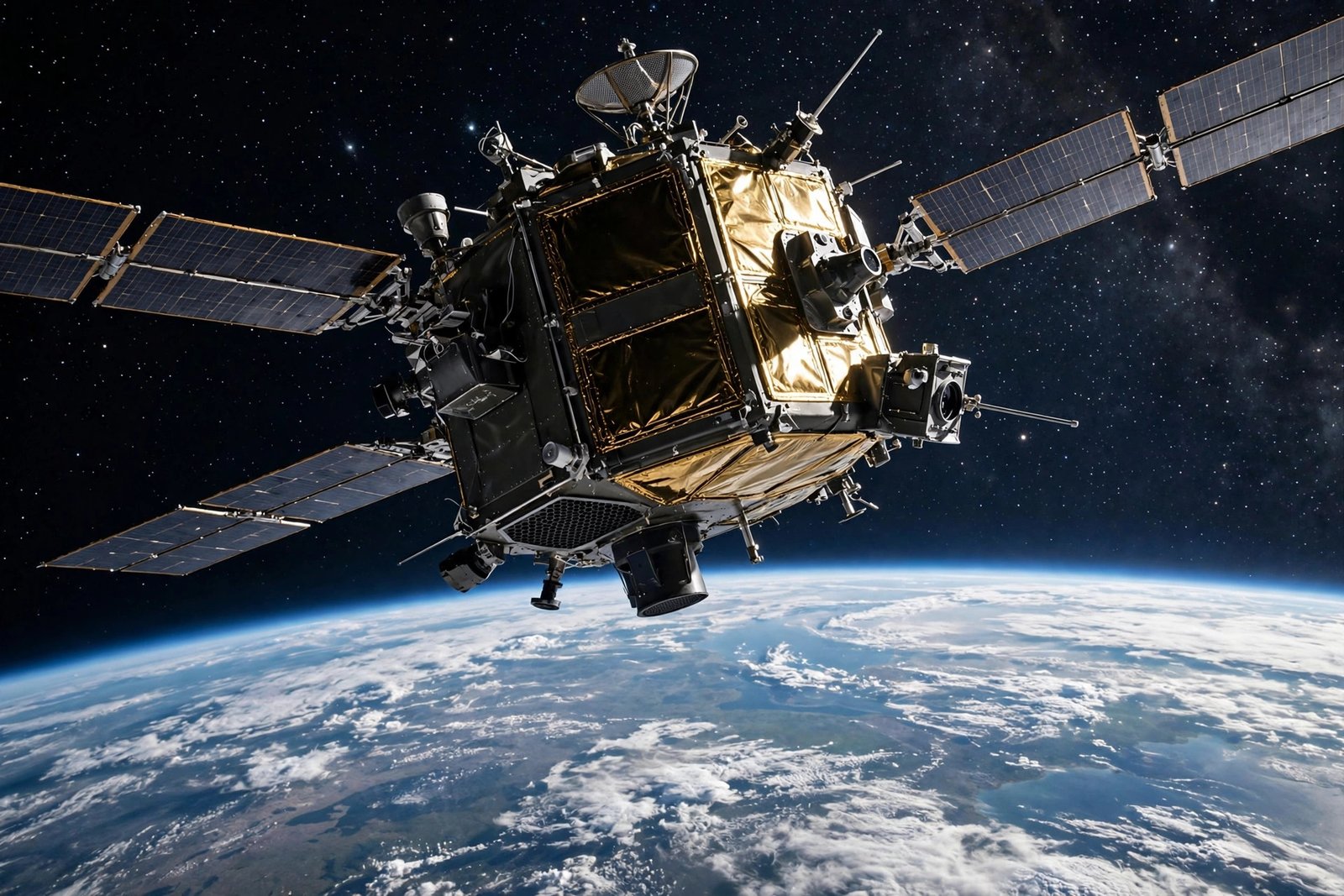
Every time your phone tells you where to turn, a Guardian is on duty. The US Space Force is America’s sixth military branch — the first new service since the Air Force was created in 1947 — and it guards the satellites your daily life depends on. Established on December 20, 2019, it is by far the smallest branch, with fewer than 10,000 uniformed members, yet it protects a domain most Americans never think about: space. These are the US Space Force facts every American should know.
How the US Space Force Was Born
The US Space Force did not appear out of nowhere. For decades, the military’s space missions lived inside the Air Force, mainly under Air Force Space Command, which had run military satellites and missile warning since 1982. By the 2010s, though, a growing number of lawmakers and generals argued that space had become too important — and too contested — to be just another Air Force side job.
The push was genuinely bipartisan. Two House members, Jim Cooper of Tennessee and Mike Rogers of Alabama, a Democrat and a Republican, championed the idea across party lines for years. Then, in March 2018, President Donald Trump put a national spotlight on the effort with an off-the-cuff announcement that America needed a separate space service. The idea had older roots, but his backing gave it unstoppable momentum.
In December 2019, Congress finally acted. The National Defense Authorization Act for Fiscal Year 2020 created the Space Force as a separate armed service, and Trump signed it into law on December 20, 2019. Overnight, America had its first new military branch in more than 70 years — joining the Army, Navy, Air Force, Marine Corps, and Coast Guard.
What the US Space Force Actually Does
Forget the science-fiction jokes. The US Space Force does not have starships or space marines. Its work is quieter — and far more essential than most people realize. Guardians sit at consoles in windowless rooms, around the clock, doing three big jobs.
First, missile warning. Infrared-sensing satellites stare at the Earth 24 hours a day, watching for the heat bloom of a missile launch. If a ballistic missile ever lifts off anywhere on the planet, these satellites see it within seconds and the warning flows to US and allied commanders. This is the job the Space Force inherited as its crown jewel, and it never stops.
Second, satellite operations. The Space Force flies the Global Positioning System — 31 satellites in medium Earth orbit that broadcast the navigation and timing signals behind your maps app. It also operates the military’s secure communications satellites, the backbone that lets deployed troops, ships, and aircraft talk to each other anywhere on Earth.
Third, space domain awareness. Guardians track tens of thousands of objects in orbit — working satellites, dead ones, rocket bodies, and fragments of debris — cataloging what is up there and warning operators when two objects might collide. As orbit gets more crowded every year, this traffic-cop role keeps getting bigger.
US Space Force Missions You’ve Never Heard Of
Beyond the headline jobs, the US Space Force runs missions most Americans have no idea exist.
- GPS timing: Those same GPS satellites do more than give directions. Their ultra-precise timing signals synchronize cell networks, bank transactions, and the power grid. If GPS timing went dark, ATMs and stock trades would stumble.
- The X-37B spaceplane: This uncrewed, reusable mini-shuttle — it looks like a small Space Shuttle — flies long, classified test missions in orbit for the Space Force, sometimes staying up for more than a year at a time.
- Launch ranges: Every rocket that lifts off from Cape Canaveral in Florida or Vandenberg in California flies through airspace and range safety managed by Space Force Guardians.
- Missile-defense sensors: Ground radars at far-flung stations, including Alaska’s Clear Space Force Station, sweep the skies for incoming threats headed toward North America.
None of it involves laser battles. All of it matters enormously — which is exactly why the branch exists.
Meet the Guardians: The People of the US Space Force
Members of the US Space Force are called Guardians, a name announced in December 2020 on the branch’s first birthday. The motto is Semper Supra — Latin for “Always Above” — a nod to the high ground they defend.
Guardians are a different breed of service member. There are no separate Reserve or National Guard components; every Guardian is effectively full-time, focused on deep technical expertise. Enlisted ranks mirror the Air Force with “specialist” titles for junior members, and officers follow the same general-to-lieutenant ladder as the other services.
Culture matters here too. Because the branch is so small and so technical, it deliberately built a lean, startup-like structure — small teams called “deltas” instead of the big wings the Air Force uses, and three field commands: Space Operations Command, Space Systems Command, and Space Training and Readiness Command. The idea is to stay fast in a domain where technology changes by the month.
The first Chief of Space Operations was General John “Jay” Raymond, who stood the service up from scratch. In November 2022, General B. Chance Saltzman took the helm as the second chief, with a stated focus on making Guardians ready for what the branch bluntly calls “competition in space.”
Where US Space Force Guardians Serve
Guardians serve at installations across the United States and around the world. The headquarters sits at Peterson Space Force Base in Colorado Springs, Colorado, alongside much of the branch’s nerve center.
Other key locations include Schriever Space Force Base in Colorado, where satellite operations crews fly constellations from the ground; Buckley Space Force Base, home to missile-warning operations; Vandenberg Space Force Base in California and Patrick Space Force Base in Florida, which run the nation’s space launch ranges; Clear Space Force Station in Alaska, with its giant missile-warning radar; and Pituffik Space Base in Greenland, one of the most remote American military outposts on Earth.
It is a small footprint for a global mission — a handful of bases watching over the entire sky. The story of American military courage did not start in orbit, of course; the Tuskegee Airmen proved that excellence has no ceiling long before anyone dreamed of a space branch, and the sacrifices remembered at Pearl Harbor remind us why vigilance — then on the seas, now in orbit — has always been America’s shield.
Why the US Space Force Matters to Your Daily Life
You may never meet a Guardian, but you use their work every single day. When your rideshare driver finds you, that is GPS. When a hurricane forecast updates, that is weather data flowing through space systems. When your credit card swipe clears in seconds, that is satellite timing. When US troops overseas call home or coordinate a rescue, that is military satellite communications.
Space has quietly become critical infrastructure — as vital as highways and the power grid. Other nations know it too, which is why the branch was created: to make sure no adversary can blind or deafen America by attacking its satellites. Deterrence in orbit works the same way it works on Earth — by being prepared, visible, and ready.
The Future of the US Space Force
The challenges ahead are real. Orbit is getting crowded with commercial satellites and debris, and rival nations have tested anti-satellite weapons — China in 2007 and Russia in 2021 both destroyed satellites in widely reported tests, scattering dangerous fragments. Guardians now train for a future where satellites may need to dodge, maneuver, and defend themselves.
At the same time, the branch is leaning into partnerships with America’s booming commercial space industry, buying services from private companies the way the Pentagon once only built everything itself. As NASA’s Artemis program aims to return astronauts to the Moon, the Space Force’s role will stretch even farther — because wherever Americans go, someone has to keep watch.
The US Space Force is small, young, and easy to joke about. But the facts tell a different story: it guards the invisible infrastructure of modern American life, around the clock, from 22,000 miles up. Semper Supra — always above. That is not a slogan. It is the job description.
Want more stories of American strength and ingenuity? Explore the Power of USA section for more on the people, machines, and missions that keep America moving forward.