
In the summer of 1941, the United States Army finally gave Black men a chance to become military pilots — and then stacked the odds against them. The training would happen at a small, hastily built airfield outside Tuskegee, Alabama, deep in the Jim Crow South, where segregation was law and many senior officers openly predicted the whole experiment would fail. What happened instead became one of the greatest stories in American military history. The Tuskegee Airmen flew more than 15,000 combat sorties over North Africa and Europe, escorted American bombers deeper into enemy territory than almost any other fighter group, and came home to help change the nation they had fought for. This is their true story.
To understand why their story matters, you have to understand the America they grew up in. In 1941, fewer than 4,000 African Americans were serving in the U.S. military, and only a handful were officers. Black soldiers were mostly confined to labor battalions, cooking details, and supply work. The idea that a Black man could master the most demanding machine of the war — the fighter plane — was something the military establishment refused to believe. The men who proved them wrong are known today as the Tuskegee Airmen, and their legacy reaches far beyond the battlefield.
Who Were the Tuskegee Airmen?
The Tuskegee Airmen were the first Black military aviators in the United States Armed Forces. The name covers several groups of men: the fighter pilots of the 99th Fighter Squadron and the 332nd Fighter Group, the bomber pilots and crews of the 477th Bombardment Group, and the thousands of support personnel — navigators, bombardiers, mechanics, radio technicians, and parachute riggers — trained at Tuskegee alongside them. Altogether, roughly 1,000 Black pilots earned their wings through the Tuskegee program between 1941 and 1946, supported by more than 14,000 ground personnel.
These men did not come from military families or flying clubs. They were teachers, factory workers, college students, and sharecroppers’ sons. Many had to score at the very top of their classes just to be allowed into training, because the program’s critics were watching for any failure they could use as proof that the whole idea was a mistake. The pressure was enormous. It was not enough to be good — they had to be flawless.
And they were. When the first class graduated in March 1942, just five pilots earned their wings, including Captain Benjamin O. Davis Jr., the son of one of the Army’s few Black generals. Davis would go on to command the 332nd Fighter Group in combat and later became the first Black general officer in the United States Air Force. Men like Davis carried not just their own dreams but the hopes of an entire generation of Black Americans.
How the Tuskegee Airmen Earned Their Wings
The Tuskegee experiment began under public pressure. For years, Black newspapers, civil rights leaders, and organizations like the NAACP had demanded that Black Americans be allowed to serve as pilots. In January 1941, the War Department finally relented and formed the all-Black 99th Pursuit Squadron of the U.S. Army Air Corps. But the training would not happen at an established base — it was assigned to a specially constructed, segregated airfield near Tuskegee, Alabama, with academic instruction provided by Tuskegee Institute, the famous Black university founded by Booker T. Washington.
The base, Moton Field, opened on July 19, 1941, and student pilots began training on single-engine aircraft. The conditions were spare. Equipment arrived late. Instructors were scarce. But the cadets had something their critics never counted on: an iron determination to succeed where no Black pilot had gone before. They studied navigation at night, drilled until their flying was precise, and supported one another through a program designed to wash them out.
That determination paid off. By 1943, the program was expanding. Three more all-Black fighter squadrons — the 100th, 301st, and 302nd — were activated, and in 1944 they joined the 99th to form the 332nd Fighter Group. A second Black flying group, the 477th Bombardment Group, was created to train bomber crews on B-25 medium bombers, though the war ended before the 477th could be deployed overseas. Every one of these units traced its roots to that small field in Alabama.
Tuskegee Airmen in Combat: North Africa to Berlin
The 99th Fighter Squadron saw its first combat on June 2, 1943, flying low-level strafing missions over North Africa in Curtiss P-40 Warhawks. These were dangerous, close-to-the-ground attacks against enemy troops and vehicles — the kind of missions that taught the young pilots how to fight as a unit. Later that year they moved to Sicily and then to mainland Italy, where they earned two Distinguished Unit Citations for actions over Sicily and at Monte Cassino.
In 1944, the four squadrons of the 332nd Fighter Group came together in Italy as part of the 15th Air Force, and their mission became the most demanding job in the air war: escorting American heavy bombers — B-17s and B-24s — on long-range raids deep into enemy territory, including missions all the way to Berlin. Bomber crews were dying in terrible numbers on these runs, and their survival depended on the fighter escorts that protected them from German interceptors. The Tuskegee Airmen flew the escorts.
The numbers they posted are staggering. Across the war, the Tuskegee fighter pilots flew 1,578 combat missions and more than 15,000 sorties. They destroyed 112 German aircraft in the air and another 150 on the ground, sank an enemy torpedo boat, and wrecked nearly 1,000 railcars, trucks, and other military vehicles. Sixty-six airmen were lost in the line of duty. Bomber crews came to request the fighters with the red tails by name — a reputation no amount of prejudice could manufacture.
Charles McGee, one of the Tuskegee pilots, went on to fly 409 combat missions across World War II, Korea, and Vietnam — a record for an American pilot. His story, and those of hundreds of his fellow airmen, is a reminder that the program’s critics had it exactly backwards: the men they said could not fly became some of the finest pilots America ever produced.
The “Red Tails” and the Aircraft They Flew
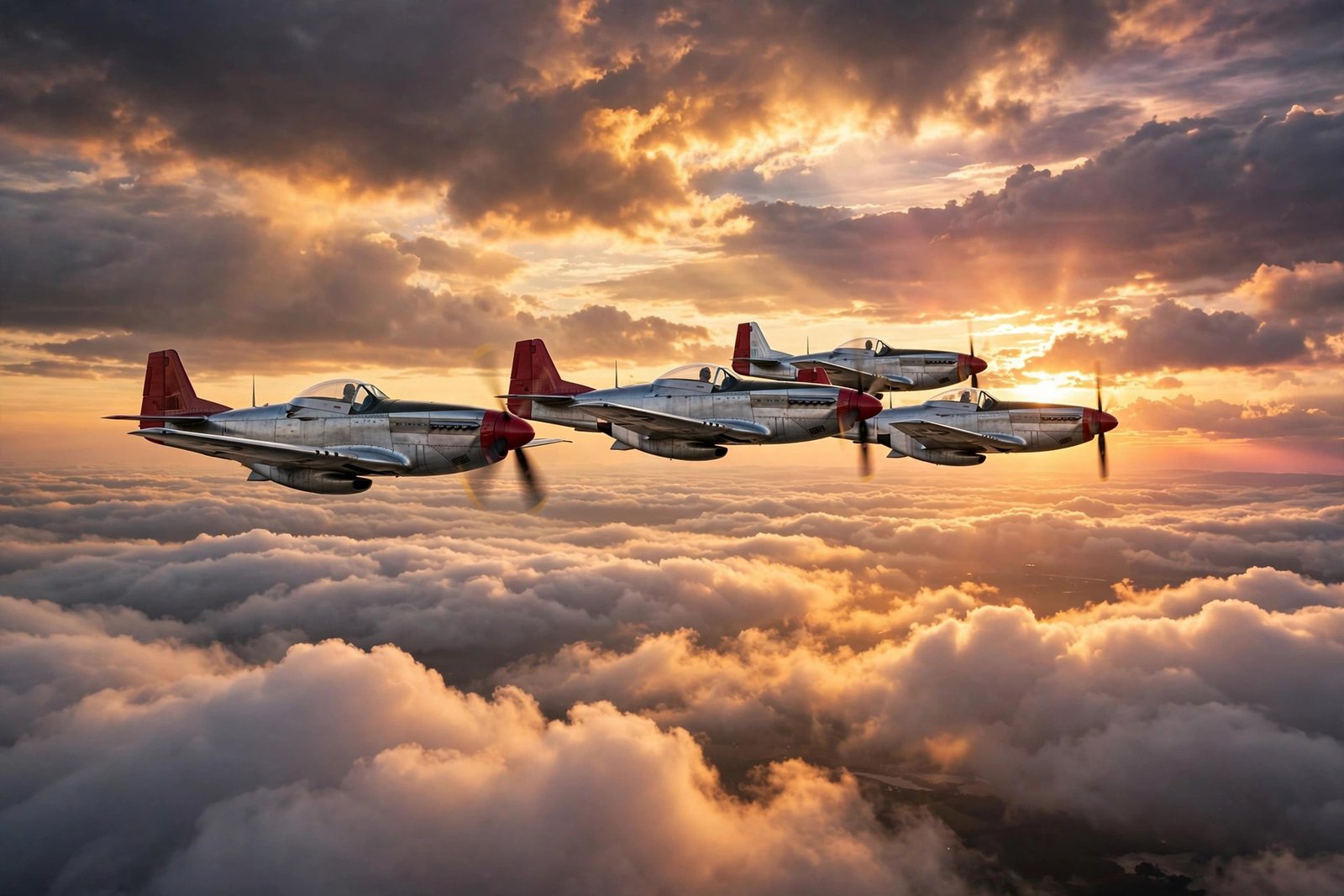
The nickname “Red Tails” came from the paint scheme the pilots chose themselves. When the 332nd’s P-47 Thunderbolts got bright red tails, the marking stuck, and the P-51 Mustangs that followed carried red noses, red rudders, and red propeller spinners. In the sky over Europe, German pilots learned what that flash of red meant.
The aircraft they flew tell the story of their war. The 99th started in combat with the rugged P-40 Warhawk. The 332nd began with Bell P-39 Airacobras, moved to the heavy P-47 Thunderbolt in the summer of 1944, and finally received the aircraft they are most associated with — the North American P-51 Mustang — in July 1944. The long-range Mustang was what made the Berlin escort missions possible, and in Red Tail hands it became a legend of its own. Today, a restored P-51 painted in 332nd Fighter Group markings stands in the National WWII Museum’s Freedom Pavilion in New Orleans.
Fighting Two Wars: Hitler Abroad and Racism at Home
The Tuskegee Airmen famously said they were fighting two wars — one against a military enemy overseas, and one against racism at home and abroad. It was not a figure of speech. At home, the military was rigidly segregated. Black officers were refused entry to white officers’ clubs. In April 1945, more than 100 Black officers of the 477th Bombardment Group were arrested after entering a whites-only officers’ club at Freeman Field, Indiana, to protest segregation — a standoff that helped push the military toward integration.
Overseas, the airmen sometimes found more respect from their bomber-crew comrades than from the Army that trained them. Many bomber pilots, after being escorted home safely through flak and fighters, stopped caring about the color of the men in the cockpits flying wing on them. The airmen gave their cause a name: the “Double V” — victory over the Axis abroad, and victory over racism at home. They pursued both with everything they had.
Their record made the case that prejudice could not. The Tuskegee Airmen collected 150 Distinguished Flying Crosses, 744 Air Medals, the Silver Star, and three Distinguished Unit Citations. These were not participation awards — they were combat decorations, earned over North Africa, Sicily, Italy, and Germany. When the war ended, no one in the military could seriously argue anymore that Black Americans could not serve as equals in the air.
The Record That Helped Desegregate the Military
On July 26, 1948, President Harry Truman signed Executive Order 9981, desegregating the United States Armed Forces. The order did not mention the Tuskegee Airmen by name, but their record was the proof that made the policy possible. The military that had insisted on a segregated Tuskegee experiment now had to accept what the airmen had demonstrated every day over Europe: courage, skill, and discipline have no color.
The recognition kept coming. In 2007, the surviving Tuskegee Airmen were awarded the Congressional Gold Medal, one of the nation’s highest civilian honors. Tuskegee’s Moton Field is now the Tuskegee Airmen National Historic Site, preserving the hangars and buildings where the first Black military pilots trained. Their story is told in museums across the country, including a dedicated exhibit and a restored Red Tail P-51 at the National WWII Museum.
For another powerful World War II story from the same era, read our account of the Pearl Harbor true story — the attack that brought America into the war these airmen helped win. And to see how American military power evolved in the decades after, explore our guide to U.S. Space Force facts.
Where to Honor the Tuskegee Airmen Today
The best place to stand where history happened is the Tuskegee Airmen National Historic Site at Moton Field in Tuskegee, Alabama. The site includes the original hangars, a museum with exhibits on the training program, and aircraft displays. The National WWII Museum in New Orleans also features a restored P-51 Mustang in Red Tails markings. If you visit either one, take a moment at the memorials — and remember the five young men of the first class who took off from a segregated field in Alabama and changed the country they came home to.
The Tuskegee Airmen proved something larger than their combat record. They proved that talent is everywhere, and that a nation willing to look for it in every community becomes stronger for it. That is why their story is still told — in classrooms, in museums, and in articles like this one. If this story moved you, share it. The least we owe these heroes is to remember their names.