
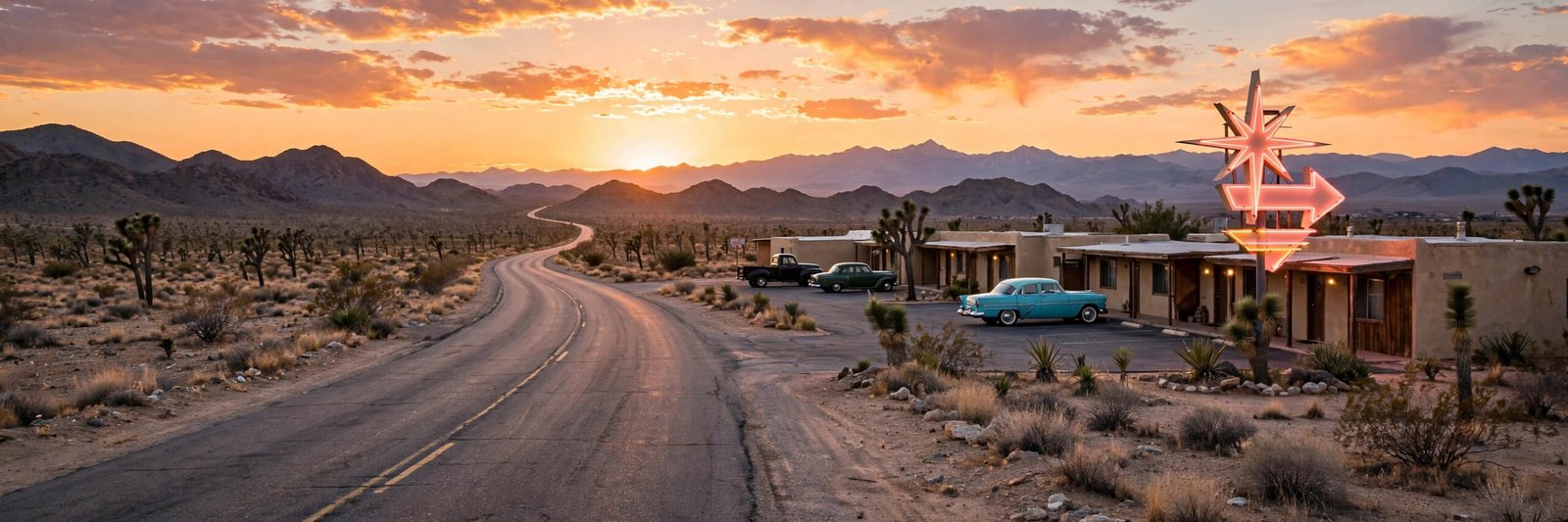
There is no road in America quite like Route 66. Stretching roughly 2,448 miles from Chicago to Santa Monica, the “Mother Road” is the most famous highway in the world — a ribbon of neon signs, retro diners, ghost towns, and giant roadside statues that carried Dust Bowl families west during the Great Depression and still draws road-trippers from every corner of the globe today. A Route 66 road trip is not really about the miles. It is about the journey: the small towns, the quirky stops, and the feeling that you are driving through a living museum of American culture. This guide covers the best stops coast to coast, how many days you need, and the practical tips that make the trip unforgettable.
Route 66 was established on November 11, 1926, as one of the original U.S. highways, linking Chicago, Illinois, with Santa Monica, California. It was decommissioned as an official highway in 1985, replaced by the faster interstates — but the road itself never really went away. Thanks to dedicated preservation groups and the towns that refused to let it fade, most of the original route is still drivable today as a patchwork of preserved alignments and frontage roads. Driving it now means following the brown “Historic Route 66” signs through eight states, past the same landmarks that have greeted travelers for a century.
Why a Route 66 Road Trip Still Matters
America has faster roads, but it has no road with more soul. Route 66 was the escape route for hundreds of thousands of families fleeing the Dust Bowl in the 1930s — John Steinbeck called it the “Mother Road” in The Grapes of Wrath. In the postwar years it became the road of freedom: soldiers coming home, families heading west for new lives, teenagers chasing the California dream. The motels, diners, and service stations that sprang up along it defined roadside America.
Today the road is a time capsule. The neon still buzzes in Tucumcari. The Blue Swallow Motel still parks guests in 1940s-era garages. The giant Gemini Giant statue still waves at drivers in Wilmington, Illinois. A Route 66 road trip is the closest thing America has to time travel, and 2026 marks the highway’s centennial — one hundred years since the Mother Road first opened. There has never been a better time to drive it.
Route 66 Road Trip by State: Chicago to Santa Monica
Illinois — Where It All Begins
Your trip starts in downtown Chicago at the corner of Adams Street and Michigan Avenue, where the “Route 66 Begin” sign makes the essential first photo. Fuel up at Lou Mitchell’s, the classic diner that has fed travelers since 1923, then roll south through small towns. In Pontiac, the Route 66 Hall of Fame and Museum holds thousands of artifacts, and in Wilmington, the 28-foot Gemini Giant — a fiberglass spaceman holding a rocket — is one of the road’s most photographed statues. Springfield’s Cozy Dog Drive-In claims to have invented the corn dog on a stick, and the locals will fight you over it.
Missouri — Caves and the Gateway Arch
Crossing into Missouri, Route 66 winds through the Ozarks and past Meramec Caverns, the cave system that Jesse James supposedly used as a hideout and that has advertised itself on barns across the Midwest for generations. St. Louis is the big stop here: the Gateway Arch rises 630 feet over the Mississippi River, marking the spot where the Mother Road crosses the great river heading west. The neon-drenched towns of the Ozarks — with their vintage motor courts and pie diners — are pure Route 66.
Kansas — The 13-Mile Stretch
Route 66 barely touches Kansas — only about 13 miles of it run through the state’s southeast corner near Galena. But those 13 miles punch above their weight. The tiny town of Galena has a restored Kan-O-Tex service station, and the rusty tow truck out front is said to have inspired the character of Mater in Pixar’s Cars. It is a quick detour, but skipping it means missing the bragging rights of driving Route 66 through all eight states.
Oklahoma — Neon, Music, and the Blue Whale
Oklahoma has more drivable miles of Route 66 than any other state, and it shows. In Catoosa, the Blue Whale — a giant blue whale sculpture built as an anniversary gift in the 1970s — has become an icon of roadside whimsy. Tulsa’s stretch of 11th Street glows with restored neon signs, and in Arcadia, Pop’s 66 serves hundreds of soda flavors beneath a 66-foot-tall soda bottle sculpture. Elk City’s National Route 66 Museum walks you through the road’s history, and Clinton and Weatherford keep the vintage motels coming.
Texas — Cadillacs in the Desert
The Texas Panhandle gives you one of the most famous stops on the entire road: Cadillac Ranch outside Amarillo, where ten Cadillacs are buried nose-down in a wheat field as a piece of public art from 1974. Bring spray paint — adding your tag to the cars is part of the tradition. In Amarillo, the Big Texan Steak Ranch dares brave eaters to finish a 72-ounce steak with all the trimmings in under an hour — free if you succeed. The Midpoint Cafe in Adrian marks the exact halfway point between Chicago and Santa Monica: 1,139 miles from each end.
New Mexico — Turquoise, Adobe, and the Blue Hole
New Mexico is where the desert takes over and Route 66 gets its most cinematic. Santa Rosa’s Blue Hole is a stunning natural swimming hole — a sapphire-blue spring, 80 feet deep, that stays a constant 61 degrees year-round and draws divers from across the country. Tucumcari keeps the neon dream alive with the Blue Swallow Motel, a 1940s motor court where each room has its own garage and the neon sign is a landmark in its own right. Take the pre-1937 alignment north through Santa Fe for adobe architecture and green chile everything, then drop back to Albuquerque’s Old Town before heading west.
Arizona — The Longest Unbroken Stretch
Arizona holds the longest continuous stretch of original Route 66 still drivable, and it is packed with legends. The Petrified Forest National Park sits right on the old alignment, with 225-million-year-old fossilized trees scattered across the Painted Desert. Holbrook’s Wigwam Motel lets you sleep in a concrete teepee — one of only three surviving Wigwam villages. Seligman is the town that refused to die: when the interstate bypassed it, barber Angel Delgadillo campaigned to get Route 66 designated a historic highway, and the town’s vintage shops and classic cars inspired Pixar’s Radiator Springs. Farther west, the old mining town of Oatman is run by wild burros — descendants of miners’ pack animals — that wander the wooden sidewalks. Take the detour north at Flagstaff to the Grand Canyon; our Antelope Canyon guide covers another Arizona wonder worth the side trip.
California — The Final Miles to the Pacific
The last state is a run through the Mojave Desert, past the bottle-tree sculptures of Elmer’s Bottle Tree Ranch and the ghost-town quiet of Amboy, before the road climbs into the Los Angeles basin. It ends at the Santa Monica Pier, where the “End of the Trail” sign marks the western terminus. Walk to the end of the pier, look out at the Pacific, and you have done what Dust Bowl families, beatniks, and rock-and-roll dreamers have done for a century: followed the Mother Road all the way to the ocean. Cap the trip with California sunshine — our hidden beaches guide points to quiet stretches of sand beyond the tourist crowds.
How Many Days Do You Need for a Route 66 Road Trip?
Driven straight through with no stops, the route takes about 40 hours behind the wheel — but that misses the entire point. Most travelers plan 10 to 14 days for the full Chicago-to-Santa Monica run, which works out to roughly 175 to 250 miles of driving per day with plenty of time for stops, meals, and photo ops. A rushed 7-day trip is possible if you are short on time, but you will be choosing between landmarks instead of savoring them.
If you cannot do the whole road, pick a signature segment. Chicago to St. Louis gives you the classic Midwest stretch. Oklahoma City to Amarillo packs in neon, museums, and Cadillac Ranch. Flagstaff to Santa Monica covers the desert, the Mojave, and the pier finish. Any of them stands alone as a great American road trip.
Best Time of Year for a Route 66 Road Trip
Spring (April to May) and fall (September to October) are the sweet spots — comfortable temperatures across the whole route, wildflowers in the desert in spring, and thinner crowds. Summer is doable but brutal: temperatures through Oklahoma, Texas, New Mexico, and Arizona can top 100 degrees, so drive in the cooler morning and evening hours and keep water in the car. Winter brings snow risk to the Midwest sections and is not recommended for the full route. For another kind of wildlife watching to pair with a spring drive, see our guide on where to see bald eagles in the USA.
Practical Tips for Driving the Mother Road
- Follow the brown signs, not just GPS. Navigation apps will keep pulling you onto the interstate. The “Historic Route 66” markers are what keep you on the original alignments and the small towns.
- Get your kicks on paper. Pick up a Route 66 passport or the classic EZ66 guide at a visitor center — getting it stamped in each town is half the fun.
- Book the vintage motels early. Places like the Blue Swallow in Tucumcari and the Wigwam Motel in Holbrook have few rooms and sell out in peak season.
- Carry cash and a full tank. Some desert stretches have long gaps between gas stations, and a few tiny-town stops are cash-friendly.
- Pack for the desert. Sunscreen, hats, sunglasses, and more water than you think you need — especially crossing Arizona and New Mexico.
- Leave room for spontaneity. The best Route 66 memories come from the unplanned stops: the pie diner you did not expect, the ghost town that was not in the guide.
A Route 66 road trip is the great American drive — part history lesson, part scavenger hunt, part meditation on the open road. From the Chicago skyline to the Santa Monica Pier, every mile has a story, and the road rewards the traveler who takes the time to hear them. So fill the tank, roll down the windows, and get your kicks. The Mother Road is waiting — and in its centennial year, it has never looked better.