
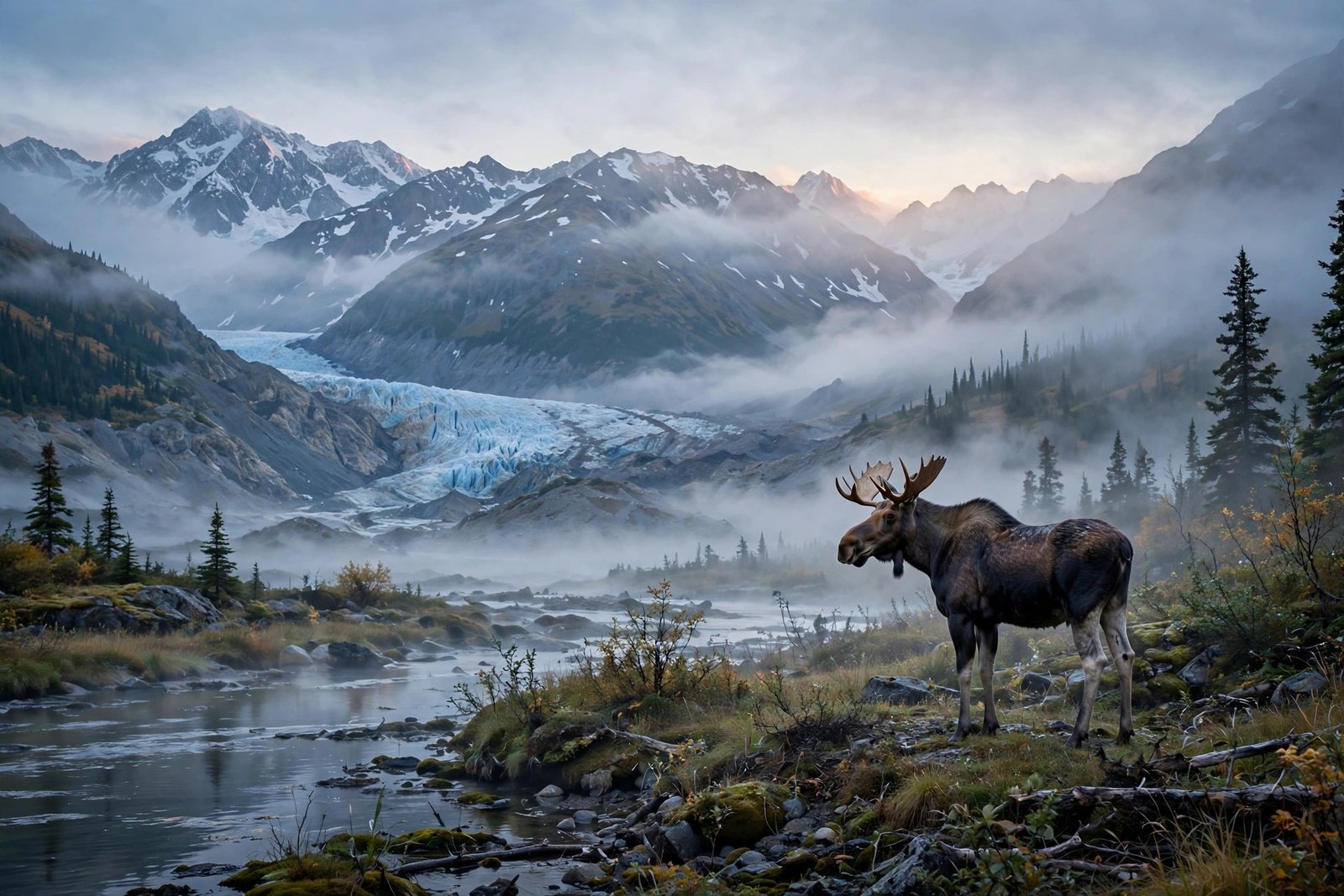
Ask most Americans to describe Alaska and you will hear the same words: cold, remote, beautiful. But the real facts about Alaska go far beyond the postcard version. This is a state so enormous it could swallow Texas, California, and Montana combined and still have room to spare. It holds the highest peak in North America, more coastline than the rest of the country put together, and a city where the sun refuses to set for months at a time. Whether you are planning a trip or just love great trivia, these 27 surprising facts about Alaska will change the way you see the Last Frontier.
Facts About Alaska’s Land: Bigger and Wilder Than You Think
1. Alaska is the largest US state by a staggering margin. At about 665,000 square miles, Alaska is more than twice the size of Texas — and bigger than Texas, California, and Montana combined. It covers roughly one-fifth of the entire Lower 48.
2. Its coastline is longer than the rest of the country combined. Alaska has about 6,640 miles of coastline (over 33,000 if you count every island and inlet). That is more shoreline than all the other 49 states put together, which is one reason the state feels like several worlds in one.
3. Alaska has around 100,000 glaciers. According to the National Park Service, an estimated 100,000 glaciers cover about five percent of the state — yet only 616 of them have official names. Nowhere else in America comes close.
4. Denali is the tallest mountain in North America. Rising 20,310 feet above sea level, Denali towers over every other peak on the continent. On a clear day, it can be seen from Anchorage, more than 130 miles away.
5. Seventeen of America’s 20 highest peaks are in Alaska. The state doesn’t just hold the tallest mountain — it nearly owns the entire list. Only a handful of peaks in the Lower 48 even crack the top 20.
6. The largest glacier in North America is here. The Bering Glacier near Cordova sprawls across roughly 1,900 square miles and stretches more than 120 miles long — bigger than the state of Rhode Island. If you want to grasp the scale of Alaska’s ice, start there.
7. More than half of America’s national park land is in Alaska. The state is home to 8 national parks, and Wrangell-St. Elias — at 13.2 million acres — is the largest national park in the entire country. It is bigger than Switzerland.
8. Alaska has over 3 million lakes and 3,000 rivers. Water defines this state. Its lakes range from tiny tundra ponds to massive bodies of water, and its rivers include some of the wildest free-flowing waterways left on Earth.
9. Alaska is the northernmost, westernmost — and easternmost — state. This sounds impossible until you look at a map: the Aleutian Islands stretch so far west that Amatignak Island crosses the 180th meridian into the Eastern Hemisphere. So Alaska wins the compass in three directions at once. Few facts about Alaska surprise people more than this one.
Facts About Alaska’s Sky: Where the Sun Refuses to Set
10. In summer, the sun can shine for 24 hours a day. Above the Arctic Circle, Alaska experiences the famous midnight sun. In Utqiagvik, the country’s northernmost community, the sun stays above the horizon for more than 80 straight days each summer.
11. In winter, the sun disappears for about two months. The flip side of the midnight sun is polar night. In Utqiagvik, the sun does not rise at all from roughly mid-November to late January — around 65 days of twilight and darkness.
12. Alaska is one of the best places on Earth to see the northern lights. Fairbanks sits directly under the auroral oval, making it a world-class destination for aurora viewing. The lights dance across the sky on clear winter nights, sometimes visible from August through April.
13. Summer daylight grows absurdly large vegetables. The Matanuska Valley near Anchorage gets up to 20 hours of summer daylight, and local farmers grow prize-winning cabbages topping 100 pounds. At the Alaska State Fair, giant-vegetable contests are serious business.
14. America’s northernmost city changed its name back. The city long known as Barrow officially restored its traditional Inupiat name, Utqiagvik, in 2016 after residents voted for the change. It remains the northernmost incorporated city in the United States.
Facts About Alaska’s Past: From Russian Colony to 49th State
15. The United States bought Alaska from Russia for $7.2 million. In 1867, Secretary of State William Seward negotiated the purchase for roughly two cents an acre. Critics mocked it as “Seward’s Folly” and “Seward’s Icebox” — until gold, oil, and fish proved them spectacularly wrong.
16. The name “Alaska” means “great land.” It comes from the Aleut word Alyeska, used by the Indigenous Unangan (Aleut) people of the Aleutian Islands. Few state names carry a more fitting meaning.
17. The Klondike Gold Rush put Alaska on the map. When gold was discovered in the Klondike in the late 1890s, around 100,000 prospectors stampeded north. The capital, Juneau, is itself named for gold prospector Joe Juneau, who struck it rich in the area in 1880.
18. Alaska became the 49th state in 1959. Statehood arrived on January 3, 1959 — just months before Hawaii joined as the 50th. For nearly a century, Alaska had been a territory, prized for resources but denied full representation.
19. A 13-year-old designed the state flag. In 1927, a seventh-grader named Benny Benson won a territory-wide contest with his design: eight gold stars forming the Big Dipper and the North Star on a dark blue field. He won a $1,000 scholarship and a trip to Washington, DC.
20. Denali got its Indigenous name back in 2015. For nearly a century, North America’s tallest peak was officially called Mount McKinley. In 2015, the federal government restored the Koyukon Athabascan name Denali, meaning “the high one” — the name local Native peoples had used for centuries.
21. Alaska survived the second-strongest earthquake ever recorded. On March 27, 1964 — Good Friday — a magnitude 9.2 earthquake rocked south-central Alaska, the most powerful quake in North American history and the second-largest ever measured anywhere. It reshaped coastlines and lifted parts of the seafloor by dozens of feet.
22. An 800-mile pipeline moves Alaska’s oil south. After the giant Prudhoe Bay oil discovery in 1968, engineers built the Trans-Alaska Pipeline — roughly 800 miles from the Arctic coast to the ice-free port of Valdez. Much of it runs above ground on supports so the hot oil doesn’t melt the permafrost.
23. Alaska pays its residents an annual dividend. Thanks to oil revenue saved in the Alaska Permanent Fund, every qualifying resident receives a yearly check — a share of the state’s resource wealth simply for living there. No other state does anything like it.
More Facts About Alaska: People, Wildlife, and Everyday Life
24. Alaska is home to many distinct Indigenous cultures. Long before Russian or American flags flew here, the Inupiat, Yupik, Unangan (Aleut), Tlingit, Haida, Tsimshian, and Athabascan peoples built thriving societies adapted to the Arctic and subarctic. Their languages, art, and traditions remain central to Alaskan identity.
25. A legendary dog-sled relay saved an entire town. In 1925, mushers and sled dogs relayed diphtheria serum 674 miles across Alaska to save the town of Nome — the famous serum run led by dogs like Balto and Togo. The Iditarod Trail Sled Dog Race, covering nearly 1,000 miles from Anchorage to Nome, partly commemorates that journey. Fittingly, dog mushing is Alaska’s official state sport.
26. There is no state income tax and no statewide sales tax. Alaska is one of the few states with neither. Combined with the annual Permanent Fund dividend, it makes Alaska’s tax picture unlike anywhere else in America.
27. The wildlife is on another scale entirely. Kodiak bears — among the largest bears on Earth — roam Kodiak Island. The moose is the official state land mammal, the king salmon the state fish, and the willow ptarmigan the state bird. And Bristol Bay hosts the largest sockeye salmon run in the world, with tens of millions of fish returning each summer. If bald eagles are your thing, Alaska is also one of the best places to see bald eagles in the USA — the Chilkat River alone hosts thousands each fall.
These facts about Alaska barely scratch the surface. It is a place of superlatives — biggest, longest, tallest, northernmost — yet its real magic is quieter: the hush of a glacier calving into the sea, the green shimmer of the aurora, the endless summer evenings. Like the country’s hidden beaches and the desert Southwest’s slot canyons, Alaska rewards the travelers who look beyond the obvious.
The Bottom Line
Now you know the facts about Alaska that most people never hear — from a flag designed by a seventh-grader to a city where winter means two months without sunrise. This is a state that refuses to be ordinary, and that is exactly why travelers keep coming back. Which of these 27 facts surprised you most? Share this with someone who needs an Alaska trip on their bucket list — and start planning yours.