
On a quiet Sunday morning in Hawaii, as sailors slept in their bunks and families headed to church, the sky filled with the drone of approaching aircraft. What happened next — the pearl harbor attack — killed 2,403 Americans in under two hours and dragged the United States into World War II. It remains the deadliest foreign attack on American soil before September 11, 2001, and one of the most studied mornings in military history. This is the true story of December 7, 1941: why it happened, what unfolded minute by minute, and the ordinary men who became heroes.
Why Japan Launched the Pearl Harbor Attack
The attack did not come out of nowhere. By 1941, Japan was deep into an aggressive expansion across Asia, having invaded China and moved into French Indochina. In response, the United States cut off Japan’s oil supply and froze Japanese assets — an economic stranglehold that Japan’s leaders saw as an existential threat. Japan imported nearly all of its oil, and without it, its navy and war machine would grind to a halt within months.
Admiral Isoroku Yamamoto, commander of Japan’s Combined Fleet, devised a bold gamble: a surprise carrier strike to cripple the US Pacific Fleet at Pearl Harbor, buying Japan time to seize the oil-rich territories of Southeast Asia unopposed. He had studied in America and warned that Japan could run wild for a year — but had no confidence beyond that.
Ironically, Japan’s primary targets were not battleships at all. Yamamoto wanted America’s aircraft carriers. But on the morning of December 7, all three Pacific carriers — the Enterprise, Lexington, and Saratoga — were at sea, safely out of reach. The Japanese pilots would have to settle for the battleships lined up in a row along Ford Island.
The Pearl Harbor Attack: A Timeline of December 7, 1941
The first warning came just after 7:00 AM, when two Army radar operators at Opana Point on Oahu’s north shore spotted a massive formation of incoming aircraft. They reported it — and were told not to worry. The blips were assumed to be a flight of American B-17 bombers expected from California.
At 7:48 AM Hawaiian time, the first wave of 183 Japanese planes — fighters, bombers, and torpedo planes launched from six aircraft carriers 230 miles north of Oahu — roared over Pearl Harbor. Within minutes, torpedoes were ripping into the hulls of moored battleships and bombs were falling on the airfields at Hickam, Wheeler, and Bellows.
The most devastating single moment came around 8:10 AM. A Japanese armor-piercing bomb struck the USS Arizona near its forward ammunition magazines. The resulting explosion was catastrophic — a fireball that shot hundreds of feet into the air and sank the battleship in nine minutes, killing 1,177 of its crew. Survivors described burning oil spreading across the water, forcing men to swim through flames.
Minutes later, torpedoes slammed into the USS Oklahoma, which rolled over and capsized, trapping hundreds of men inside her hull. The USS West Virginia and USS California were also hit hard and settled to the harbor floor. Only the USS Nevada managed to get underway — her crew beached her deliberately rather than let her sink in the channel and block the harbor entrance.
A second wave of 167 planes struck at about 8:50 AM, pounding ships and airfields for another hour. By around 9:45 AM, it was over. Eight American battleships were damaged, four of them sunk. A total of 188 US aircraft were destroyed, most of them on the ground. The Japanese lost just 29 aircraft and five midget submarines.
The Ships and the Men Who Were Lost
The human cost of the pearl harbor attack was staggering. In total, 2,403 Americans were killed and 1,178 were wounded. The Navy suffered the heaviest losses by far.
The USS Arizona’s toll — 1,177 dead — accounted for nearly half of all American deaths that day. Among the fallen were the ship’s captain, Franklin Van Valkenburgh, and Rear Admiral Isaac Kidd. All 21 members of the ship’s band died together. Thirty-eight sets of brothers served aboard the Arizona; 63 of the 79 brothers were killed.
The USS Oklahoma lost 429 men when she capsized. The USS West Virginia lost 106, the USS California 105. At Hickam Field, 191 people died, including five civilians. In total, 49 civilians were killed across Oahu — some by Japanese bombs, others tragically by American anti-aircraft shells falling back to earth.
Perhaps the most haunting detail: more than 900 of the Arizona’s dead remain entombed in the sunken hull to this day. In the decades since, dozens of Arizona survivors chose to have their ashes interred inside the wreck, rejoining their shipmates in eternal rest.
Heroes of the Pearl Harbor Attack
Amid the chaos, ordinary sailors did extraordinary things. The most famous was Doris “Dorie” Miller, a Black mess attendant aboard the USS West Virginia. With no training on the weapon, Miller carried his wounded captain to safety, then manned an anti-aircraft machine gun and fired at the attacking planes until ordered to abandon ship. He became the first Black American to receive the Navy Cross — and like the Tuskegee Airmen who would follow him into the war, his courage challenged a segregated military’s assumptions about who could be a hero. Miller was killed in 1943 when his next ship was torpedoed.
Others fought just as fiercely. Ensigns and chiefs organized bucket brigades and damage control on burning ships. At the airfields, pilots who managed to get airborne in the middle of the attack took on overwhelming odds. Fifteen Medals of Honor were ultimately awarded for actions on December 7 — a testament to how many men refused to run.
After the Pearl Harbor Attack: America Goes to War
The day after the attack, President Franklin D. Roosevelt stood before a joint session of Congress and called December 7, 1941, “a date which will live in infamy.” Congress declared war on Japan within the hour, with only one dissenting vote. Three days later, Germany and Italy declared war on the United States, and America was fully in World War II.
The shock transformed the nation overnight. Isolationism — the powerful belief that America should stay out of foreign wars — collapsed in a single morning. Millions of young men enlisted. Factories converted to wartime production. A country that had been divided about the war was suddenly united by it.
The military reckoning was swift. Admiral Husband Kimmel and General Walter Short, the Navy and Army commanders at Pearl Harbor, were relieved of their commands. Investigations would debate for decades how much warning Washington had and whether Hawaii’s commanders were scapegoated — but the failure to anticipate the attack remains a defining case study in military surprise.
Strategically, Japan’s gamble failed. The carriers it had hoped to destroy survived — and just six months later, at the Battle of Midway, American carrier aircraft sank four Japanese carriers, turning the tide of the Pacific War. The battleships Japan sank at Pearl Harbor, meanwhile, mostly returned: of the eight damaged battleships, six were repaired and fought again.
Pearl Harbor Today: The Memorial
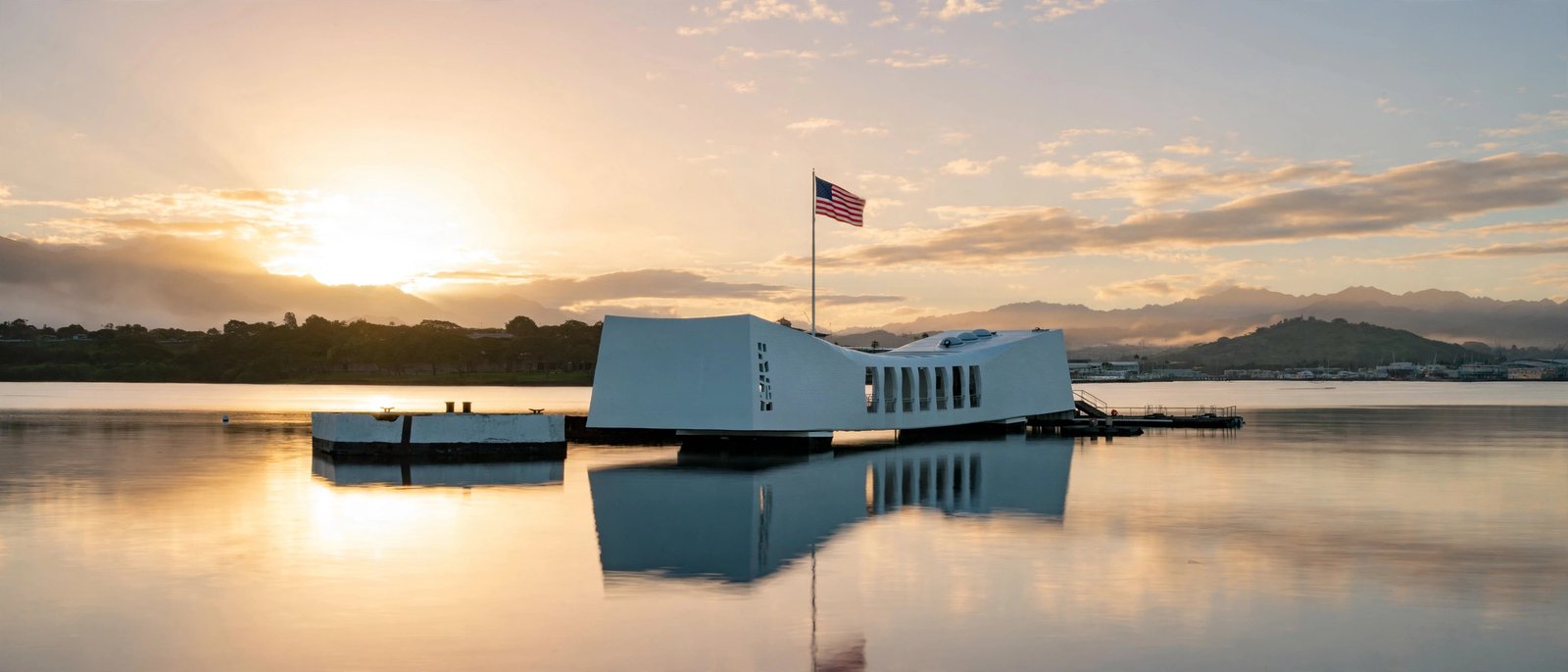
Today, Pearl Harbor is home to the Pearl Harbor National Memorial on Oahu. Its centerpiece is the USS Arizona Memorial, dedicated in 1962 — a stark white structure that straddles the sunken battleship without touching it. Visitors look down through the water at the rusting hull, where drops of oil still rise to the surface more than 80 years later. Survivors called them the “black tears of the Arizona.”
The memorial draws nearly two million visitors a year. It stands not just as a tribute to the fallen, but as a reminder of how quickly peace can shatter — and how much ordinary courage matters when it does. From the battleships of 1941 to the Space Force guardians of today, the story of American military service keeps being written.
The Bottom Line
The pearl harbor attack lasted less than two hours, but its echoes shaped the entire 20th century. It ended American isolationism, launched the United States onto the world stage, and cost 2,403 Americans their lives in a single morning. Remembering December 7 is not about reliving old hatreds — it is about honoring the sailors, soldiers, and civilians who paid the price of a nation’s unpreparedness, and the heroes who rose anyway. Share this story, visit the memorial if you ever reach Oahu, and never forget.