
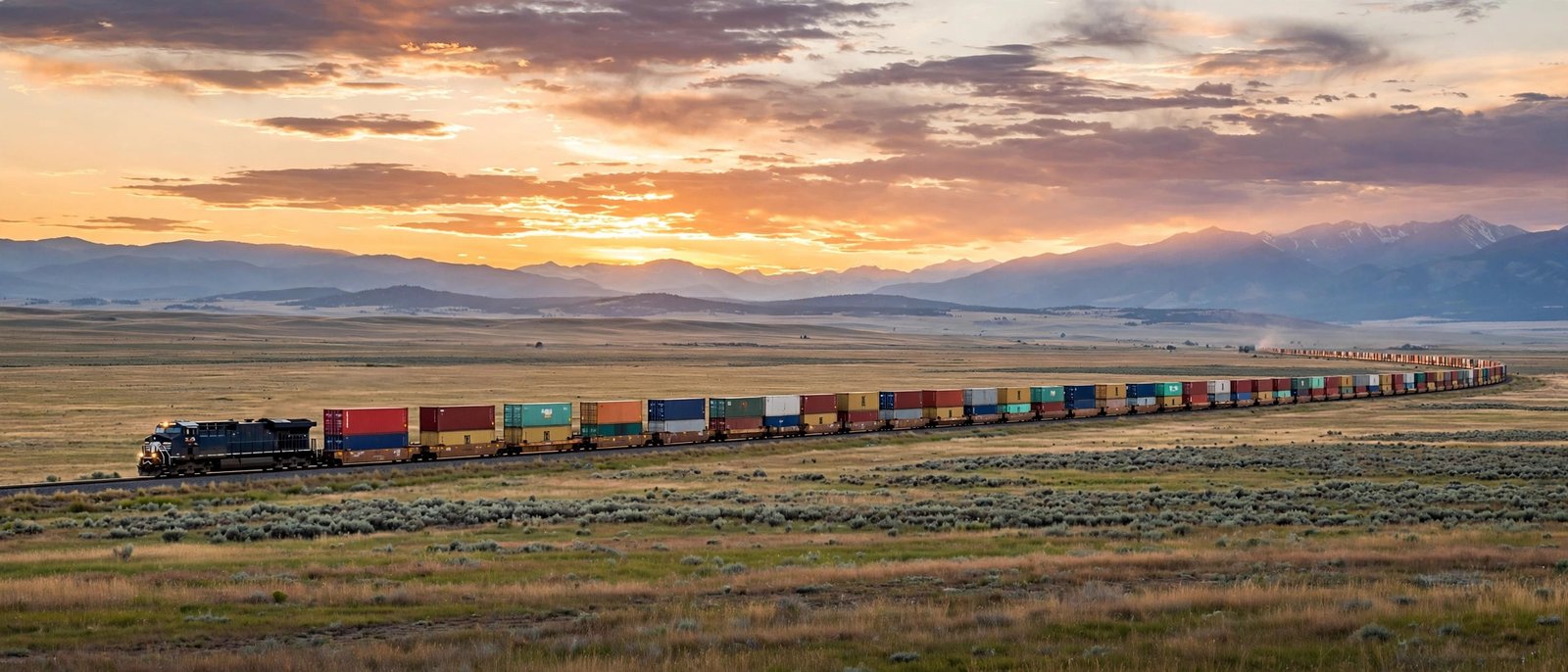
Long before a package reaches your doorstep, it may have already traveled a thousand miles by train, crossing prairies, mountains, and busy cities in the dark while most of America sleeps. That quiet, constant movement is the backbone of the modern economy, and US rail freight power is the reason store shelves stay stocked, factories keep running, and exports keep moving to ports on both coasts. When you understand how freight rail works, you start to see the country differently: not just as highways and airports, but as a steel network that carries the heaviest loads with remarkable efficiency.
Freight trains do not get the attention that passenger trains or airplanes do, yet they move an enormous share of what America makes, grows, and consumes. A single train can replace hundreds of trucks, using far less fuel per ton and producing fewer emissions per load. For farmers in the Midwest, manufacturers in the Rust Belt, and retailers everywhere, rail is not an old-fashioned leftover. It is a living system that connects small towns to global markets, and its importance has only grown as supply chains have become longer and more complex.
How US Rail Freight Power Moves the American Economy
At its core, US rail freight power is about scale. One locomotive can pull dozens of cars, and a modern freight train can stretch for more than a mile, carrying grain, coal, cars, chemicals, containers, and consumer goods all at once. That ability to move bulk goods cheaply over long distances keeps prices lower for businesses and shoppers alike, because transportation is a major part of the cost of almost everything we buy.
The economic reach of freight rail shows up in places you might not expect. When a harvest is good in Kansas or North Dakota, railcars carry wheat and corn to mills, export terminals, and food processors. When automakers build cars in Michigan or Tennessee, trains deliver parts to assembly plants and finished vehicles to dealers. When retailers prepare for the holidays, containers arriving from Asia move inland by rail from ports in California, Texas, and the East Coast. In each case, rail provides the long, steady haul that trucks alone could not handle affordably.
- Agriculture: Grain, soybeans, fertilizer, and farm equipment move in bulk from rural areas to processing centers and ports.
- Energy and industry: Coal, chemicals, plastics, steel, and lumber depend on rail for heavy, high-volume shipments.
- Consumer goods: Containers filled with electronics, clothing, furniture, and household products travel by rail between ports, warehouses, and distribution hubs.
- Vehicles: Finished automobiles and auto parts move in specially designed railcars across the country.
That breadth matters for jobs as well. Railroads directly employ engineers, conductors, dispatchers, mechanics, and track workers, while supporting many more jobs in warehousing, manufacturing, farming, and port operations. Towns that grew up around rail yards and junctions still depend on that traffic today, and new logistics parks are often built beside rail lines precisely because companies want direct access to the network. To understand how American strength is built on more than one kind of infrastructure, see how the country projects influence abroad in our look at US military bases around the world, and how technology shapes trade in our story on US tech giants and global power.
The Network Behind US Rail Freight Power
The strength of US rail freight power rests on a privately owned network that spans roughly 140,000 miles of track, operated by a mix of large Class I railroads and hundreds of smaller regional and short-line carriers. Unlike highways, which are publicly funded, most freight track in the United States is owned and maintained by the railroad companies themselves, which invest billions each year in track, bridges, locomotives, and signaling systems.
Seven large Class I railroads handle most long-distance traffic, with two major systems in the West and several in the East and Midwest, plus cross-border connections to Canada and Mexico. Short-line railroads play a quieter but vital role: they serve local factories, grain elevators, and small towns, collecting cars and delivering them to the larger network. Without those local links, many rural businesses would lose affordable access to national and international markets.
Intermodal shipping has transformed the network in recent decades. Instead of unloading a container and reloading its contents, workers can lift an entire container from a ship to a train to a truck without opening it. That seamless transfer saves time, reduces damage, and makes rail competitive for goods that once traveled only by truck. Major intermodal hubs near Chicago, Kansas City, Dallas, Memphis, and Los Angeles now function as inland ports, where trains, trucks, and warehouses meet around the clock.
What Freight Trains Carry Across America
If you stood beside a busy main line for a day, you would see a remarkable cross-section of American life roll past. Covered hopper cars carry grain and cement. Tank cars carry chemicals, vegetable oil, and fuels. Flatcars carry lumber, steel coils, and heavy machinery. Well cars carry double-stacked containers in bright colors from shipping lines around the world. Autoracks carry new cars and trucks, their sides partly open so you can glimpse rows of vehicles inside.
Seasonal patterns shape what moves and when. Autumn brings the grain harvest, with long trains of hoppers heading to mills and export terminals. Spring and summer bring construction materials, as lumber and aggregates move to building sites. The holiday season brings a surge of consumer containers, as retailers stock up for the busiest shopping months of the year. Railroad planners watch weather, crop forecasts, and consumer demand closely, because a delay in one region can ripple through the whole system.
Some cargoes are especially suited to rail. Heavy, bulky, or hazardous materials that would be expensive or difficult to move by truck in large quantities are natural fits for trains. Chemicals for manufacturing, for example, often travel in dedicated tank cars with strict safety rules. Coal, while declining as a share of electricity generation, still moves in large volumes to power plants and steel mills. Even as the energy mix changes, railroads continue to adapt, carrying more finished goods, agricultural products, and intermodal containers than in past decades.
Rail Versus Trucks: Why Trains Still Win on Long Hauls
Trucks are essential for the first and last miles of a journey, delivering goods directly to stores, homes, and factories. But over distances of several hundred miles or more, trains have clear advantages. Steel wheels on steel rails create far less rolling resistance than rubber tires on asphalt, so a train can move a ton of freight much farther on a gallon of fuel. That efficiency translates into lower costs and lower emissions per ton, which is why shippers often choose rail for long hauls and trucks for shorter, more flexible deliveries.
The two modes work best together rather than in competition. A container might arrive by ship, travel 1,500 miles by train, and finish its last 50 miles by truck. That partnership keeps highways less congested and helps address driver shortages, because one train crew can move the equivalent of hundreds of truckloads. For travelers who love long American journeys, the same spirit of crossing the country over land lives on in road-trip culture, as explored in our Route 66 road trip guide, but for heavy freight, rail remains the workhorse of distance.
Challenges Facing Freight Rail Today
Freight rail is not without problems. Congestion at major hubs, especially around Chicago, can slow trains that must cross multiple railroad systems. Extreme weather, from winter storms to floods and wildfires, can close lines and damage track. Labor disputes and staffing shortages have at times disrupted service, raising questions about reliability for shippers who depend on predictable schedules.
Communities also raise fair concerns about long trains blocking road crossings, noise, and safety around hazardous cargo. Railroads have responded with improved braking systems, better inspection technology, and efforts to reduce blocked crossings, but the tension between efficient long trains and local access remains a live debate. Regulators, railroads, shippers, and towns continue to negotiate how to balance national freight needs with daily life in rail communities.
The Future of Freight Rail in America
Looking ahead, US rail freight power will depend on investment in technology as much as in steel. Railroads are testing automated inspection systems, advanced sensors that detect track defects early, and more fuel-efficient locomotives, including battery-electric and hydrogen-powered prototypes for yard and short-haul work. Precision scheduling, using data to plan train movements more tightly, aims to improve reliability and make better use of existing track without building entirely new lines.
Trade patterns will also shape the future. As manufacturing shifts, ports expand, and e-commerce grows, railroads must adapt to new routes and cargo types. Growth in intermodal traffic, agricultural exports, and domestic manufacturing could all increase demand for rail service, while a shift toward lighter, faster consumer goods may push railroads to offer more flexible, time-sensitive options. Whatever changes come, the basic advantage of rail remains: moving large volumes efficiently over long distances is hard to replace.
Conclusion: Why Freight Rail Still Matters
The next time you see a freight train rolling through town, take a moment to think about what it carries and where it is headed. Behind that long line of cars is a system that feeds cities, supplies factories, stocks stores, and connects American producers to the world. That enduring strength is why US rail freight power remains one of the country’s quiet superpowers, often overlooked but essential to everyday life. Share this story with someone who loves trains, infrastructure, or American history, and keep an eye out for freight rail in your own community — you will start noticing it everywhere.