
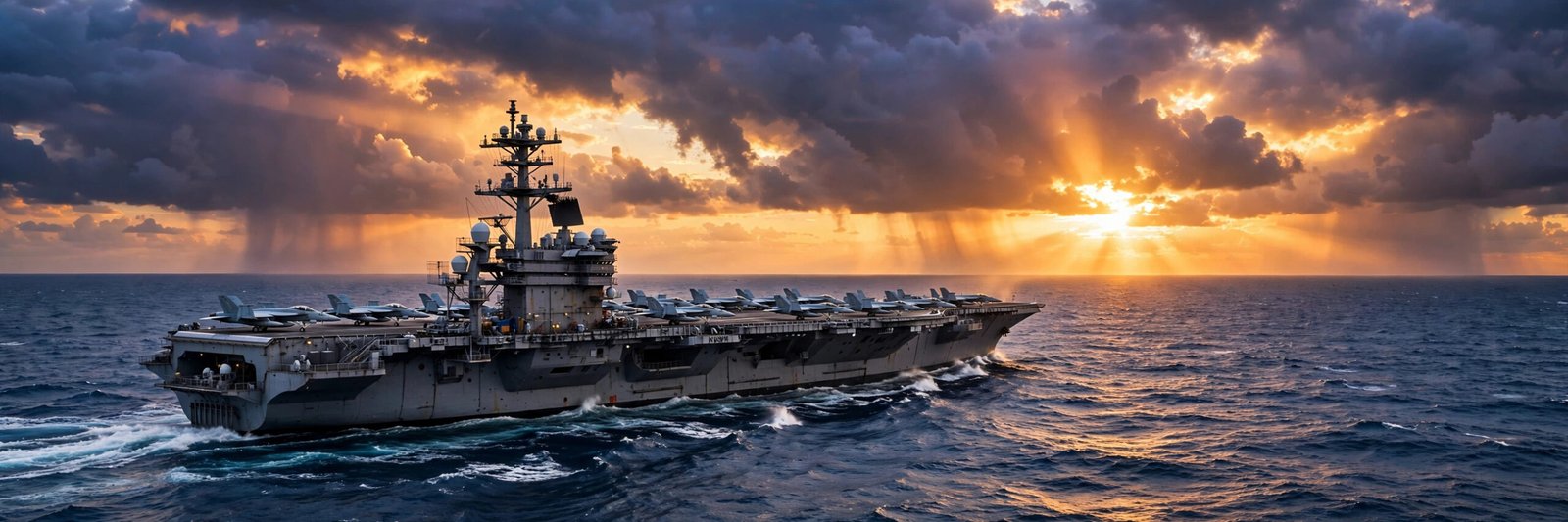
Few phrases carry as much weight in world affairs as US military power. It is the reason aircraft carriers steam through distant seas, why allies sleep soundly at night, and why the United States remains the single most influential military nation on the planet. But what does US military power actually consist of? The answer goes far beyond ships and soldiers.
True military strength is a blend of money, technology, people, geography, and alliances. When all of those pieces fit together, the result is something no other nation has been able to match in the modern era. In this guide, we break down the real facts behind America’s military dominance, from the five service branches and the world’s largest defense budget to the carriers, bases, and volunteers that keep the nation safe.
The Five Service Branches
The foundation of American military strength is its five armed services, each with a distinct mission. Together, they form a force that can fight on land, at sea, in the air, and in space.
The Army is the largest branch and the backbone of land warfare. Its soldiers operate tanks, helicopters, artillery, and advanced missile systems, and the Army is responsible for seizing and holding ground in a conflict.
The Navy keeps the world’s sea lanes open. With a fleet of submarines, destroyers, and support ships, the Navy protects global trade routes and can deliver firepower almost anywhere on Earth.
The Air Force owns the skies with stealth bombers, fighter jets, and a massive fleet of refueling and transport aircraft. Air superiority has been a hallmark of American military operations for generations.
The Marine Corps is the nation’s rapid-response force, trained to deploy quickly from the sea to the shore. Marines are known for their expeditionary mindset and are often the first to arrive in a crisis.
The Space Force, the newest branch, protects American satellites and space infrastructure. Modern warfare depends on GPS, communications, and surveillance from orbit, so space is now treated as a full warfighting domain. You can read more in our guide to US Space Force facts.
The World’s Largest Defense Budget Fuels US Military Power
The United States spends more on defense than any other country in the world, reportedly more than the next several nations combined. That spending is the engine that drives every other element of American military strength.
Where does the money go? A large share pays for people: salaries, housing, health care, and retirement benefits for service members and their families. Another major share funds research and development, which keeps American weapons a generation ahead. The rest buys and maintains equipment, from submarines that take years to build to the fuel that keeps jets flying.
Budget size alone does not win wars, but it buys options. It lets the Pentagon maintain forces in Europe, the Indo-Pacific, and the Middle East simultaneously. It funds training exercises with dozens of allies. And it creates a defense industrial base that can surge production when needed.
Eleven Nuclear-Powered Aircraft Carriers
No symbol captures US military power quite like the aircraft carrier. The United States operates eleven nuclear-powered supercarriers, more than every other nation combined. Each one is a floating airbase, roughly a thousand feet long, carrying dozens of aircraft and thousands of sailors.
Because they are nuclear-powered, these carriers can sail for years without refueling, giving America the ability to park an airfield off almost any coast on the planet. When a crisis erupts, the first question American presidents reportedly ask is: where is the nearest carrier?
Carriers rarely travel alone. They sail with destroyers, cruisers, submarines, and supply ships in what is called a carrier strike group, a formation that can defend itself against air, surface, and submarine threats while striking targets hundreds of miles away.
Technology and Innovation: America’s Military Edge
America’s military edge has always rested on technology. Stealth aircraft were an American invention, and the United States still leads in the drones, sensors, and networks that modern commanders rely on.
Some of the key technology advantages include:
- Stealth: American stealth bombers and fighters are designed to evade enemy radar, allowing strikes deep inside defended airspace.
- Submarines: Nuclear-powered attack and missile submarines patrol silently for months, a deterrent that is nearly impossible to track.
- Satellites and space systems: American forces navigate, communicate, and target using one of the world’s most advanced space architectures.
- Cyber and electronic warfare: Dedicated commands defend military networks and can disrupt an adversary’s systems.
- Precision weapons: Guided munitions mean one aircraft can now do the work that once required entire squadrons.
Emerging fields such as artificial intelligence, hypersonic weapons, and directed-energy systems are the next frontier, and the United States is investing heavily to stay ahead.
A Global Network of Bases and Alliances
American military strength extends far beyond the nation’s own borders. According to publicly available Pentagon reporting, the United States maintains hundreds of military installations across dozens of countries, a global footprint no rival comes close to matching.
These bases serve several purposes. They put American forces close to potential trouble spots, cutting response times from weeks to hours. They host joint training with allies, building the habits of cooperation before a crisis begins. And they signal commitment: an American base in a partner country is a promise that the United States will show up.
Alliances multiply that power. NATO remains the most powerful military alliance in history, and partnerships across the Indo-Pacific, the Middle East, and the Americas extend America’s reach even further. When the United States acts with allies, it brings not just its own strength but the combined weight of dozens of nations.
The All-Volunteer Force: America’s Greatest Strength
Perhaps the most underrated element of US military power is its people. Since 1973, the United States has relied on an all-volunteer force, meaning every service member chose to serve. That choice produces a professional, experienced, and motivated military.
Volunteer troops tend to stay longer, which builds expertise. Noncommissioned officers, the sergeants and petty officers who run day-to-day operations, are widely considered among the best-trained enlisted leaders in the world. Their experience is a decisive advantage in real combat.
The force is also more diverse than ever. Women serve in every role, including combat positions, and service members come from every state, background, and walk of life. That diversity of thought strengthens decision-making under pressure.
The legacy of service runs deep in American history. From the Tuskegee Airmen who shattered barriers in World War II, whose story we tell in the Tuskegee Airmen true story, to the sailors who answered the call on December 7, 1941, covered in our Pearl Harbor true story, generations of volunteers have defined what American military power means.
How Analysts Measure US Military Power
Experts who rank the world’s militaries look at both numbers and quality. Public indexes weigh factors like fleet size, aircraft numbers, defense spending, logistics, and geography. On nearly every one of these measures, the United States ranks at or near the top.
But raw numbers can mislead. A country can have more tanks or more troops and still be weaker, because quality, training, and the ability to get forces where they are needed matter more. America’s real advantage is the combination: enormous resources, the best training pipelines, and a global logistics network that can sustain operations far from home.
Deterrence is the ultimate measure. The strongest military is one that never has to fight, because potential adversaries decide the cost of challenging it is too high. For decades, American military strength has provided that deterrent effect across the globe.
Why Military Power Matters to Everyday Americans
It is easy to think of military power as something distant, but it touches daily life in America in concrete ways:
- Safe trade routes: The Navy’s protection of sea lanes helps keep global shipping flowing, which keeps prices stable for American consumers.
- Deterrence: A strong military discourages attacks on the homeland and on allies, making large-scale war less likely.
- Disaster relief: Military ships, helicopters, and engineers are often first responders after hurricanes, earthquakes, and tsunamis.
- Jobs and innovation: Defense spending supports millions of jobs and has produced technologies like GPS and the internet that civilians use every day.
American military strength is therefore not only a shield but an engine of the American economy and a quiet guardian of the global order that lets commerce and travel flow.
From the five service branches to the carriers at sea, the satellites overhead, and the volunteers in uniform, US military power rests on an unmatched combination of resources, technology, alliances, and people. It is a strength built over generations, and understanding it is the first step to appreciating what keeps America secure. If you found these facts useful, share this article with a fellow patriot and explore more stories of American strength across ENG Post.