
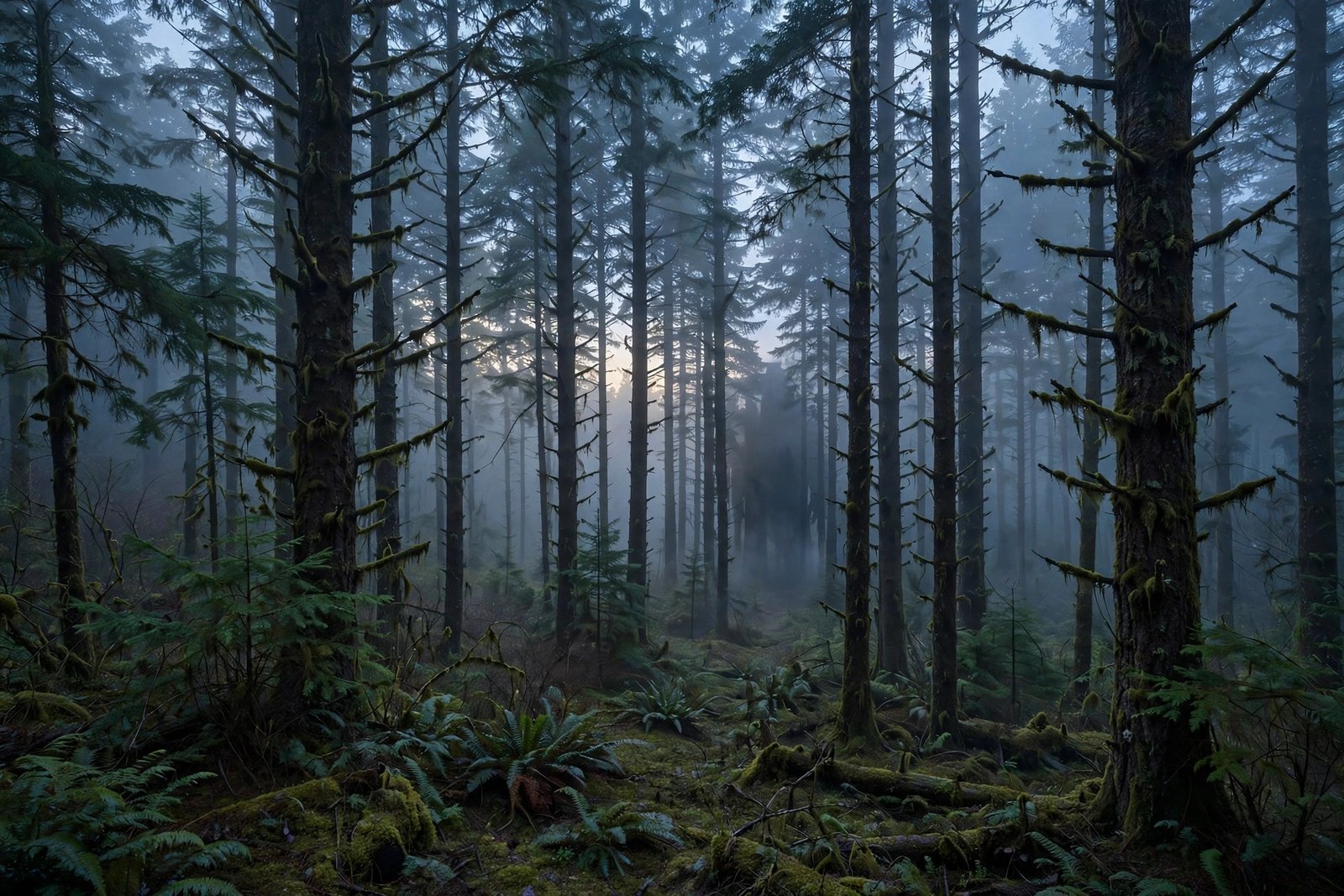
Somewhere in the dark timber of the Pacific Northwest, something tall moves between the trees. It walks upright, on two legs. It does not match any animal in the field guide. And for more than sixty years, thousands of Americans have sworn they have seen it. This is the bigfoot legend — the most famous mystery in American folklore, a story that has survived every debunking attempt thrown at it.
Is Bigfoot real? That is the question that has launched a thousand documentaries, filled festival grounds in small mountain towns, and kept hunters, hikers, and skeptics arguing for generations. In this guide, we walk through the whole story — the sightings, the famous film, what scientists say, and why the legend refuses to die. Along the way, we will be clear about where the facts end and the folklore begins.
What Is the Bigfoot Legend?
The bigfoot legend describes a large, hairy, ape-like creature said to roam the forests of North America, especially the Pacific Northwest. Witnesses typically describe a figure seven to eight feet tall, covered in dark hair, with a powerful build, a strong odor, and — of course — enormous footprints.
Stories like this did not start with modern America. Long before the word existed, many Indigenous nations of the Pacific Northwest told traditional stories of wild, hairy people living in the forests. These were cultural and spiritual stories, not scientific claims — but they show that the idea of a forest giant is deeply rooted in the region.
The modern version of the legend is different: it claims a flesh-and-blood animal is out there right now. That version begins in the late 1950s, with a bulldozer operator and a set of footprints in northern California.
Bluff Creek, 1958: The Footprints That Named the Bigfoot Legend
In 1958, a road-construction worker named Jerry Crew found enormous human-like footprints around his job site near Bluff Creek in Humboldt County, California. He made plaster casts of several prints and carried them into town. A local newspaper, the Humboldt Times, ran the story — and the headline introduced a name that stuck forever: Bigfoot.
The casts showed prints far larger than any human foot, and the story spread far beyond California. Reporters came. Curious visitors came. More footprint reports followed in the same region. Whether those first prints were made by a prankster, a misread track, or something else has been argued ever since, but the effect is not in dispute: in 1958, Bigfoot went from a local curiosity to a national story.
The area around Bluff Creek was already primed for it. Logging roads had pushed deep into remote forest, bringing people into places that had been nearly empty of humans. More eyes in the woods meant more strange encounters reported — and every report fed the growing legend.
The Patterson-Gimlin Film: One Minute That Changed Everything
On October 20, 1967, two men from Yakima, Washington — Roger Patterson and Bob Gimlin — were riding horseback along Bluff Creek in northern California when they said they spotted a large, dark, hairy figure crouched at the water’s edge. Patterson grabbed his rented 16mm movie camera, ran toward the figure, and filmed it as it walked away across a sandbar.
The result is the Patterson-Gimlin film: less than a minute of shaky color footage — about 59.5 seconds — showing an ape-like figure striding across the creek bed. At one point, the figure turns its head and upper body to glance back at the camera. That single frame, known as frame 352, became the most famous Bigfoot image ever taken. The filmmakers called the subject Patty, believing it was female.
Here is where we separate what is confirmed from what is claimed. It is confirmed that the film exists, that it was shot in 1967, and that Patterson and Gimlin presented it as genuine. Patterson died of cancer in 1972, maintaining to the end that the creature on the film was real. Gimlin has spent decades denying any involvement in a hoax and stands by the story.
It is also true that skeptics have challenged the film since day one. In 1998, a Yakima man named Bob Heironimus claimed he had worn the ape suit in the footage — a claim Patterson’s supporters reject. Costume experts have argued both sides: some say no 1967 costume could move the way the figure moves; others say a determined builder absolutely could have made one. Nearly sixty years later, the film remains what it has always been: the most examined and most disputed minute of footage in the history of American folklore. It has never been conclusively proven real, and it has never been conclusively proven fake.
Where the Bigfoot Legend Shows Up Across America
The Pacific Northwest gets the most attention — Washington, Oregon, and northern California account for the largest share of sighting reports collected by the Bigfoot Field Researchers Organization (BFRO), a group founded in 1995 that maintains the biggest public database of reports. According to the BFRO, Washington state has generated more reports than any other state. But the legend is not confined to one region. Reported sightings come from every corner of the country, and many regions have their own local names for the creature:
- The Fouke Monster (Arkansas): In 1971, residents around Fouke, Arkansas, reported encounters with a large, hairy creature near Boggy Creek. The reports inspired the 1972 docudrama The Legend of Boggy Creek, which became a drive-in sensation and cemented the South’s version of the legend.
- The Skunk Ape (Florida): In the swamps of South Florida, witnesses describe a similar creature with a famously foul smell — hence the name. Reports go back decades in the Everglades region.
- The Grassman (Ohio): Ohio has its own long-running tradition of bigfoot-type reports, particularly in the state’s eastern woodlands.
- Honobia, Oklahoma: The small community of Honobia in the Kiamichi Mountains hosts an annual Bigfoot festival that draws thousands of visitors, proof that the legend is also serious small-town business.
This regional spread is part of what makes the legend so durable. It is not one story in one place — it is a whole family of stories, adapted to local forests, swamps, and mountains. If you love exploring America’s wilder corners, the same curiosity that draws people to Bigfoot country also draws them to real natural wonders — like the hidden beaches of the USA or the best places to see bald eagles in the wild.
What Science Says About the Bigfoot Legend
Now for the hard part of the bigfoot legend: the evidence problem. Despite decades of searching — with trail cameras, thermal imagers, drones, and organized expeditions — no one has produced a confirmed Bigfoot body, skeleton, or DNA sample. That is the single biggest fact working against the legend, and honest Bigfoot researchers admit it.
Genetic testing has not helped the case. When supposed Bigfoot hair, blood, or tissue samples have been analyzed by scientists, the results have consistently come back as known animals — bears, deer, raccoons, and the occasional human. No mystery DNA has ever held up.
Wildlife biologists offer a simpler explanation for many sightings: bears. A black bear standing upright on its hind legs, glimpsed at dusk through trees, can look startlingly humanlike — tall, dark, broad-shouldered, walking on two legs. Add low light, surprise, and a human brain wired to see faces and figures, and you have a recipe for honest misidentification.
There is one scientific hypothesis that believers often cite. A researcher named Grover Krantz once proposed that Bigfoot could be a surviving population of Gigantopithecus, a real genus of giant ape known from fossils in Asia. It is a fascinating idea — but it remains a hypothesis, not evidence. No Gigantopithecus fossil has ever been found in North America, and mainstream anthropologists do not accept the connection.
So where does that leave the science? In this position: the bigfoot legend is not supported by confirmed physical evidence, but science cannot prove a negative either. What researchers can say is that every testable piece of evidence so far has pointed to known animals, hoaxes, or misidentification.
Why the Bigfoot Legend Refuses to Die
If the evidence is so thin, why does the legend keep growing? Because Bigfoot is about more than zoology. It is about the romance of the unknown.
America’s forests are vast. Even today, huge stretches of the Cascades, the Rockies, and the Appalachians are rarely visited by people. The idea that something large could still hide out there scratches a deep itch — the hope that the map still has blank spaces. Every blurry trail-cam clip that goes viral gives the legend another jolt of life, even when the clip later turns out to be a bear, a person in a costume, or a stump.
There is also a thriving culture around it. Festivals like the one in Honobia draw thousands. Small towns sell Bigfoot souvenirs, run Bigfoot-themed 5Ks, and welcome the tourism dollars. Reality television has kept the search on screens for years. And social media has done what the Humboldt Times did in 1958 — only faster. A single strange video can now reach millions of people overnight.
None of that proves Bigfoot exists. But it explains why the legend behaves less like a scientific question and more like a story America tells about itself — about wilderness, mystery, and the thrill of wondering what is just beyond the treeline. If that sense of wonder is what you are after, it is worth chasing in places where the marvels are guaranteed: the surprising wilds of Alaska deliver awe without any footprints required.
The bigfoot legend endures because it sits exactly on the border between what we know and what we hope. Until someone produces evidence that survives a laboratory, that is where it will stay — and honestly, that may be exactly where the legend belongs.