
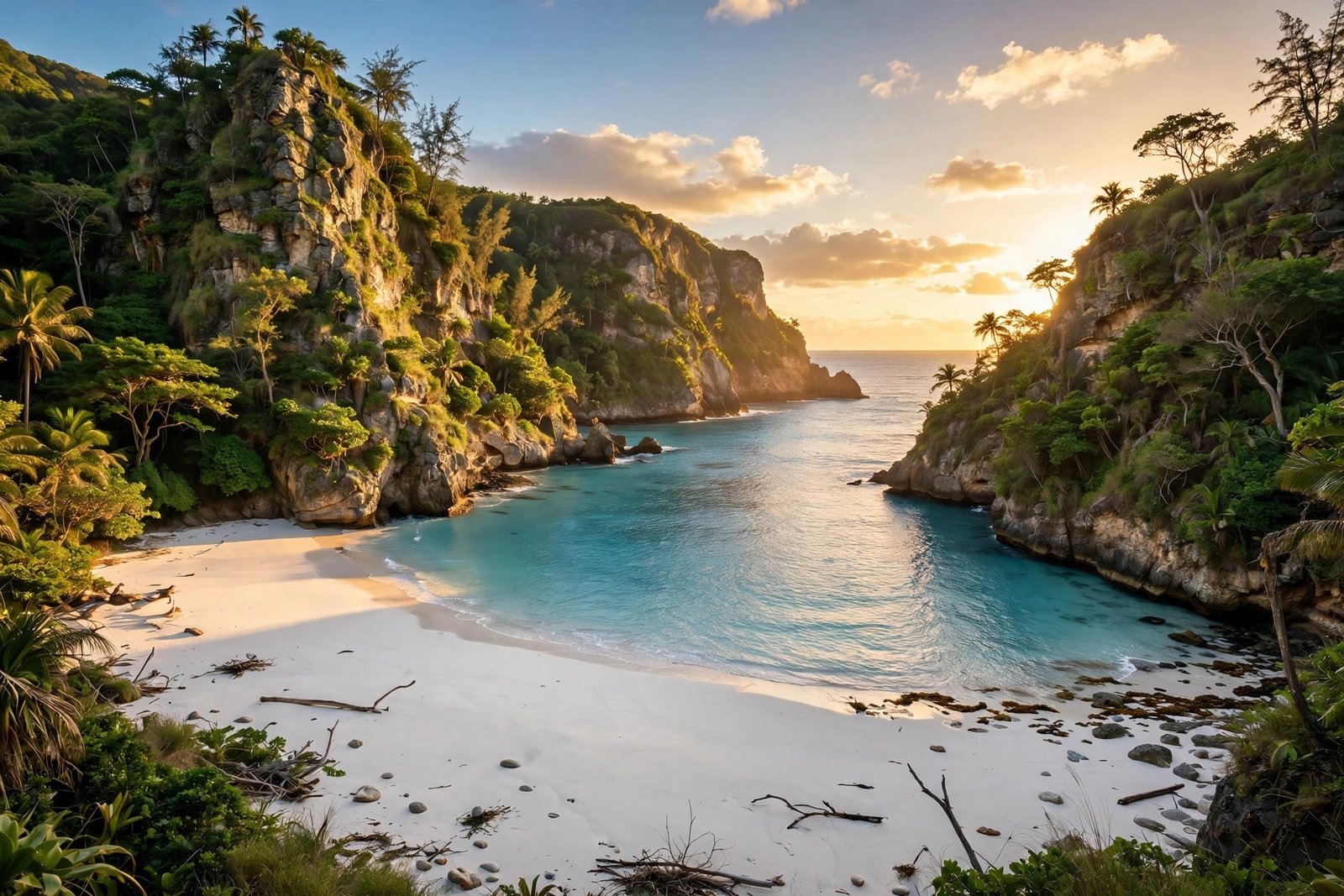
America’s famous beaches are wonderful — and wonderfully crowded. But beyond the boardwalks and the umbrella grids, the country’s coastline hides a quieter truth: the secret beaches USA travelers usually miss are often the most beautiful ones. These are the beaches at the end of the road, past the last turnoff, where the only soundtrack is the surf and the only footprints might be your own.
This guide rounds up ten genuinely lesser-known beaches across the country, from California’s strange geological wonders to Hawaii’s lava-guarded coves, Puerto Rico’s hidden Caribbean corners, and the wild Atlantic barrier islands. None of them require a private yacht — just a little effort, a sense of adventure, and the willingness to go one step farther than the crowds.
What Makes the Secret Beaches USA Different?
The best secret beaches share one thing: a natural filter that keeps crowds away. Sometimes it is a long hike over lava rock. Sometimes it is a ferry schedule, a dirt road, or simply the fact that the famous beach next door gets all the attention. That filter is a gift. It means space to breathe, cleaner sand, calmer water, and the rare feeling of discovering something for yourself.
It also means you travel on the beach’s terms. Most of the beaches below have no lifeguards, no snack bars, and no cell signal worth mentioning. You bring everything in and carry everything out. If that sounds like your kind of trip, these ten secret beaches are waiting.
The 10 Secret Beaches USA Has Kept Quiet
1. Bowling Ball Beach — Schooner Gulch State Beach, Mendocino County, California
At low tide, the southern end of Schooner Gulch State Beach on California’s Mendocino coast reveals one of the strangest sights in America: rows of almost perfectly spherical boulders lined up along the sand like nature’s own bowling alley. These “bowling balls” are concretions — sedimentary rock formed over millions of years as minerals cemented around a core, then exposed as the softer surrounding mudstone eroded away. Each sphere runs about two to five feet across, and they sit in such neat rows that your brain will struggle to accept they formed naturally.
Timing is everything here. Visit at high tide and you will wonder if you are at the right beach, because the bowling balls disappear completely underwater. Check a tide chart and aim for a negative low tide, when the maximum number of spheres is visible. The beach sits a few miles south of Point Arena along Highway 1, and the sunset light on the stones is worth planning your whole day around.
2. Glass Beach — Fort Bragg, California
Just up the coast in Fort Bragg sits one of the strangest secret beaches USA has to offer, and it tells a very different story. From 1906 until 1967, locals used these coastal bluffs as a town dump, tossing bottles, jars, and household goods over the cliffs. Over the decades, the Pacific did what the Pacific does: it shattered, tumbled, and polished the debris into smooth, colorful sea glass that now carpets the shore in shades of green, amber, white, and — if you are lucky — rare ruby reds and deep blues.
Today Glass Beach is protected as part of MacKerricher State Park, a testament to nature’s ability to reclaim and transform. One honest note: years of visitors pocketing souvenirs have thinned the glass considerably, and collecting is now restricted, so check current park rules before taking anything home. Come for the story and the shimmer, and leave the beach as you found it.
3. Pfeiffer Beach — Big Sur, California
Big Sur is famous, but Pfeiffer Beach still flies under the radar of most Highway 1 travelers — partly because it is genuinely hard to find. The turnoff is the unmarked, winding Sycamore Canyon Road, a narrow two-mile descent that larger vehicles cannot attempt. The reward is one of California’s most photogenic beaches: Keyhole Rock, an offshore formation with a natural arch, and patches of purple sand colored by manganese garnet washing down from the cliffs.
The beach is a day-use area managed by Los Padres National Forest with a $15 per vehicle parking fee, and the small lot fills fast — arrive early or on a weekday, because there are no reservations and no roadside parking. In winter, photographers gather at sunset when the light streams through the keyhole arch. Swimming is not recommended here due to strong surf, but for walking, exploring tide pools, and photography, few California beaches compare. Fold it into a longer drive with our Antelope Canyon Arizona guide for a desert-to-coast American road trip.
4. Ruby Beach — Olympic National Park, Washington
On Washington’s wild Olympic Peninsula, Ruby Beach is the kind of place that ruins ordinary beaches for you. A short trail drops through coastal forest to a shoreline of massive sea stacks — including the towering Abbey Island — strewn with sculptural driftwood and pebbles polished by the Pacific. The sand carries a faint pink tint from tiny grains of garnet mixed into it, which is how the beach got its name.
It sits right off Highway 101, about 27 miles south of Forks, so the “secret” here is relative — but arrive at low tide on a weekday and you may share the tide pools with more sea stars than people. Check tide charts before you go, since high water can cut off sections of the beach. Eagles often cruise the shoreline here, and if wildlife watching is your thing, see our guide on where to see bald eagles in the USA.
5. Makalawena Beach — Big Island, Hawaii
Makalawena — “Maks” to those in the know — is exactly the kind of secret beaches USA travelers dream about: powdery white sand, turquoise water, black lava rock, and almost nobody there. The catch is the approach. This string of coves sits inside Kekaha Kai State Park on the Kona coast, reachable only by hiking about 20 to 40 minutes over rough, shadeless lava fields from Mahai’ula Beach, or by tackling a rugged unpaved road that demands a true high-clearance 4WD.
The effort is the point. Bring sturdy closed-toe shoes (not flip-flops), reef-safe sunscreen, and far more water than you think you need — there are no facilities of any kind. Go in the morning for the calmest water and the easiest lava crossing, pack out every scrap of trash, and give the sea turtles the wide berth the law requires. On a calm day, the snorkeling is superb.
6. Keawa’ula Beach (Yokohama Bay) — Oahu, Hawaii
Drive Farrington Highway west from Waikiki until the road simply ends, and you will find Keawa’ula Beach, better known by its nickname Yokohama Bay. It is the last sandy beach on Oahu’s west shore before Ka’ena Point, a long crescent of golden sand backed by the dramatic Waianae mountains, and it feels a world away from the crowds of Waikiki — about a 90-minute to two-hour drive, in fact.
The Hawaiian name means “red harbor,” a nod to the colors this coastline takes on. Lifeguards are on duty, but treat the ocean with respect: summer can bring calm, swimmable water, while winter surf and currents turn dangerous fast. The Ka’ena Point trailhead starts just past the beach if you want to keep walking to the island’s wild northwestern tip, where monk seals and seabirds are common sights.
7. Playa Sucia (La Playuela) — Cabo Rojo, Puerto Rico
Playa Sucia translates to “dirty beach,” which might be the most misleading name in the Caribbean. Also known as La Playuela, this secluded cove on Puerto Rico’s southwestern tip is a curve of fine white sand wrapped in green hills, with aquamarine water so clear it barely looks real. It sits at the southern tip of the Cabo Rojo National Wildlife Refuge, which is exactly why it has stayed undeveloped — no hotels, no beachfront cafes, just the cove.
Getting there is half the adventure: follow the dirt track to the end of the Morrillos Peninsula, park near the 19th-century Cabo Rojo lighthouse, and walk down to the shore. Climb the lighthouse for the classic view over the bay, then hike the surrounding trails to the much-photographed natural stone bridge offshore. The shallow edges are gentle, but stay near shore in the deeper sections, where the undertow can be strong.
8. Loggerhead Key — Dry Tortugas, Florida
Seventy miles west of Key West, past the end of the road and then some, lies Dry Tortugas National Park — and three miles west of its main island sits Loggerhead Key, one of the most remote secret beaches USA offers. There is no ferry here and no dock for visitors; you arrive by private boat, kayak, or charter, beach your small craft on the dinghy beach, and step onto a shoreline most travelers will never see.
Named for the loggerhead sea turtles that nest here, the island is open for day use only, with its historic 1858 lighthouse and all buildings off-limits to visitors. What is open is spectacular: white sand, gin-clear water, and some of the best snorkeling in the Florida Keys, from coral heads to the Windjammer shipwreck site a mile southwest. No facilities, no fresh water, no shade — bring everything, take everything back.
9. Stafford Beach, Cumberland Island — Georgia
Georgia’s Cumberland Island is a National Seashore nearly eighteen miles long, and its Atlantic-facing beaches are among the longest undeveloped stretches of sand on the East Coast. Stafford Beach, on the island’s southeastern shore, is a wide sweep of white sand where you can walk for an hour and meet no one — except, quite possibly, a wild horse standing at the edge of the surf.
The island’s famous feral horses, numbering around 150 to 200 and completely unmanaged, roam the dunes, maritime forests, and beaches freely. Reaching the island is part of the experience: the ferry departs from St. Marys, Georgia, and the crossing takes about 45 minutes. Daily visitor numbers are limited and the ferry books up, so reserve ahead. Bring food, water, and sun protection — there are no shops or concessions on the island, and that is precisely the charm.
10. Sandbridge Beach — Virginia Beach, Virginia
Most visitors to Virginia Beach never make it fifteen miles south of the resort strip to Sandbridge, and the locals who do are in no hurry to advertise it. This five-mile stretch of dunes and sea oats has no boardwalk, no arcade noise, and none of the mechanical beach-raking of the main strip — which is why the shelling here is some of the best on the Virginia coast. After a storm or at low tide, the wrack line yields whelks, sand dollars, sea glass, and the occasional shark’s tooth.
Sandbridge sits on a narrow peninsula between the Atlantic and Back Bay, backed by the Back Bay National Wildlife Refuge and False Cape State Park, which guarantees the land behind the beach will never be overdeveloped. Dolphins cruise past with reliable regularity, and the S-Turns surf break draws a small, dedicated local crowd. It is the rare secret beach that is also an easy day trip from a major city.
How to Visit Secret Beaches Responsibly
Hidden beaches stay hidden-beautiful only if visitors treat them gently. A few rules that apply to every beach on this list: pack out all trash, including food scraps. Do not pocket shells, rocks, or sea glass where collecting is restricted — Glass Beach and many parks limit or prohibit it. Check tide charts and weather before remote-coast visits, and never turn your back on the ocean at surf beaches like Pfeiffer or Yokohama in winter.
Respect wildlife closures without exception. Barrier islands like Cumberland close sections during bird nesting season, Hawaiian beaches protect resting monk seals and nesting turtles by law, and refuge beaches exist for the animals first. Keep a real distance, keep dogs leashed or home where required, and remember that the privilege of an empty beach comes with the responsibility of leaving it empty-beautiful for the next person.
America’s coastline is full of places the crowds never reach, and the secret beaches USA hides best are just the beginning. Pick one, check the tides, pack more water than you think you need, and go see what the end of the road looks like. If hidden places are your thing, our Antelope Canyon guide covers another American wonder that rewards travelers willing to plan ahead. Now get out there and find your own stretch of sand.