
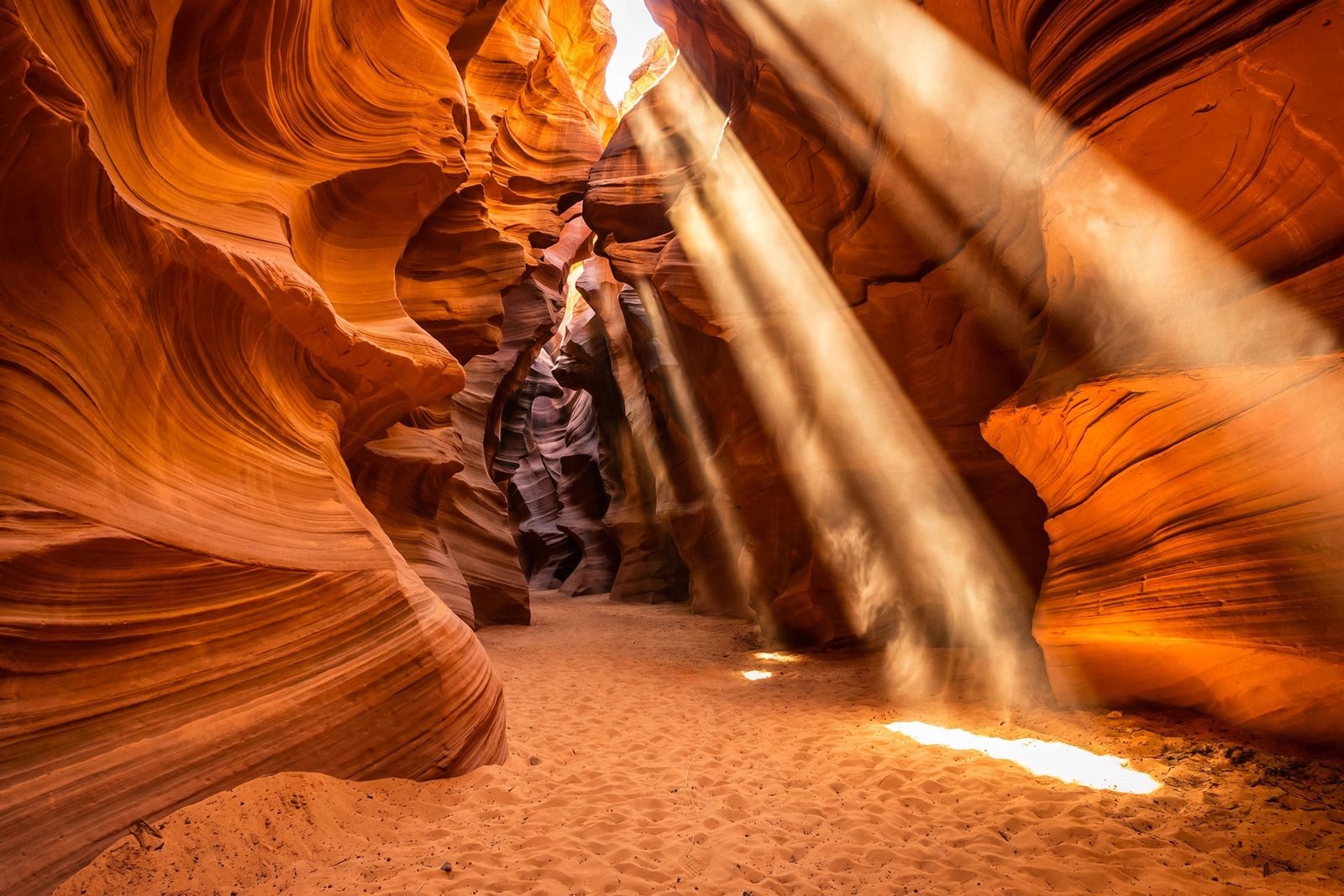
There is a moment inside Antelope Canyon when the desert above you simply disappears. The walls close in, the light turns to honey, and for a few minutes you forget you are standing on the floor of northern Arizona at all. If you have seen the photographs — swirling orange walls, shafts of light dropping from a slit of sky — you already know Antelope Canyon, one of the most photographed slot canyons on Earth. But no photograph quite prepares you for standing inside it.
Antelope Canyon sits just outside the small town of Page, Arizona, on Navajo Nation land, and it draws travelers from every corner of the world. This complete 2026 visitor guide covers everything you need to know before you go: the real difference between the Upper and Lower sections, when the famous light beams appear, how to book a tour, what it costs, and how to make the most of your visit.
What Makes Antelope Canyon Unlike Anywhere Else on Earth
Antelope Canyon is a slot canyon, a narrow corridor carved into Navajo sandstone by the patient work of desert flash floods over millions of years. In places the walls rise more than 100 feet overhead while the passage at your feet is only a few feet wide. Water did the carving, but light does the decorating: as the sun moves across the sky, the walls shift from burnt orange to rose to deep violet, and the whole canyon seems to glow from within.
The canyon has two separate sections, each with its own character and its own Navajo name. The Upper section is known to the Navajo as Tsé bighánílíní, often translated as the place where water runs through rocks. The Lower section is Hazdistazí, or spiral rock arches. Both lie on protected Navajo Nation tribal land east of Page, and both can only be entered on an authorized guided tour with a Navajo guide.
What surprises most first-time visitors is how intimate the experience feels. This is not a viewpoint you admire from a distance. You walk the canyon floor, brush your fingertips along stone that water sculpted grain by grain, and watch the light change minute by minute. It is equal parts geology lesson, cultural experience, and pure visual wonder — which is exactly why planning ahead matters so much.
Upper Antelope Canyon vs Lower Antelope Canyon: Which Tour Should You Pick?
The single most-asked question here is which section to book. They sit only a few miles apart, run by different operators, and photograph similarly enough that many travelers cannot tell them apart at first glance. Once you are inside, though, they feel like noticeably different places.
The Upper section is the famous one. Entry is at ground level with no stairs, and the canyon is shaped like an A — wider at the bottom, narrower at the top, which is what lets the celebrated light beams drop straight to the canyon floor. The Upper section is the only place you can see those vertical shafts of light, and only from about late March through early October, around midday. Tours are pricier here, typically running from around $85 to well over $150 per adult depending on the season and time slot, and the midday beam tours are the first to sell out. Because there are no stairs, the Upper walk is also the better choice if anyone in your group has limited mobility.
The Lower section is shaped like a V — narrower at the bottom — and getting in means descending several steep metal staircases. The walk is more of a mini-adventure, and many visitors say the spiraling, twisting formations here are actually more dramatic than the Upper’s. Lower tours generally cost less, often in the $60 to $85 range for adults, and the canyon tends to feel a little less crowded. The tradeoff is the stairs: this is not the section for bad knees, very young children, or anyone uneasy on steep steps.
Here is a simple way to decide. Book the Upper tour if seeing the light beams is your priority, if stairs are a problem, or if you are traveling with small kids or older relatives. Book the Lower tour if you want a more adventurous walk, a lower price, and rich reflected color without the beam crowds. If your schedule allows it, many visitors do both in one day — the two trailheads are about ten minutes apart by car, and guides recommend leaving two and a half to three hours between tour times for check-in and transport.
How to Book Your Antelope Canyon Tour
This is the part you cannot skip: independent entry is not allowed here. The canyon lies entirely within the Navajo Nation, and access is restricted to authorized Navajo-led guided tours. You will be turned away without a reservation, so everything starts with booking.
Book as early as you can. For the coveted summer midday tours — the ones with the light beams — experienced guides recommend booking six to nine months in advance, because those slots sell out almost immediately. For other summer times, three to five months is realistic. Spring and fall trips usually need two to four months of lead time, while winter tours can often be booked a few weeks out. If you are visiting between late March and early October and want midday light, do not wait.
Every tour includes the mandatory Navajo Nation permit fee, roughly $15 per person, which is usually folded into the ticket price. Expect to check in 30 to 45 minutes before your tour time with a photo ID and your booking confirmation. For the Upper section, the adventure starts with a bumpy ride in a 4×4 truck from town out to the canyon entrance — part of the fun, though worth knowing if anyone in your group dislikes rough roads.
Pack light, because the rules are strict: backpacks, purses, and large bags are not allowed inside, and neither are tripods, monopods, selfie sticks, or drones. A handheld camera or smartphone is fine, and a clear water bottle is a good idea. Closed-toe shoes are mandatory. Your guide will keep the group moving and — a real bonus — will often help you frame the shots these walls are famous for.
When to See the Antelope Canyon Light Beams
Let us be specific about the light beams, because they are the reason half the visitors come. The famous vertical shafts of sunlight appear only in the Upper section, only from roughly late March through early October, and only around midday, about 11 a.m. to 1 p.m. During those months the sun climbs high enough at midday to drop direct light through the narrow opening above the canyon floor. In winter the sun stays too low and the beams simply do not form.
Even in season, you need a clear sky — overcast days wash the beams out. The strongest, most reliable beams tend to fall between April and early September, and the prime 11 a.m. to 1:30 p.m. tour slots cost more and sell out first. If you are booking specifically for the beams, choose an Upper tour in that midday window and keep your schedule flexible by a day or two in case weather interferes.
Not chasing beams? Early morning and late afternoon tours are lovely in their own right, with softer reflected light and smaller crowds. The Lower section never gets the vertical beams at any time of year, but its glowing walls photograph beautifully in the gentle light of morning or late afternoon — many photographers actually prefer it.
What to Pack and Expect on Your Slot Canyon Tour
A standard sightseeing tour spends about an hour inside the canyon, with the full experience — check-in, transport, and the walk — running closer to 90 minutes. Expect a group, especially at midday in summer; this is one of the most visited natural attractions in Arizona, and solitude is not part of the package. What you get instead is a genuinely moving hour in one of the strangest, loveliest places in the American Southwest.
Bring the essentials and leave the rest:
- Closed-toe shoes — mandatory, and you will be glad of them on sandy, uneven ground.
- Water — a clear bottle is allowed, and the desert heat outside the canyon is no joke.
- Your camera or phone — handheld only. A simple dust sleeve or even a plastic bag protects gear, because fine sand drifts down from the canyon rim.
- Light layers — the canyon stays cooler than the desert air above it, especially in winter mornings.
- Sun protection — hat and sunscreen for the exposed staging areas before and after the tour.
Leave backpacks, tripods, selfie sticks, and drones behind — all are banned on standard tours, and drones are prohibited across Navajo Nation land. Travel light and you will move through the narrow passages far more comfortably.
Things to Do Near Page, Arizona After Your Tour
Page makes an excellent base for more than just the canyon. A few minutes from town, Horseshoe Bend serves up one of the most recognizable views in the American West — the Colorado River bending in a near-perfect horseshoe 1,000 feet below the overlook. It pairs naturally with a morning or afternoon at the canyon.
Lake Powell and the Glen Canyon Dam are right there too, offering boat tours, kayaking, and a very different kind of desert scenery. If you are building a longer trip, this whole corner of Arizona folds beautifully into a classic Southwest road trip — our Route 66 road trip guide covers how to string these stops together. And when the desert heat has you dreaming of water, take a look at our secret beaches in the USA for the other end of the spectrum.
Staying Safe: Flash Floods and Canyon Rules
Slot canyons and water have a complicated relationship. The same flash floods that carved these walls can make them dangerous during storms — even storms dozens of miles upstream, where rain can send a wall of water down the wash hours later under a blue sky. This is why tours are cancelled when rain threatens the watershed, and why you should never try to enter a slot canyon during or after rain.
The practical upshot for your trip: if your tour is cancelled for weather, you will get a refund or a chance to reschedule, and you should take it gratefully. The monsoon season, roughly early July through mid-September, is when cancellations are most likely. Operators and the Navajo Nation monitor conditions constantly, and modern safety protocols — developed after a tragic 1997 flash flood — mean a guided tour on a clear day is a safe experience. Trust your guide’s judgment, stay with the group, and respect the land you are walking on. It is sacred ground, not just a photo backdrop.
This narrow crack in the Arizona desert rewards the travelers who plan ahead: book early, aim for the light if that is your dream, travel light, and give the canyon your full attention for an hour. Do that, and you will understand why it became one of the most beloved natural wonders in America. Start planning your trip now — and when you go, tell us which section stole your heart.