
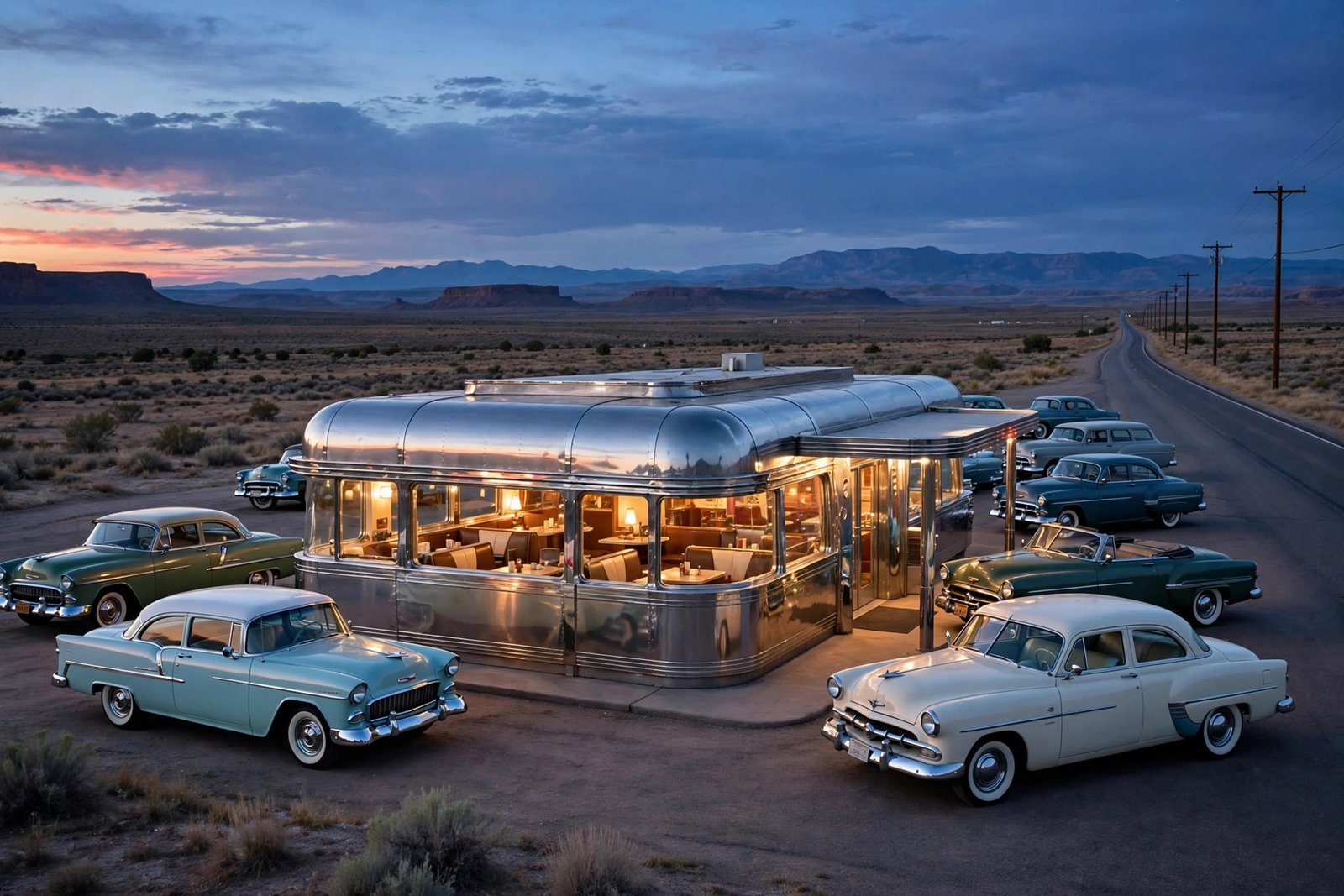
There’s a certain magic in pulling off the highway and seeing a neon sign glowing through the evening mist — the promise of hot coffee, a bottomless cup, and a slice of pie under glass. The classic American diners are more than restaurants; they are rolling museums of American road culture, open late, priced fair, and welcoming to everyone. This roadside guide celebrates their history, their food, and the surviving diners every traveler should visit at least once.
Whether you’re planning an epic cross-country road trip or just hunting for the best pancakes in your state, this guide will point you toward the booths, counters, and jukeboxes that defined a century of American eating.
The History of Classic American Diners
The story of classic American diners begins not with a building, but with a wagon. In 1872, a Providence, Rhode Island, man named Walter Scott started selling sandwiches, pies, and coffee from a horse-drawn wagon to night-shift workers. The idea caught on, and soon similar lunch wagons — then prefabricated dining cars built to look like railroad cars — were feeding workers across the industrial Northeast.
By the 1920s, factories were mass-producing diners. Companies like the Worcester Lunch Car Company, Kullman, O’Mahony, and Paramount turned out sleek steel cars with long counters, swivel stools, and booths, shipping them by rail to towns across America. The railroad-car look gave them their signature narrow footprint and their name: diners, short for dining cars.
The golden age arrived after World War II. As highways like Route 66 and the new interstate system opened the country to automobile travel, diners positioned themselves along the road, glowing neon signs beckoning tired drivers at all hours. Open 24 hours, serving breakfast all day, they became the democratic restaurant — truckers, families, teenagers, and celebrities all took the same stools. A “blue plate special” — a full, cheap, filling meal — became an American institution.
The diner has never fully died. While chains and fast food reshaped the landscape, the best surviving diners stayed exactly what they always were: honest food, honest prices, and a door that never seems to close.
What Defines Classic American Diners
Not every chrome building with a menu board is the real thing. True classic American diners share a set of signature features that have barely changed in a century:
- Stainless steel and neon: A gleaming exterior, often with a neon sign, designed to catch the eye of passing drivers at 60 miles per hour.
- The counter and stools: A long counter with swivel stools is the heart of the diner, where regulars sip coffee and chat with the short-order cook.
- Booths with jukeboxes: Many vintage diners still have booths with tabletop jukeboxes, where a quarter buys you three songs.
- Bottomless coffee: Hot, fresh, and refilled without asking — coffee is practically a diner sacrament.
- All-day breakfast: Eggs, pancakes, and hash browns are available morning, noon, and midnight.
- Pie under glass: A rotating display of cakes and pies at the counter, because dessert is not an afterthought.
- Open late or 24 hours: The classic diner never turns away a hungry traveler.
If a spot checks most of these boxes, you’re in the right place. The diners that endure are the ones that never forgot these fundamentals.
Iconic Diner Foods
The menu at a great diner reads like a greatest-hits album of American comfort food. These are the dishes that define the experience:
- Pancakes and waffles: Tall stacks of buttermilk pancakes and crisp waffles, often served with real maple syrup and whipped butter.
- The patty melt and the burger: Griddled beef on toasted bread or a bun, with melted cheese and caramelized onions — diner burgers are griddle masterpieces.
- Disco fries / gravy fries: In New Jersey, fries smothered in gravy and melted mozzarella are a rite of passage.
- Meatloaf and the blue plate special: The hearty daily special — meatloaf, mashed potatoes, and gravy — that working America ran on for decades.
- Club sandwiches and melts: The triple-decker turkey club, cut into quarters with a pickle spear, is diner canon.
- Milkshakes and egg creams: Thick shakes and the New York egg cream (no egg, no cream — just milk, seltzer, and chocolate syrup) are diner fountain classics.
- Pie and rice pudding: Apple pie a la mode and old-fashioned rice pudding end the meal the way diners have for a hundred years.
The golden rule of ordering at a classic diner: if the special is on a chalkboard, order the special.
Legendary Diners Worth the Road Trip
Some diners are so famous they’ve become destinations in their own right. Here are legendary roadside diners that reward a detour:
- Mickey’s Diner — St. Paul, Minnesota: Opened in 1939, this art-deco dining car is listed on the National Register of Historic Places and has appeared in numerous films. It’s open 24 hours, 365 days a year.
- Tom’s Restaurant — New York City: The Upper West Side institution whose exterior millions recognize from the sitcom Seinfeld. Inside, it’s a working diner serving the neighborhood since the 1940s.
- Tops Diner — East Newark, New Jersey: New Jersey is America’s undisputed diner capital, and Tops is its most celebrated — an upscale take on the classic diner that still serves the all-night crowd.
- 11th Street Diner — Miami Beach, Florida: A genuine 1950s diner car relocated to South Beach, serving late-night food steps from the ocean.
- The Blue Benn Diner — Bennington, Vermont: A small-town classic serving farmers and travelers alike, famous for its maple-syrup-soaked breakfasts.
- Rosie’s Diner — Rockford, Michigan: The restored 1940s diner immortalized in Bounty paper towel commercials of the 1970s, still flipping pancakes today.
Pair your diner road trip with America’s most famous highway — our Route 66 road trip guide maps the motels, neon, and pie stops you shouldn’t miss along the Mother Road.
Tips for a Perfect Diner Road Trip
Hunting down roadside diners is one of the great American road trip hobbies. A few rules of the road make it even better:
- Eat breakfast for dinner: The all-day breakfast menu is a diner’s strongest hand — play it.
- Talk to the regulars: The counter is a community. Regulars know which pie is fresh and which booth has the best view.
- Tip generously: Diner servers work hard for modest checks; a generous tip keeps the tradition alive.
- Go late: The after-midnight diner crowd — truckers, nurses, night owls — is where the real atmosphere lives.
- Photograph the neon: Diner neon signs are some of America’s best surviving roadside art. Capture them at dusk.
- Plan the route around the diner: Build your day’s drive so lunch lands at a diner you’ve been wanting to try — hunger is the best seasoning.
After a big diner breakfast, nothing beats a scenic stretch of coastline — check our hidden beaches of the USA guide for secret spots to walk it off.
The Modern Diner Revival
The diner story didn’t end with the golden age — it’s being written again right now. Across the country, a new generation of operators is rescuing vintage dining cars from demolition and restoring them bolt by bolt, from the neon tubing to the tile floors. Preservation-minded owners hunt for original diners on real estate listings, move them to new locations, and reopen them with the griddles hot and the jukeboxes humming.
At the same time, brand-new retro diners are opening in cities and small towns, built from scratch in the old style — stainless steel, neon, terrazzo floors — because the format simply works. Chefs who trained in fine-dining kitchens are trading tasting menus for griddles, discovering that a perfectly executed patty melt demands as much skill as anything they plated before. The result is a wave of diners that honor the classics while quietly raising the bar: better coffee, higher-quality beef, house-made pies.
Pop culture keeps feeding the revival. Road-trip documentaries, food television, and social media have turned diner tourism into a genuine hobby, with travelers mapping routes specifically to check off famous counters. A diner’s neon sign has become one of the most photographed icons of Americana, and the all-night counter remains a favorite setting for filmmakers chasing an authentic slice of American life.
Even the food is evolving without losing its soul. Many revived diners now offer vegetarian and vegan versions of the classics — plant-based patty melts, tofu scrambles, oat-milk shakes — alongside the traditional bacon and eggs. Gluten-free pancakes and locally sourced ingredients appear on menus that still cost less than a fast-food combo. The formula hasn’t changed: comfort, speed, and value. It just welcomes more people to the table now.
The revival proves something the original diner owners always knew. You can’t manufacture atmosphere, and you can’t download community. The modern diner revival isn’t nostalgia for its own sake — it’s a recognition that the counter stool, the refillable coffee cup, and the pie case were right all along.
Why Classic American Diners Still Matter
In an age of drive-thrus and delivery apps, classic American diners endure because they offer something no app can: a place. The diner is neutral ground where a truck driver and a CEO sit at the same counter, where the coffee is always hot, and where a teenager on a first date and a retiree on a fixed income are treated exactly the same.
They are also living history. Every gleaming steel car, every neon arrow, every swivel stool carries the memory of a century when America hit the road and needed a place to eat. Preserving diners isn’t nostalgia — it’s stewardship of the country’s roadside soul.
So the next time you see that glowing sign on the horizon, take the exit. Order the pancakes. Stay for the pie. The diners of this country have been waiting for you — all day, all night, and always with the coffee on.
Found a diner we should feature? Tell us in the comments — and share this guide with your favorite road-trip partner. The booth is waiting.