
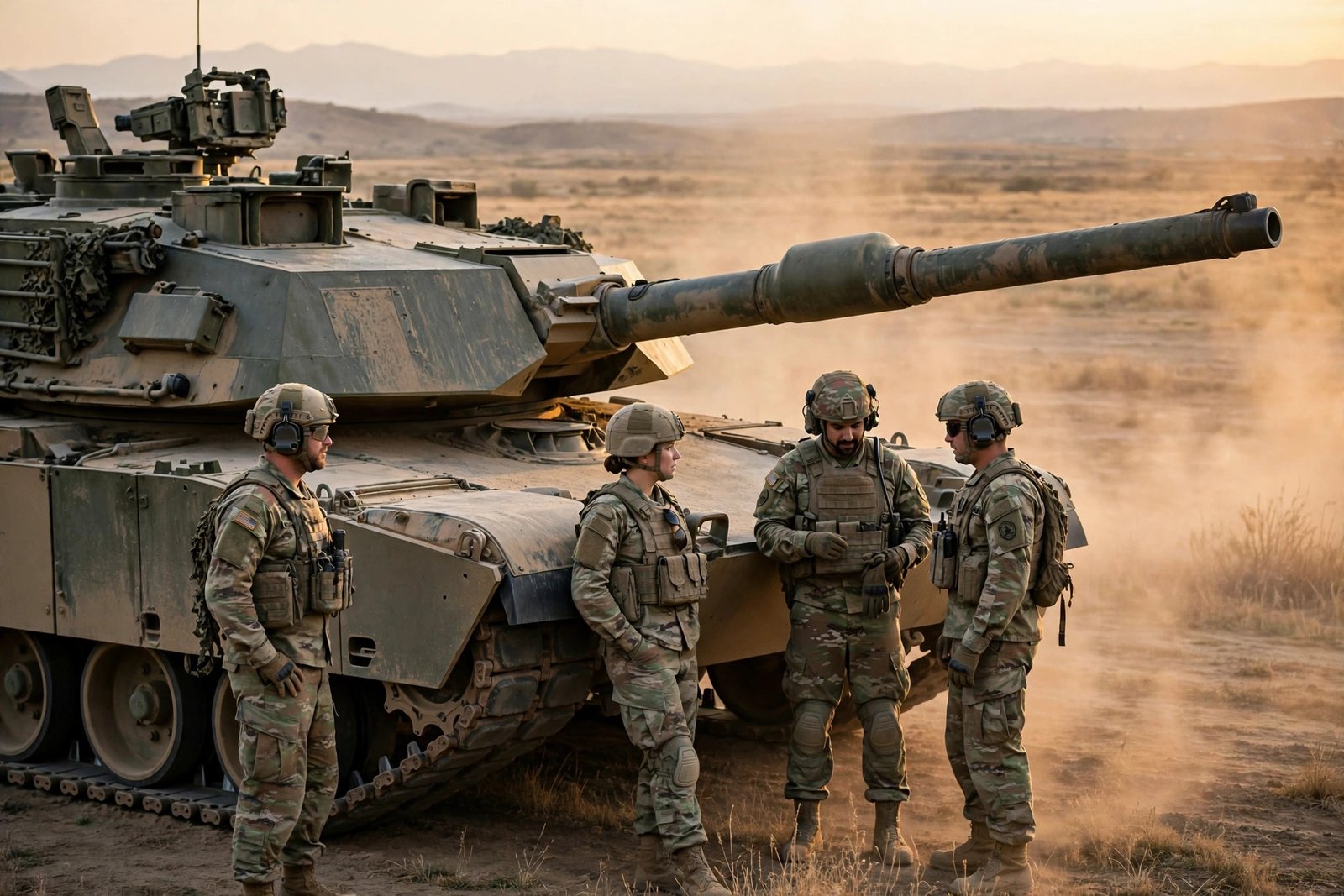
The hatch slams shut, the engine roars, and suddenly four soldiers become one machine. That is the world of the American tanker, and US Army tank crews true stories are some of the most gripping accounts in military history. From the muddy fields of Europe in World War II to the deserts of Iraq, these crews fought wars from inside a steel box, trusting each other with their lives every single day.
This article looks at the real experiences of American tank crews across different eras. These are not Hollywood inventions. They are drawn from the documented history of the units, the vehicles, and the battles that shaped armored warfare. If you love stories of courage, teamwork, and machines pushed to their limits, you are in the right place.
US Army Tank Crews True Stories From World War II
When the United States entered World War II, its tank force was still young. The main American medium tank of the war was the M4 Sherman, a reliable and widely produced vehicle that served in North Africa, Italy, and across Western Europe after D-Day. Sherman crews knew their tank was not the heaviest on the battlefield. German Panther and Tiger tanks carried thicker armor and more powerful guns. American crews made up the difference with numbers, speed, teamwork, and sheer determination.
One of the most respected units of the war was the 761st Tank Battalion, the first Black tank battalion in US Army history. Its crews trained for years before being sent into combat in late 1944, and they fought continuously for months through France, Belgium, and Germany, including during the Battle of the Bulge. Their record earned the battalion a Presidential Unit Citation decades later, and their story is a reminder that courage in a tank crew had nothing to do with skin color and everything to do with skill and grit.
Another famous chapter comes from the fighting around Bastogne during the Battle of the Bulge in the winter of 1944 to 1945. American armored units raced to relieve surrounded airborne troops, fighting through snow, ice, and determined German resistance. Tank crews in those weeks often fought with little sleep, engines struggling in the cold, and supply lines stretched thin. Yet they kept moving forward, because the soldiers trapped in Bastogne were counting on them.
Life in a Sherman was cramped and loud. The crew of five worked in a space barely larger than a small closet, surrounded by ammunition, radios, and machinery. The commander scanned for targets with his head out of the hatch when he could, the gunner aimed the main gun, the loader fed shells as fast as humanly possible, the driver steered, and the assistant driver worked the hull machine gun and radio. Every man depended on every other man. A mistake by one could endanger them all.
The Sherman Era: Crews Who Fought in Steel Boxes
The Sherman earned a mixed reputation among its crews. On one hand, it was mechanically dependable, relatively fast, and easy to maintain in the field. On the other hand, its armor was thinner than that of the heaviest German tanks, and its early main gun struggled against thick frontal armor. Crews learned to fight smart: they used flanking maneuvers, called in artillery and air support, and worked closely with infantry.
Many veterans later described the strangest part of tank warfare: the mix of boredom and terror. Long road marches, maintenance checks, and waiting in cold fields could stretch for days. Then, in a matter of seconds, an ambush or an artillery barrage could turn an ordinary morning into a fight for survival. Crews formed bonds in that pressure cooker that lasted the rest of their lives. Many tankers say they never again trusted anyone the way they trusted their crew.
Some of the most moving US Army tank crews true stories come not from victories but from rescues. Tank crews regularly risked their vehicles to pull wounded infantry to safety, to tow damaged tanks out of danger, and to hold a position so that others could withdraw. In armored warfare, the tank is a weapon, but the crew inside it is a family, and families protect their own.
The lessons of World War II shaped the Army for decades. After the war, the United States kept investing in better armor, better guns, and better training. The Armor School, long based at Fort Benning in Georgia, became the place where every new tanker learned the trade. The spirit, though, stayed the same: four or five soldiers, one tank, and total trust.
US Army Tank Crews True Stories From Korea and Vietnam
The Korean War brought new challenges. Tanks fought in mountainous terrain that was nothing like the open fields of Europe, and the cold Korean winters were brutal on men and machines alike. American tank crews supported infantry in grinding battles along ridgelines and valleys, often firing in direct support of troops fighting on foot just ahead of them.
Vietnam was different again. Heavy tanks were less suited to jungle warfare, but armored cavalry units and tanks still played important roles, especially in operations where firepower and mobility mattered. Crews in Vietnam dealt with ambushes, mines, and an enemy that often fought from concealment. The heat, humidity, and rain made maintenance a constant battle. Crews learned to improvise, to adapt, and to keep their vehicles running in conditions that would have defeated less determined soldiers.
Across both wars, one theme repeats in veterans accounts: the crew comes first. Tankers cleaned their tank together, ate together, and stood watch together. In Vietnam, some crews even personalized their vehicles with names and artwork, a tradition going back to World War II. Those names were not decoration. They were identity, a way of saying that this machine and this crew were one.
Desert Storm: The Modern Abrams Crew
The Gulf War of 1991 introduced the world to the M1 Abrams, the tank that still anchors American armored forces today. The Abrams crew has four members: the commander, the gunner, the loader, and the driver. It carries a powerful main gun, advanced optics, and composite armor, and it can move fast across open desert.
One of the best-known armored battles of the war was the Battle of 73 Easting, fought in February 1991 during the ground campaign in Iraq. There, American armored cavalry units, equipped with M1 Abrams tanks and Bradley fighting vehicles, encountered Iraqi armored forces in the desert. In poor visibility caused by sand and weather, American crews used superior training, thermal sights, and gunnery to defeat a larger force. The battle became a textbook example of what well-trained tank crews can do.
Another major engagement, the Battle of Medina Ridge, saw American armored divisions fight large Iraqi tank formations. Again, training and technology proved decisive. Crews reported engaging targets at long range, moving quickly between firing positions, and coordinating closely with other units. The ground war lasted only about 100 hours, but for the crews involved, those hours were intense, exhausting, and unforgettable.
Veterans of Desert Storm often describe the strange quiet inside the tank between engagements: the hum of the turbine engine, the radio chatter, the heat of the desert, and then sudden action as a target appeared in the sights. The Abrams changed tank warfare, but it did not change the heart of it. The crew still had to work as one.
What Life Inside a Tank Is Really Like
For civilians, the most surprising part of tanker life is how physical and how personal it is. Consider the four jobs on a modern Abrams crew:
- Commander: leads the crew, scans for targets, talks on the radio, and makes the tactical decisions.
- Gunner: aims and fires the main gun and coaxial machine gun, using advanced sights and fire controls.
- Loader: loads the main gun by hand, a job that demands speed, strength, and total focus.
- Driver: steers the tank, often with a very limited view, trusting the commander to guide him.
Crews train together for months. They practice loading drills until the movements are automatic. They practice maintenance until they can fix common problems in the field. They practice communication until a few short words are enough to coordinate a complex maneuver. That is why tankers so often describe their crew as brothers. They have trusted each other in situations where trust was everything.
There is also the everyday reality that movies skip. Tanks break down. They get stuck in mud. They run low on fuel. Crews spend long hours on maintenance, cleaning, and checks. The glamour of armored warfare is mostly in the history books; the daily life is work, discipline, and routine, punctuated by moments of real danger.
Why These Stories Still Matter
The stories of American tank crews matter because they are stories about ordinary people doing extraordinary things together. A tank is an impressive machine, but without its crew it is just metal. The courage belongs to the people: the teenager who volunteered in 1943, the draftee who served in Korea, the professional soldier who crossed the Iraqi desert in 1991, and the men and women serving in armored units today.
They also matter because armored warfare continues to evolve. New technology, drones, and modern anti-tank weapons are changing the battlefield again. Yet the core lesson of every generation of tankers remains the same: training, teamwork, and trust decide battles more than any single piece of equipment.
If these stories inspire you, explore more tales from the Army on this site, including true stories of US Army engineers and true stories of the Green Berets. Each branch has its own history, but the same thread runs through all of them: soldiers who refused to quit, and crews who refused to leave anyone behind.
Conclusion: Steel, Crew, and Courage
From the Sherman tanks of World War II to the Abrams tanks of today, US Army tank crews true stories remind us that war is ultimately a human story. The machines changed, the battlefields changed, and the enemies changed. What never changed was the bond inside the tank: four or five soldiers, sealed in steel, depending on each other completely.
Next time you see a photo of an American tank, look past the armor and the gun. Think about the crew inside: the commander scanning the horizon, the gunner steady on the sights, the loader ready with the next round, and the driver waiting for the order to move. Their stories deserve to be remembered, shared, and honored.
Did this story move you? Share it with a veteran, a history lover, or a friend who appreciates true stories of courage. And leave a comment telling us which era of tanker history you would like us to cover next.