
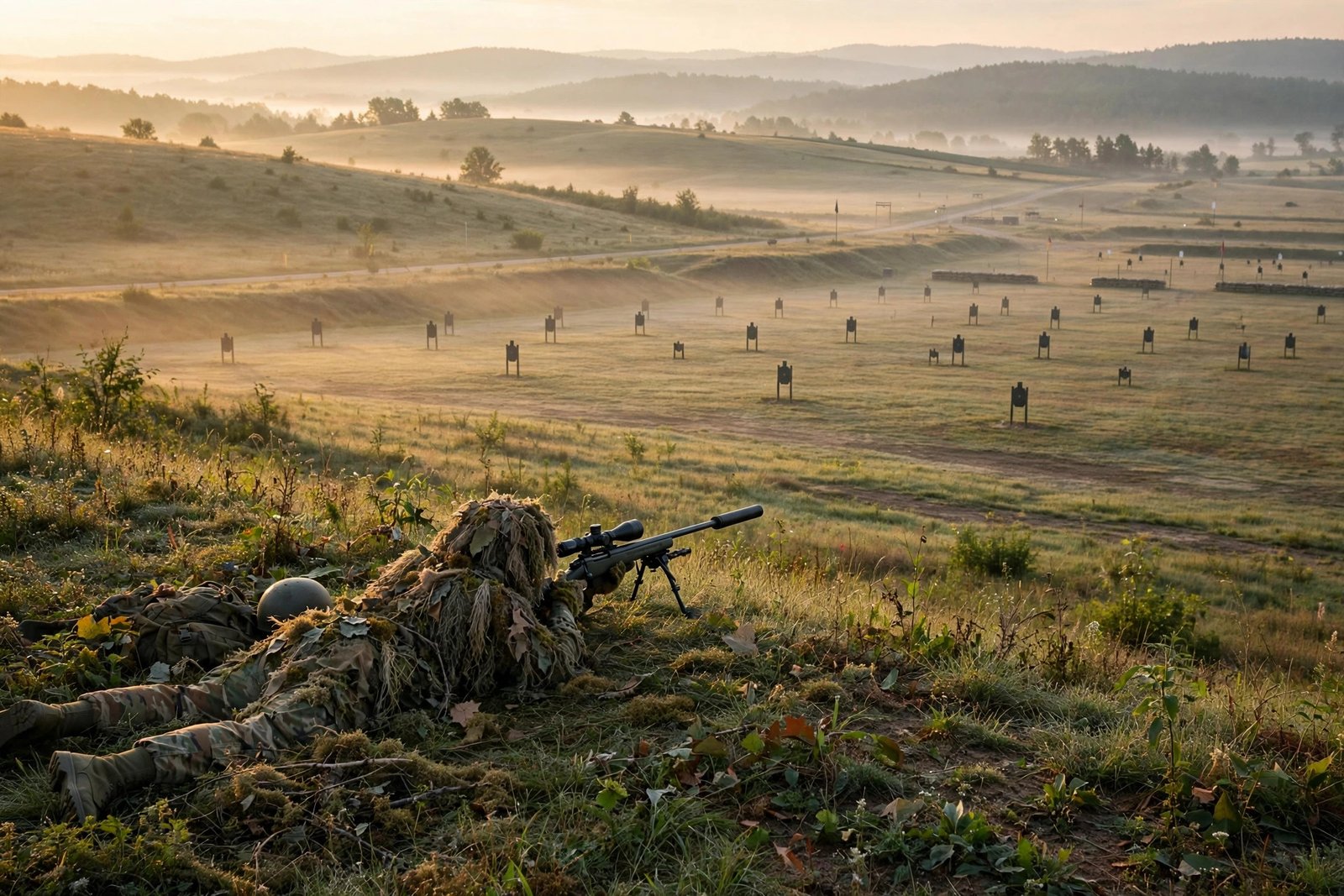
Somewhere in the tall grass, a soldier lies perfectly still. He has not moved for hours. His breathing is slow, his eyes fixed on a distant road, and his rifle rests exactly where it needs to be. This is the world of the Army sniper, and US Army snipers true stories are some of the most remarkable tales in American military history. They are not stories about firing shot after shot. They are stories about patience, discipline, and the quiet courage to wait for one perfect moment.
The men and women who serve as snipers in the United States Army carry one of the most demanding jobs in the military. They operate in small teams, often far from friendly forces, gathering information and protecting their fellow soldiers. Their work is rarely seen and almost never celebrated in the moment, yet it has shaped battles and saved lives for more than two centuries. In this article, we explore the history, training, and real experiences behind these extraordinary soldiers.
The Long History Behind US Army Snipers True Stories
US Army snipers true stories begin long before modern rifles and high-powered scopes. During the American Revolutionary War, American riflemen armed with long rifles picked off British officers from distances that shocked European armies. These early sharpshooters, many of them frontiersmen from Pennsylvania and Virginia, used their hunting skills on the battlefield. Their accuracy gave the Continental Army an edge, and the idea of the skilled marksman as a military asset was born.
During the American Civil War, both Union and Confederate armies formed dedicated sharpshooter units. The Union raised regiments of sharpshooters who were required to prove their skill by hitting targets at long range before they were accepted. These men wore green uniforms to blend into the woods and carried specially made rifles. They served as scouts and skirmishers, and their presence forced enemy commanders to think twice before exposing themselves on the battlefield.
By the time of World War I, the Army had begun to treat sniping as a formal skill. American snipers in France learned from British and French instructors who had developed sniping tactics in the trenches. The lessons of that war carried into World War II, where Army snipers served in Europe and the Pacific, and then into Korea and Vietnam. Each conflict added new lessons about camouflage, observation, and the importance of the sniper as a source of battlefield intelligence.
How Army Snipers Train at Fort Benning
Today, the path to becoming an Army sniper runs through the United States Army Sniper School at Fort Benning, Georgia. The course is known as one of the toughest schools in the Army, and not every soldier who arrives will graduate. Candidates must already be skilled infantrymen, and they must pass strict physical and marksmanship standards before the training even begins.
The course lasts several weeks and covers far more than shooting. Students learn the art of the stalk, moving across open ground without being seen. They learn camouflage and concealment, building ghillie suits from natural materials and using the terrain to disappear. They study range estimation, learning to judge distances by eye, because a wrong guess of even a few yards can mean a missed shot at long range.
Ballistics is another major part of the training. Snipers must understand how wind, temperature, humidity, and altitude affect a bullet in flight. They learn to read the wind by watching grass, trees, and dust, and to make precise adjustments to their scopes. They also learn observation and reporting, because a sniper team often spends more time watching and reporting enemy movement than shooting. A sniper who can describe what he sees clearly and accurately is as valuable as one who can hit a target at a thousand yards.
One of the most famous parts of the course is the final stalk exercise, in which students must move undetected across open ground to within shooting range of instructors who are actively searching for them. It is a test of everything they have learned: patience, movement, camouflage, and nerve. Soldiers who pass earn the right to wear the sniper qualification, a mark of distinction within the infantry.
US Army Snipers True Stories From Vietnam
Some of the most widely told US Army snipers true stories come from the Vietnam War, where Army snipers served in the jungles and rice paddies of Southeast Asia. Among the best documented is the story of Staff Sergeant Adelbert Waldron, an Army sniper who served with the 9th Infantry Division. Waldron is credited with 109 confirmed kills, a figure recorded in Army records, making him one of the most successful American snipers of the war. He was awarded the Distinguished Service Cross, the Silver Star, and the Bronze Star for his service.
What makes Waldron’s story so compelling is not only the number of confirmed engagements but the way he worked. He operated in the Mekong Delta, a landscape of water, mud, and dense vegetation where visibility was often measured in yards rather than miles. He and his spotter would move quietly into position, sometimes by boat, and wait for hours or days. His rifle was a standard-issue weapon fitted with a scope, and his success came from fieldcraft and patience rather than special equipment.
Other Army snipers in Vietnam told similar stories of long waits and careful movement. Teams would be inserted by helicopter into remote areas and left to observe trails and enemy positions for days at a time. They carried little food and water, and they could not risk a campfire or a radio call that might give them away. When they did engage, it was usually a single shot, followed by a careful withdrawal before the enemy could respond. The work demanded a level of self-discipline that few soldiers ever experience.
It is worth noting what these stories are not. They are not tales of lone heroes acting on their own. Every Army sniper works as part of a team, usually a two-man pair: the shooter and the spotter. The spotter watches, measures wind and distance, and protects the shooter. The two men depend on each other completely, and the trust between them is one of the strongest bonds in the Army.
The Sniper’s Tools: Rifle, Scope, and Spotter
The modern Army sniper’s rifle is a precision instrument, built and maintained to exacting standards. Over the years, the Army has used several sniper rifle systems, each one chosen for accuracy and reliability at long range. What matters more than the specific model is the relationship between the sniper and the weapon. A sniper knows his rifle the way a musician knows an instrument, and he spends countless hours practicing with it until shooting becomes second nature.
The scope is the sniper’s other essential tool. Modern optics allow a sniper to see clearly at distances where the naked eye sees only a blur. But the scope is only as good as the person behind it. A sniper must learn to control his breathing, slow his heartbeat, and squeeze the trigger so smoothly that the rifle barely moves. The difference between a hit and a miss can be a fraction of an inch at the trigger.
The spotter’s role deserves more attention than it usually gets. The spotter carries a high-powered spotting scope and calls out wind changes, target movement, and range corrections. In many teams, the spotter is the more experienced soldier, and the two men take turns shooting. The spotter also serves as security, watching the team’s surroundings while the shooter focuses on the target. Without a good spotter, even the best shooter is working half-blind.
Other tools of the trade include the ghillie suit, a camouflage garment covered in strips of fabric and natural materials that breaks up the human outline. Snipers build their own ghillie suits, adding local vegetation to match the terrain where they will operate. They also carry rangefinders, ballistic calculators, notebooks for recording observations, and radios for reporting what they see. Every item is chosen for a reason, and every ounce matters when a team may have to move miles on foot.
Life on a Mission: Patience, Discipline, and Teamwork
Ask any sniper what the job is really like, and the first word is usually patience. A sniper team may spend days in a single position, watching a road, a building, or a stretch of terrain. They cannot stand up, stretch, or make noise. They eat cold food, drink sparingly, and take turns sleeping in short shifts. The mental discipline required is enormous, because boredom and discomfort can be as dangerous as the enemy.
Observation is the heart of the mission. A sniper team is often the eyes of the larger unit, reporting enemy movements, identifying positions, and providing early warning of attacks. The information they gather can shape decisions made by commanders miles away. In this sense, the sniper is as much an intelligence gatherer as a shooter, and many missions end without a single shot fired.
When a shot is required, the decision is never taken lightly. Army snipers operate under strict rules of engagement, and they must positively identify their target before firing. The shot itself is the result of careful calculation: distance, wind, angle, and the movement of the target all factor into a single moment. After the shot, the team must move quickly and quietly, because the sound of the shot may reveal their position.
The bond between a sniper and his spotter is often described as one of the closest relationships in the military. They train together, eat together, and depend on each other for survival. They learn each other’s habits, moods, and tells, and they can communicate with a glance or a hand signal. Many veterans say that the trust built on sniper missions lasts a lifetime.
Modern Army Snipers in Iraq and Afghanistan
In the wars in Iraq and Afghanistan, Army snipers faced a new kind of battlefield. Instead of jungles and open fields, they worked in cities, villages, and mountain valleys. They provided overwatch for patrols moving through urban streets, watched rooftops and windows for threats, and protected convoys from ambush. Their role as guardians of their fellow soldiers became even more visible, and many units came to rely on sniper teams as an essential part of every operation.
The urban environment brought new challenges. Shots were often taken at shorter ranges but through windows, across rooftops, and between buildings where wind behaved unpredictably. Snipers learned to read the movement of dust, laundry on a line, and even the behavior of birds to judge the wind in a city. They also had to be certain of their targets, because civilians and friendly forces might be only a few yards from an enemy fighter.
In Afghanistan’s mountains, the challenges were different. Thin air and extreme distances stretched the limits of rifles and shooters alike. Sniper teams operated at high altitude, carrying heavy loads up steep slopes, and engaging targets across valleys that seemed impossibly wide. The lessons learned in those mountains have shaped sniper training ever since, and they are part of the reason the Army continues to invest in long-range marksmanship.
Through it all, the core of the job never changed. Whether in a jungle, a city, or a mountain valley, the Army sniper’s work rests on the same foundations: careful observation, precise shooting, and absolute discipline. The technology has improved, but the soldier behind the rifle remains the decisive factor.
What These Stories Teach Us
The true stories of Army snipers teach us something important about service and sacrifice. These soldiers do not seek the spotlight. They work in silence, often alone or in pairs, far from the attention that other heroes receive. Their contribution is measured not in headlines but in the lives of the soldiers they protect and the information they provide.
Their stories also remind us that military skill is about far more than firepower. The best snipers are students of their environment, masters of patience, and disciplined professionals who can remain calm under extraordinary pressure. They study the wind, the light, and the terrain. They understand human behavior. They know when to act and, just as importantly, when to wait.
For readers who want to learn more about the soldiers who serve alongside snipers, the stories of Army medics who risked everything to save the wounded offer another view of courage under fire. The true stories of the Green Berets show a different kind of special operations service, and the stories of Medal of Honor heroes remind us of the highest traditions of the Army.
If you ever meet a veteran who served as a sniper, listen to what they are willing to share. Many are quiet about their service, and some prefer not to discuss it at all. Respect that silence. It is part of the same discipline that made them effective soldiers. And when they do speak, you will hear stories not of glory but of duty, teamwork, and the men and women they served beside.
The legacy of the Army sniper continues today at Fort Benning, where new classes of students learn the same skills that riflemen practiced in the Revolution and sharpshooters honed in the Civil War. The weapons have changed, the optics have improved, and the battlefields look different, but the mission remains the same: to see without being seen, to protect fellow soldiers, and to be ready for the one moment that matters. That is the enduring truth behind these remarkable stories, and it is why they deserve to be remembered.
Want to explore more American military history and the people who shaped it? Keep reading ENG Post for true stories of service, sacrifice, and the soldiers who stood watch so others could come home. Share this article with someone who appreciates military history, and leave a comment telling us which story stayed with you.