
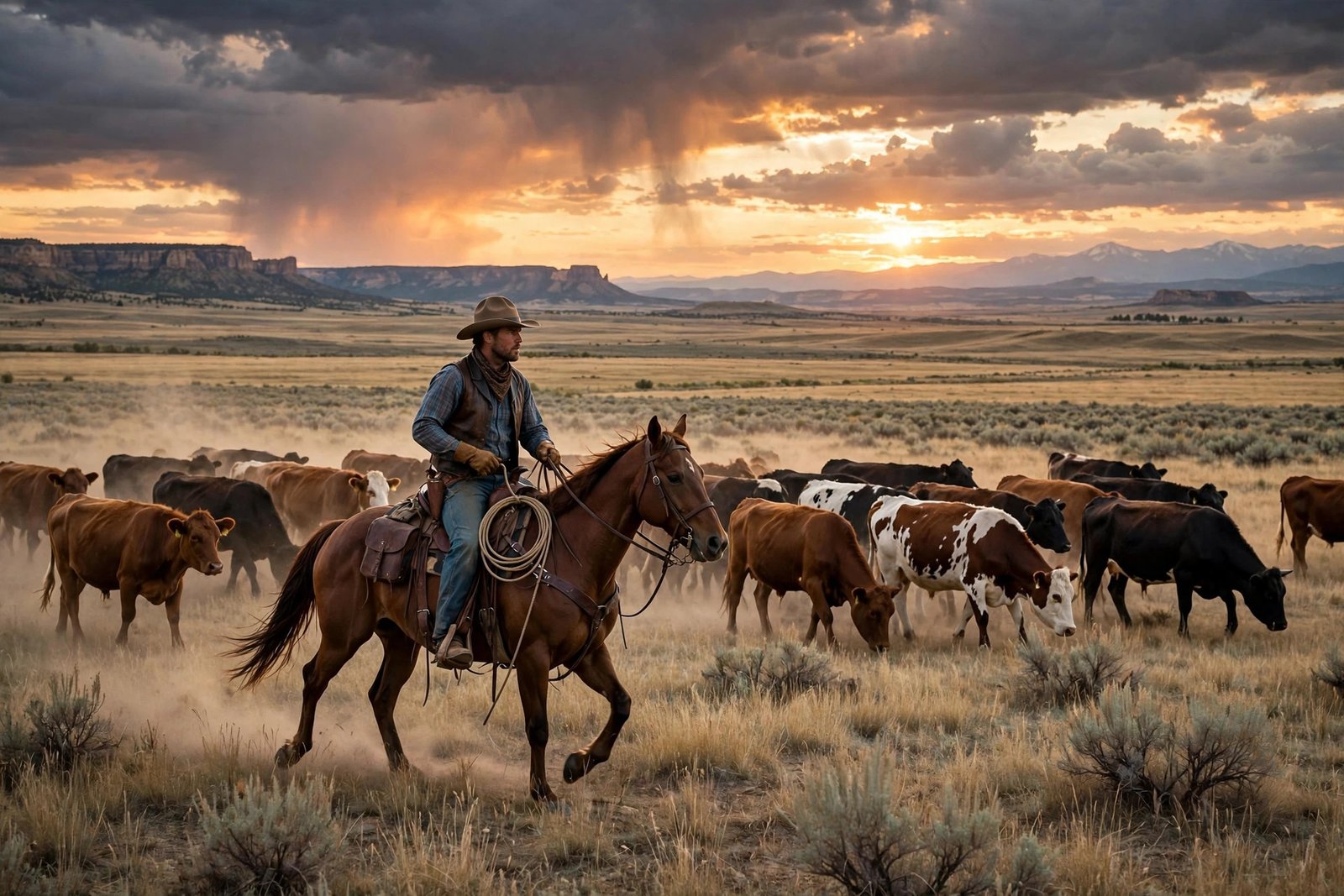
The history of American cowboys is one of the most romanticized stories in the United States, and also one of the most misunderstood. When most people picture a cowboy, they imagine a lone gunslinger in a white hat riding into a dusty town at high noon. The real story is richer, harder, and far more interesting. Real cowboys were working cattlemen, many of them young, poorly paid, and from backgrounds far more diverse than the movies suggest. They herded cattle across open prairies, slept under the stars, and helped build an industry that fed a growing nation.
Understanding the history of American cowboys means looking past Hollywood and back to the ranches, trails, and railheads of the nineteenth century. It is a story that begins not in Texas, but in Spain and Mexico, and it involves vaqueros, formerly enslaved men, Native American riders, European immigrants, and women who worked cattle alongside men. Their working era was surprisingly short, only a few decades, yet its image has lasted for more than a century and still shapes how America sees itself.
The History of American Cowboys Begins in Spain and Mexico
The roots of the American cowboy reach back to the cattle-herding traditions of Spain. When Spanish explorers and settlers came to the Americas in the 1500s, they brought horses and longhorn cattle with them. In Mexico, the skilled horsemen who managed cattle on large ranches were called vaqueros, a word that comes from vaca, the Spanish word for cow. The English word buckaroo is believed to come from vaquero, a clue to how directly American cowboy culture borrowed from its Mexican predecessors.
Vaqueros developed the tools and techniques that later cowboys would use every day. The saddle with a horn for roping, the lasso or lariat, the wide-brimmed hat for sun protection, the chaps that guarded legs against brush and rope burns, and the bandanna that kept dust out of the face all trace back to vaquero practice. The vaqueros also developed the rodeo skills of roping and riding that became both work and sport. When Anglo settlers moved into Texas in the early 1800s, then still part of Mexico, they learned cattle work from the vaqueros already living and ranching there.
After Texas won independence in 1836 and later joined the United States in 1845, the cattle business grew. Longhorn cattle, tough animals descended from Spanish stock, roamed semi-wild across the Texas brush country. They could survive drought, heat, and sparse grass, and their numbers multiplied. At the same time, beef was in high demand in the growing cities of the East and Midwest, where a steer that was worth only a few dollars in Texas could sell for many times that amount in Kansas City or Chicago. That price gap created the great cattle drives.
The History of American Cowboys on the Open Range
The classic era of the history of American cowboys runs roughly from the end of the Civil War in 1865 to the closing of the open range in the 1890s. Before the war, cattle drives were small and local. After the war, returning soldiers, freedmen, and young men looking for work found jobs on the trail, and the drives grew into huge operations. A typical drive moved two thousand or more head of cattle from Texas north to a railhead town in Kansas, a journey of hundreds of miles that took two to three months.
Life on a cattle drive was grueling. A trail crew usually included a trail boss, a cook, a wrangler who cared for the horses, and about ten cowboys. Each cowboy rode a string of horses, switching mounts through the day so no single horse was exhausted. Days began before dawn with the cook’s breakfast call. Cowboys rode flank, point, swing, and drag positions around the herd, keeping the cattle moving, turning back strays, and watching for danger. At night, two men at a time rode night guard, circling the herd and singing softly to keep the cattle calm. A sudden thunderstorm, a lightning strike, or a startled animal could cause a stampede, one of the most dangerous events on the trail.
The pay was modest. A cowboy commonly earned around twenty-five to forty dollars a month plus food, a figure often cited in histories of the period, and many cowboys spent their wages quickly in the trail-end towns. Those towns, places such as Abilene, Dodge City, and Wichita, Kansas, grew up around the railheads where cattle were loaded onto trains bound for eastern markets. They gained a wild reputation for saloons, gambling, and gunfights, though the reality was usually more ordinary: most trail towns were busy commercial centers that wanted the cattle trade and worked to keep order.
The most famous routes became legends in their own right:
- The Chisholm Trail: Running from southern Texas through Oklahoma to Abilene, Kansas, it was one of the busiest cattle routes of the 1870s.
- The Goodnight-Loving Trail: Blazed by Charles Goodnight and Oliver Loving, it carried cattle westward from Texas into New Mexico and Colorado.
- The Western Trail: A later route to Dodge City, Kansas, used heavily in the late 1870s and 1880s as the frontier moved west.
- The Shawnee Trail: An earlier route used before the Civil War to move cattle toward Missouri markets.
For readers who enjoy the real stories behind the legends, true stories of the Wild West on ENG Post separate fact from Hollywood fiction, just as this history does.
Who Were the Real Cowboys?
One of the most important corrections to the movie image is who the cowboys actually were. Historians estimate that roughly a third of working cowboys were Mexican or Mexican American, many of them vaqueros or their sons, and roughly a quarter were Black, including many formerly enslaved men who found in cattle work a job that paid wages and offered a measure of freedom and mobility. Native American men also worked as cowboys, and European immigrants, especially Irish and German settlers, joined the crews as well. The trail crews were far more diverse than the all-white casts of early Western films.
Some individual cowboys became famous, and their stories show how varied the life could be. Nat Love, born enslaved in Tennessee, became a well-known cowboy and later wrote an autobiography about his years on the range. Bass Reeves, born enslaved in Arkansas, became one of the first Black deputy U.S. marshals west of the Mississippi, arresting thousands of outlaws in Indian Territory over a long career. Charles Goodnight, a Texas rancher, helped blaze a major trail and later preserved a herd of bison on his ranch. These are real people, not inventions, and their lives are documented in memoirs, census records, and newspaper accounts of the time.
Women were part of the story too, though often overlooked. Ranch women managed households, kept books, and sometimes rode and roped alongside the men. A few, such as the stagecoach driver Charley Parkhurst, whose life story became widely known only after her death, lived and worked in the West in ways that defied the expectations of the time. On family ranches, wives and daughters were working partners, not bystanders.
Cowboys also had a culture of their own. They sang songs on night guard that later became the folk music of the West. They told tall tales around the campfire, many of them exaggerations of real events. They wore practical clothing: sturdy boots with high heels that fit stirrups, denim or wool trousers, a long-sleeved shirt, and a hat that served as sunshade, water bucket, and fan for the campfire. The fancy fringed outfits and pearl-handled revolvers of the movies were mostly for show; a working cowboy’s gear was chosen for survival.
Outlaws, Lawmen, and the Myth of the Gunfighter
No account of the cowboy era is complete without the outlaws and lawmen, but the truth is quieter than the films. Gunfights were rare. Most cowboys carried a rifle or revolver as a tool for dealing with snakes, predators, and emergencies, not for duels at noon. Towns that wanted to attract business often banned carrying firearms within town limits, and famous lawmen such as Wyatt Earp and Bat Masterson spent much of their time as policemen, gamblers, and businessmen rather than in shootouts.
The famous names still fascinate because their stories mix fact and legend. Billy the Kid, born Henry McCarty, became involved in the Lincoln County War in New Mexico, a violent conflict between rival business factions, and was killed by Sheriff Pat Garrett in 1881 at the age of twenty-one. Jesse James and his brother Frank robbed banks and trains after the Civil War and became folk heroes to some, criminals to others. Butch Cassidy and the Sundance Kid led a gang that robbed banks and trains across the West before fleeing to South America. Each of these stories has a core of documented fact wrapped in layers of dime-novel and newspaper exaggeration, and historians still sort through the two.
The dime novels and later Wild West shows did much of the myth-making. Buffalo Bill Cody’s Wild West show, which toured America and Europe from the 1880s onward, presented a staged version of cowboy life, with trick riding, sharpshooting, and reenacted battles. It was entertainment, and audiences loved it, but it fixed an image of the West that was far more violent and glamorous than daily ranch work. Hollywood inherited that image and has been revising it ever since, from the heroic Westerns of the mid-twentieth century to the more realistic and critical Westerns of recent decades.
Why the Open Range Closed
The great cattle drives ended for practical reasons, not dramatic ones. First, railroads pushed farther south and west, so cattle no longer had to be driven hundreds of miles to a railhead. Second, farmers moved onto the plains and fenced their land with barbed wire, patented in the 1870s, which blocked the old trails and ended the open range. Third, overgrazing and a series of brutal winters, especially the winter of 1886 to 1887, killed huge numbers of cattle and bankrupted many ranchers. The winter of 1886-87 is remembered in ranching history as the Big Die-Up, and it marked the end of the big open-range operations.
Ranching did not disappear; it changed. Ranches became fenced, managed operations that raised cattle on owned or leased land, bred animals for beef quality, and shipped them by truck and rail. Cowboys still worked cattle, but they did it from a home ranch rather than on months-long drives. Rodeo grew out of ranch work contests and became a professional sport. The cowboy became a working rancher again, less visible to the public but still essential to the beef industry.
At the same time, the West itself was changing. Native American nations, who had lived on the plains long before the cattle drives, were forced onto reservations through war, treaties, and federal policy during these same decades. The cattle industry expanded onto lands that had been hunting grounds and homelands. Any honest history of the cowboy era has to include that fact: the open range was open to cattlemen because it had been taken from its original inhabitants, and the cost of that expansion is part of the story.
The Cowboy in American Culture
Even though the trail-driving era lasted only about twenty-five years, the cowboy never left American culture. Country music, Western novels, films, television shows, and advertising all borrowed the cowboy’s image of independence, hard work, and self-reliance. The cowboy hat and boots became symbols worn far from any ranch. Politicians, from Theodore Roosevelt to Ronald Reagan, used cowboy imagery to signal toughness and frontier values. The image traveled around the world, so that people who have never visited the United States still recognize a cowboy at a glance.
Modern cowboys and cowgirls keep the working tradition alive. Ranch hands still ride, rope, and brand cattle across Texas, Wyoming, Montana, and the rest of the West, now using trucks, all-terrain vehicles, and veterinary science alongside horses and lassos. Rodeo cowboys and cowgirls compete professionally. Ranching families pass the work down through generations. The job looks different from 1875, but the core skills of horsemanship, animal care, and reading the land remain.
There are also efforts to preserve the real history. Museums such as the National Cowboy and Western Heritage Museum in Oklahoma City and the Autry Museum of the American West in Los Angeles collect artifacts, photographs, and art from the era. Historic ranches and trail sites are preserved as landmarks. And historians continue to recover the stories of Black, Mexican, Native, and women cowboys whose contributions were long left out of the popular story. The more complete the history becomes, the more interesting it gets.
Conclusion: The Real Cowboy Is Worth Remembering
The history of American cowboys is not really about gunfights at high noon. It is about working people, from many backgrounds, who built a cattle industry on horseback in a short, hard, remarkable era. It is about vaqueros who taught the skills, trail crews who endured months on the open prairie, ranch families who stayed when the drives ended, and a culture that still shapes American music, film, and identity. The legend is fun, but the real story is better, because it actually happened. If you enjoyed this look at the West, keep exploring the frontier’s real tales in Wild West true stories and discover more of America’s past here on ENG Post, where history is told straight, legends labeled as legends, and the facts always come first.