
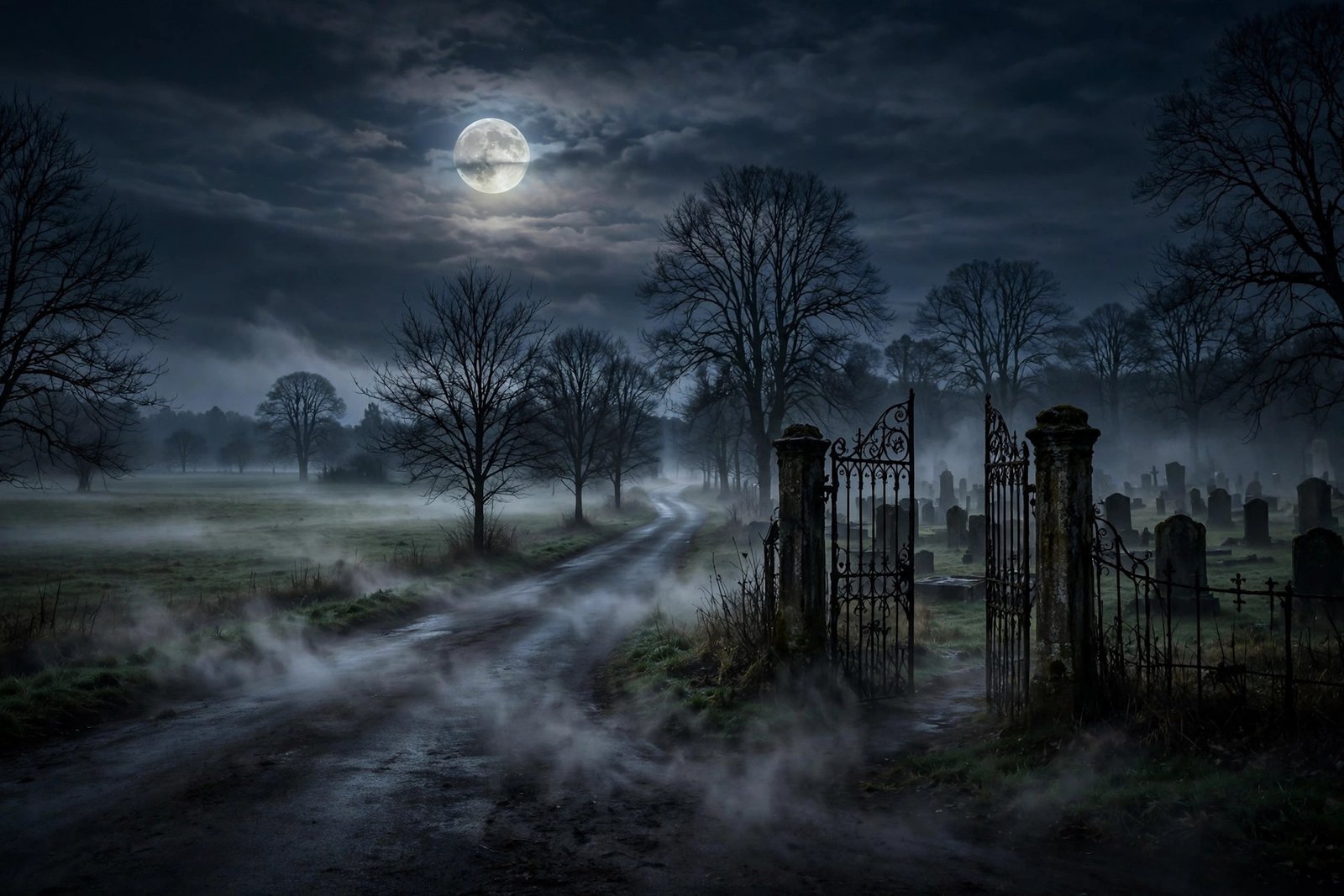
Few American ghost stories have traveled as far — or stuck around as long — as the Resurrection Mary legend. Since the 1930s, drivers along Archer Avenue in the Chicago suburbs have told the same eerie story: a young woman in a white dress, standing alone at night, flagging down a ride. She climbs in, says little, and gives the driver an address. But when the car reaches Resurrection Cemetery in Justice, Illinois, she is gone. Vanished from the back seat. Gone.
Is she real? Is she folklore? The honest answer is that Resurrection Mary lives firmly in the territory between — a classic American vanishing-hitchhiker tale with roots in a real place, real roads, and a real cemetery, but with details that cannot be verified and have clearly grown with the telling. In this article, we walk through the legend exactly as it is told, separate what can be checked from what cannot, and explore why this Chicago ghost story still haunts the imagination nearly a century later.
The Classic Encounter: How the Resurrection Mary Legend Goes
The story has many versions, but the bones of the tale almost never change. Here is the encounter as generations of Chicagoans have described it:
- A driver is traveling along Archer Avenue late at night, often in the stretch between Chicago and the southwestern suburbs.
- At the roadside, a young woman — blonde, pale, wearing a white formal or party dress — signals for a ride. She appears to be coming from a dance or social event.
- The driver stops. She gets in, sometimes offering only a few quiet words about where she is headed.
- She directs the driver toward Resurrection Cemetery, or asks to be let out near its gates.
- When the driver looks back, the passenger is gone. The car door never opened. No one is on the road.
In some versions of the tale, the young woman speaks of a date gone wrong, or asks the driver to take her home to a specific house. In others, she dances with a stranger at a ballroom — the story often names the dance halls that once stood along Archer Avenue — and then accepts a ride home, only to vanish at the cemetery gates. What unites every version is the pattern: she is solid and present, and then she is simply not there.
It is worth saying plainly: this is a legend. There is no verified record of the encounter, no police report that confirms it, no named driver whose story has been corroborated. But that is precisely what makes it a legend — and why it belongs to Chicago the way the Mothman belongs to West Virginia: a story the whole region tells about itself.
Resurrection Mary Legend Sightings Along Archer Avenue
The setting of the Resurrection Mary legend is not some remote woodland — it is Archer Avenue, one of the oldest and longest-running roads on Chicago’s southwest side. The road cuts through neighborhoods and suburbs, passing dance halls, roadhouses, and eventually Resurrection Cemetery in the village of Justice, Illinois, just southwest of Chicago. In the 1930s and 1940s, this stretch was alive with nightlife: big-band ballrooms and dance pavilions drew young crowds on weekend nights. That is the world the legend grew up in.
Accounts of the ghostly girl cluster along the Archer Avenue corridor. Drivers have described seeing a young woman in white walking the shoulder of the road, or appearing at the roadside where the lighting is poor and the cemetery’s iron gates are visible through the dark. Some versions of the story say she reaches for the car door handle as the vehicle passes the gates; others say she simply steps out of the shadows and then is gone when headlights swing back around.
One of the most repeated details in local telling is the claim that burn marks or handprints have been found on the cemetery’s front gates — said to be from Mary’s spectral hands gripping the bars. This detail, like the rest of the story, is folklore: it has never been documented or verified, and cemetery officials have not confirmed it. It belongs to the story the way the white dress belongs to the girl — a vivid image that gets retold because it is vivid, not because it is proven.
What is verifiable is that people have been telling these stories for a very long time. Newspaper features, books of Chicago folklore, and local-history collections have carried the tale for decades. The legend’s persistence across generations is itself the most documented fact about it.
Who Is Resurrection Mary? Folklore Tries to Answer
Ask who Mary was, and the legend offers several candidates — which is itself a sign that we are in folklore territory. No single identity has ever been established, and the various explanations people have offered contradict one another. Here are the theories that circulate, clearly labeled as legend rather than fact:
- The dance-hall tragedy: One popular version says Mary was a young woman killed in a car accident while returning from a dance at one of the Archer Avenue ballrooms. In some tellings, she is buried at Resurrection Cemetery, and her ghost is simply trying to get home.
- The hit-and-run victim: Another version says she was struck by a car while walking along Archer Avenue at night — a fate that would explain why she haunts the roadside itself.
- The broken-date story: Some tellings say she had a quarrel with a date at a dance and left on foot, meeting tragedy on the way. This version explains why she is always dressed for an evening out.
Folklore collectors have pointed to various graves at Resurrection Cemetery over the years, but none of the suggested identities has been verified, and the cemetery’s records do not confirm a match. Be cautious with any source that names Mary with certainty — the honest record is that no one knows, because Mary is a story, not a case file.
This matters because the best ghost stories are not about evidence; they are about meaning. Resurrection Mary is the classic American vanishing hitchhiker — a tale type found all over the world, always adapted to local roads and local cemeteries. Chicago’s version is simply the most famous one. If you love this kind of American legend, you will recognize the same storytelling bones in our guides to the Bell Witch legend of Tennessee and the Winchester Mystery House legend.
Fact vs Folklore: What We Can Actually Verify
Here is an honest accounting — the facts on one side, the folklore on the other:
- Fact: Resurrection Cemetery is a real Catholic cemetery in Justice, Illinois, established in the early 1900s. It sits along Archer Avenue.
- Fact: Archer Avenue is a real historic road connecting Chicago to its southwestern suburbs. Dance halls and ballrooms along its route were genuinely popular in the 1930s and 1940s.
- Fact: The legend of a vanishing hitchhiker at this location has been reported and retold since the 1930s, appearing in newspaper features and folklore collections for decades.
- Folklore: The identity of Mary — any specific person, name, date, or cause of death.
- Folklore: Any specific encounter — the rides, the vanishing at the gates, the handprints on the bars. These are the story’s details, not documented events.
Notice the pattern: everything that is real is the stage — the road, the cemetery, the ballrooms, the decades of retelling. Everything that is unverified is the ghost herself. That is exactly how enduring legends work. They anchor themselves to real geography so firmly that the story feels like a memory of the place, even though the central figure cannot be confirmed.
Why the Resurrection Mary Legend Endures
Nearly a century after the first tellings, why does this story still get told at campfires, on Chicago ghost tours, and in late-night conversations? A few reasons stand out.
The setting is irresistible. A beautiful young woman in a white dress. A lonely road at midnight. A cemetery gate. The legend is built from images that are cinematic before cinema — you can see the whole story in your mind the first time you hear it. That visual power is why the Resurrection Mary legend outlived the dance halls it was born in.
The encounter is interactive. Unlike legends that happen to someone else in a faraway castle, Mary happens to you — to any driver on Archer Avenue after dark. The story invites the listener to imagine themselves behind the wheel, which makes it personal and repeatable. Every new generation of drivers gets to wonder.
It speaks to a real grief. The mid-century era that birthed the legend was a world of young people, cars, and late nights — and of the genuine accidents that came with them. A ghost who died on her way home from a dance gives a supernatural shape to a very human fear: the ride home that never arrives.
Chicago keeps retelling it. Local newspapers, radio hosts, folklore writers, and ghost-tour operators have kept Mary alive for decades. A legend that gets retold well becomes part of a city’s identity — and the Resurrection Mary legend is, at this point, a piece of Chicago folklore infrastructure, as permanent as deep-dish pizza and the Hancock tower.
Visiting the Area: Safely and Respectfully
If the legend has sparked your curiosity, the best way to experience it is the respectful one. Resurrection Cemetery is an active, operating cemetery — a place of real grief for real families. A few guidelines:
- Do not enter the cemetery after hours. It is private property, and trespassing at a cemetery is both illegal and disrespectful. View the gates from the road.
- Drive Archer Avenue responsibly. If you go looking for Mary at night, remember it is a public road. Stay in your vehicle, obey speed limits, and never stop in traffic lanes.
- Join an organized ghost tour instead. Chicago has several reputable ghost and history tours that cover the Mary legend safely and legally — and the guides tell the story far better than a roadside visit ever could.
- Remember the difference between legend and loss. The cemetery holds real graves. Enjoy the folklore; respect the ground it is told on.
The Legend Is the Point
The Resurrection Mary legend has never needed proof to matter. What it needed was a road, a cemetery, a dress, and a vanishing — and the imagination of a city that has kept the story alive for the better part of a century. Whether you believe in ghosts or not, Mary endures because she is Chicago telling a story about itself: about youth and nightlife, about loss on a midnight road, and about the way a good story can make a stretch of Archer Avenue feel haunted long after the ballrooms went dark.
So the next time you drive Archer Avenue after midnight — and you glance at the passenger seat — remember what you are really looking for. Not a ghost. A legend. And in Chicago, legends like Mary never quite disappear.
Love American ghost lore? Keep reading: explore the Mothman legend of West Virginia, the Bell Witch of Tennessee, and our roundup of the best ghost towns in America — all on ENG Post.