
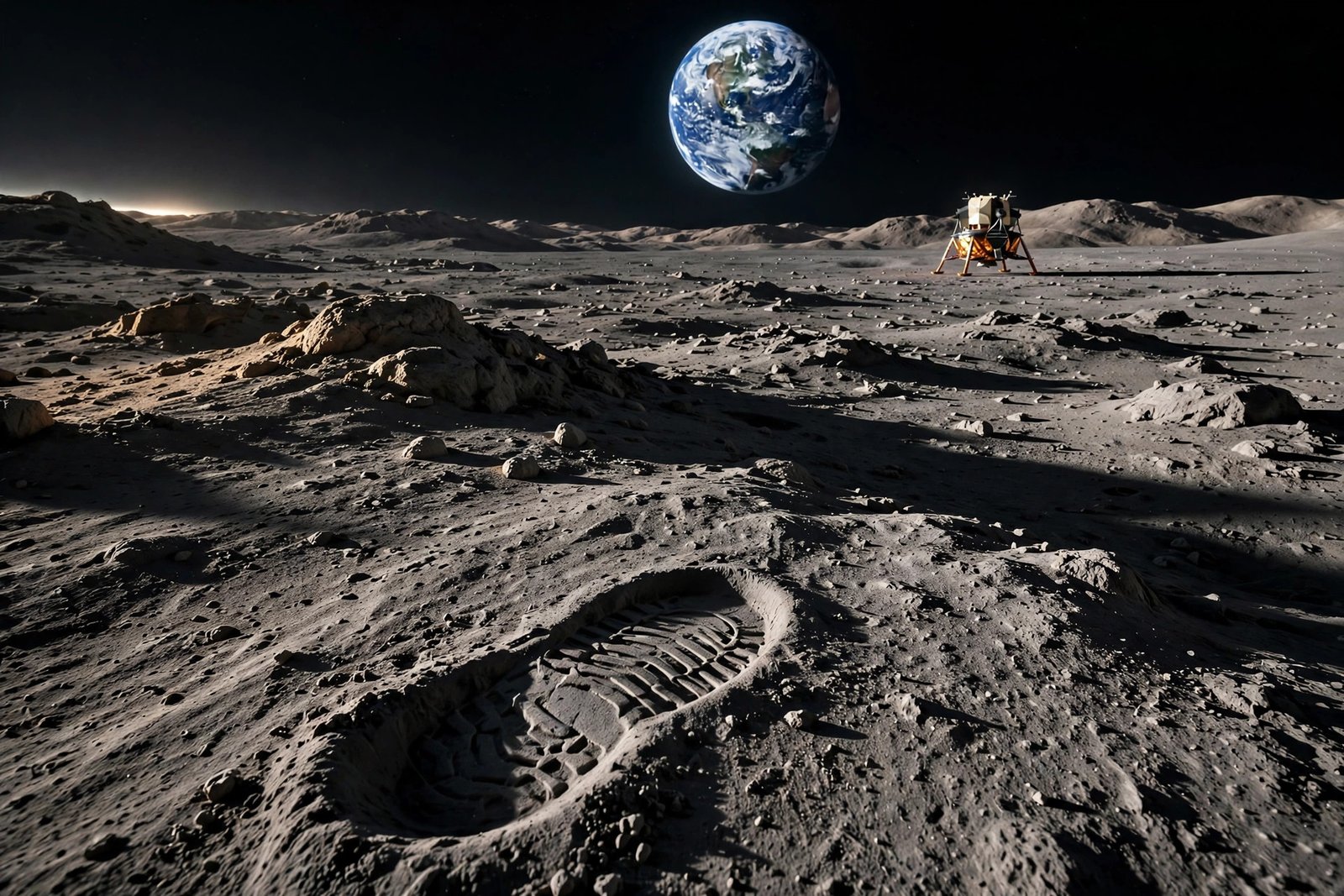
On July 20, 1969, two men walked on the surface of another world while hundreds of millions of people watched on television back on Earth. The Apollo 11 moon landing was the first time in history that human beings set foot on the Moon, and it remains one of the greatest achievements ever accomplished by any nation. More than half a century later, the story still inspires awe, because it is not science fiction or legend. It really happened, carried out by three astronauts, thousands of engineers, and a nation that had dared to set an almost impossibly bold goal.
This is the true story of Apollo 11: how the mission came to be, who flew it, what went right and what nearly went wrong, and why the footprints left in the lunar dust still matter today. Every key fact here comes from NASA’s own mission records and the public historical record, so you can separate the real achievement from the myths that grew up around it.
The Apollo 11 Moon Landing: A Race to the Moon
The Apollo 11 mission did not happen in isolation. It was the climax of the Space Race, the Cold War competition between the United States and the Soviet Union to prove technological superiority. In 1957, the Soviet Union shocked the world by launching Sputnik, the first artificial satellite. In 1961, Soviet cosmonaut Yuri Gagarin became the first human in space. America was playing catch-up, and it needed a goal big enough to rally the country.
That goal came on May 25, 1961, when President John F. Kennedy addressed Congress and committed the United States to landing a man on the Moon and returning him safely to Earth before the end of the decade. At the time, NASA had barely managed a 15-minute suborbital flight by Alan Shepard. No American had orbited the Earth yet. Kennedy’s deadline sounded almost reckless, but it gave NASA a clear target, and Congress funded it. Over the following eight years, NASA built the Apollo program from scratch: new rockets, new spacecraft, new computers, and new training methods.
The Soviet Union pursued its own lunar program, but it suffered setbacks, including the failure of its giant N1 rocket. By the late 1960s, the United States had pulled ahead. Apollo 8 orbited the Moon in December 1968, and Apollo 10 rehearsed the landing approach in May 1969, flying the lunar module to within miles of the surface without landing. Everything was ready for the real attempt.
The Crew: Armstrong, Aldrin, and Collins
Apollo 11 carried three astronauts, each with a distinct job. Neil Armstrong, the mission commander, was a former Navy pilot and test pilot known for his calm under pressure. Edwin “Buzz” Aldrin, the lunar module pilot, was an Air Force pilot with a doctorate in astronautics whose research had focused on orbital rendezvous techniques. Michael Collins, the command module pilot, would remain in lunar orbit aboard the command module Columbia while his crewmates descended to the surface.
The three men trained for years for a flight that would last just over eight days. They practiced in simulators, in centrifuges, in the deserts of the American Southwest, and in the famous “vomit comet” aircraft that simulated weightlessness. They learned geology so they could select valuable rock samples, and they rehearsed every phase of the mission, including emergencies. By launch day, they were as prepared as any crew in history.
Armstrong’s selection as the first person to step onto the Moon was partly a matter of spacecraft design: as commander, he stood closest to the lunar module’s hatch. Aldrin would follow him onto the surface about 19 minutes later, while Collins kept Columbia running in orbit, alone on the far side of the Moon at times, out of radio contact with Earth.
The Journey: From Launch to Lunar Orbit
Apollo 11 launched from Kennedy Space Center in Florida on July 16, 1969, atop a Saturn V rocket, the most powerful rocket ever successfully flown at the time. The Saturn V stood about 363 feet tall, taller than the Statue of Liberty, and its five first-stage engines produced millions of pounds of thrust. Millions of people watched the launch from beaches and roads near the space center, and countless more watched on television.
The journey to the Moon took about three days. After leaving Earth orbit, the spacecraft traveled roughly a quarter of a million miles through space. Along the way, the crew performed a transposition maneuver: the command module turned around, docked with the lunar module, and pulled it free from the rocket’s upper stage. The lunar module, named Eagle, would carry Armstrong and Aldrin to the surface, while Columbia stayed in orbit with Collins.
On July 19, Apollo 11 entered lunar orbit. The crew spent their first orbits checking systems and studying the landing site in the Sea of Tranquility, a broad, flat plain chosen because it was relatively smooth and well lit by the Sun. The next day, Armstrong and Aldrin climbed into Eagle, separated from Columbia, and began their descent.
One Small Step: July 20, 1969
The descent to the Moon was anything but smooth. As Eagle dropped toward the surface, its guidance computer sounded program alarms, known as 1201 and 1202 alarms, warning that it was overloaded with data. In Mission Control in Houston, flight controllers quickly determined the alarms were not critical, and flight director Gene Kranz gave the go-ahead to continue. The crew pressed on, trusting their training and their ground team.
Then Armstrong looked out the window and saw that the automatic guidance system was steering Eagle toward a field of boulders near a large crater. With fuel running low, he took manual control and flew the spacecraft forward, searching for a safe spot, while Aldrin called out altitude and velocity readings. Finally, with precious little fuel to spare, Armstrong set Eagle down gently on the lunar surface. Aldrin’s first words after touchdown became famous in their own right: “Houston, Tranquility Base here. The Eagle has landed.”
After checkouts and preparations, Armstrong opened the hatch and climbed down the ladder. On July 20, 1969, at about 10:56 p.m. Eastern time, he placed his boot on the lunar surface and spoke the words the world would never forget: “That’s one small step for man, one giant leap for mankind.” Aldrin joined him shortly afterward, describing the surface as “magnificent desolation.” Together they spent about two and a half hours outside the spacecraft, collecting rock and soil samples, taking photographs, planting an American flag, and setting up scientific instruments.
An estimated 600 million people watched the landing on television, the largest television audience in history up to that time. President Richard Nixon spoke to the astronauts by telephone from the White House while they stood on the Moon, calling it the most historic telephone call ever made. Before returning to Eagle, the crew left behind a plaque that read, in part: “Here men from the planet Earth first set foot upon the Moon, July 1969 A.D. We came in peace for all mankind.”
What Apollo 11 Left Behind on the Moon
When Armstrong and Aldrin lifted off from the Moon, they left more than footprints. Because the Moon has no wind or rain, those footprints may remain visible for thousands of years. They also left scientific equipment that kept working long after they departed. A laser retroreflector, an array of mirrors, allowed scientists on Earth to bounce lasers off the Moon and measure its distance with extraordinary precision, an experiment that is still used today. A seismometer recorded moonquakes, helping scientists understand the Moon’s interior.
The crew also left personal and symbolic items, including a small silicon disc carrying messages from world leaders and a patch honoring astronauts and cosmonauts who had died in the pursuit of spaceflight. The American flag they planted was knocked over by the blast of Eagle’s ascent engine, according to Aldrin’s later account, but the plaque and instruments remained.
Apollo 11 splashed down safely in the Pacific Ocean on July 24, 1969, eight days after launch. The crew was recovered by the aircraft carrier USS Hornet and then spent about three weeks in quarantine, a precaution in case of unknown lunar germs. No such germs existed, and the astronauts were soon released to a hero’s welcome, including parades in New York, Chicago, and Los Angeles.
Apollo 11 Moon Landing Myths vs. Facts
Few events in history have attracted as many conspiracy theories as the Apollo 11 mission. Some people claim the landing was staged in a studio, pointing to photographs and video as supposed evidence. The claims have been thoroughly examined and debunked by scientists, photographers, and engineers. Here are the facts behind the most common myths:
- The flag appears to wave: The flag had a horizontal rod along the top to hold it out in the airless environment, and it rippled because the astronauts twisted it into the ground. There is no wind on the Moon, but there is momentum.
- There are no stars in the photographs: The lunar surface in sunlight is extremely bright, so the cameras used short exposures that could not capture faint stars, just as stars do not show up in daytime photographs on Earth.
- The shadows look wrong: The uneven lunar terrain and reflected light from the surface cause shadows to fall at different angles. Multiple light sources are not needed to explain them.
- Independent proof exists: Laser reflectors left by Apollo 11 are still used by observatories today. Lunar orbiters from several countries, including Japan, India, and the United States, have photographed the landing sites, showing the descent stages, rover tracks, and astronaut footprints.
- The rocks are real: Apollo 11 returned about 47 pounds of lunar material, and Apollo missions overall brought back hundreds of pounds of Moon rocks. These rocks have been studied by scientists worldwide and are unlike any Earth rocks.
Perhaps the strongest evidence is the simplest: thousands of people worked on Apollo, and the Soviet Union, America’s rival, tracked the mission with its own telescopes and antennas. The Soviets never disputed that Apollo 11 landed on the Moon. A secret that large, kept by that many people, across rival nations, for more than fifty years, is simply not plausible.
Why the Apollo 11 Moon Landing Still Matters
The Apollo 11 mission changed the world in ways that go far beyond a single mission. Technologically, Apollo accelerated advances in computing, materials, communications, and navigation that later found their way into everyday life. The mission proved that humanity could leave its home planet and survive on another world, even briefly. It also gave the world a shared moment of wonder at a time of deep division. For one night in 1969, people across countries and continents watched the same grainy television images and felt the same awe.
Apollo 11 was not the end of Moon exploration. Five more Apollo missions landed astronauts on the Moon, and a total of twelve people walked on the lunar surface between 1969 and 1972. Today, NASA’s Artemis program aims to return astronauts to the Moon, this time to stay longer and to prepare for eventual missions to Mars. The lessons, hardware, and inspiration of Apollo remain the foundation of that effort.
America’s journey into space is part of a larger story of national ambition and power. To explore how the United States protects its interests beyond Earth today, read our article on US Space Force facts. And if you love exploring the natural wonders of this country, check out how many national parks there are in the USA.
The Human Side of Apollo 11
Behind the engineering triumph was a deeply human story. Armstrong, Aldrin, and Collins were not superheroes; they were test pilots and engineers who accepted extraordinary risk. Armstrong in particular was famously modest. He rarely gave interviews about the Moon landing and often deflected praise to the thousands of people who built and flew the mission. Aldrin went on to advocate for Mars exploration for decades. Collins, who never walked on the Moon, wrote beautifully about his solitary orbits and insisted he felt part of the mission, not left out of it.
The mission also belonged to the people on the ground: the flight controllers in Houston, the engineers who designed the spacecraft, the seamstresses who sewed the spacesuits, and the programmers, many of them women, who wrote the guidance software. Margaret Hamilton, who led the team that developed Apollo’s onboard flight software, later received the Presidential Medal of Freedom for her work. Apollo 11 was a team achievement on a scale the world had never seen.
For a different kind of American story, one of quiet strength beneath the waves, read about the US submarine fleet and its silent power.
Final Thoughts: A Giant Leap That Still Echoes
Apollo 11 proved that a bold goal, pursued with discipline and courage, can change what humanity believes is possible. On a July night in 1969, two men stood in the dust of another world, a third kept watch above them, and hundreds of millions of people on Earth held their breath together. The footprints are still there, waiting, in the silent gray dust of the Sea of Tranquility.
If this true story inspired you, share it with someone who loves history, science, or space. And the next time you look up at a full Moon, remember that human beings have stood there, looked back at Earth, and seen our whole world as a single blue marble in the dark. What would you ask Neil Armstrong if you could? Tell us in the comments, and keep exploring the stories that made America.