
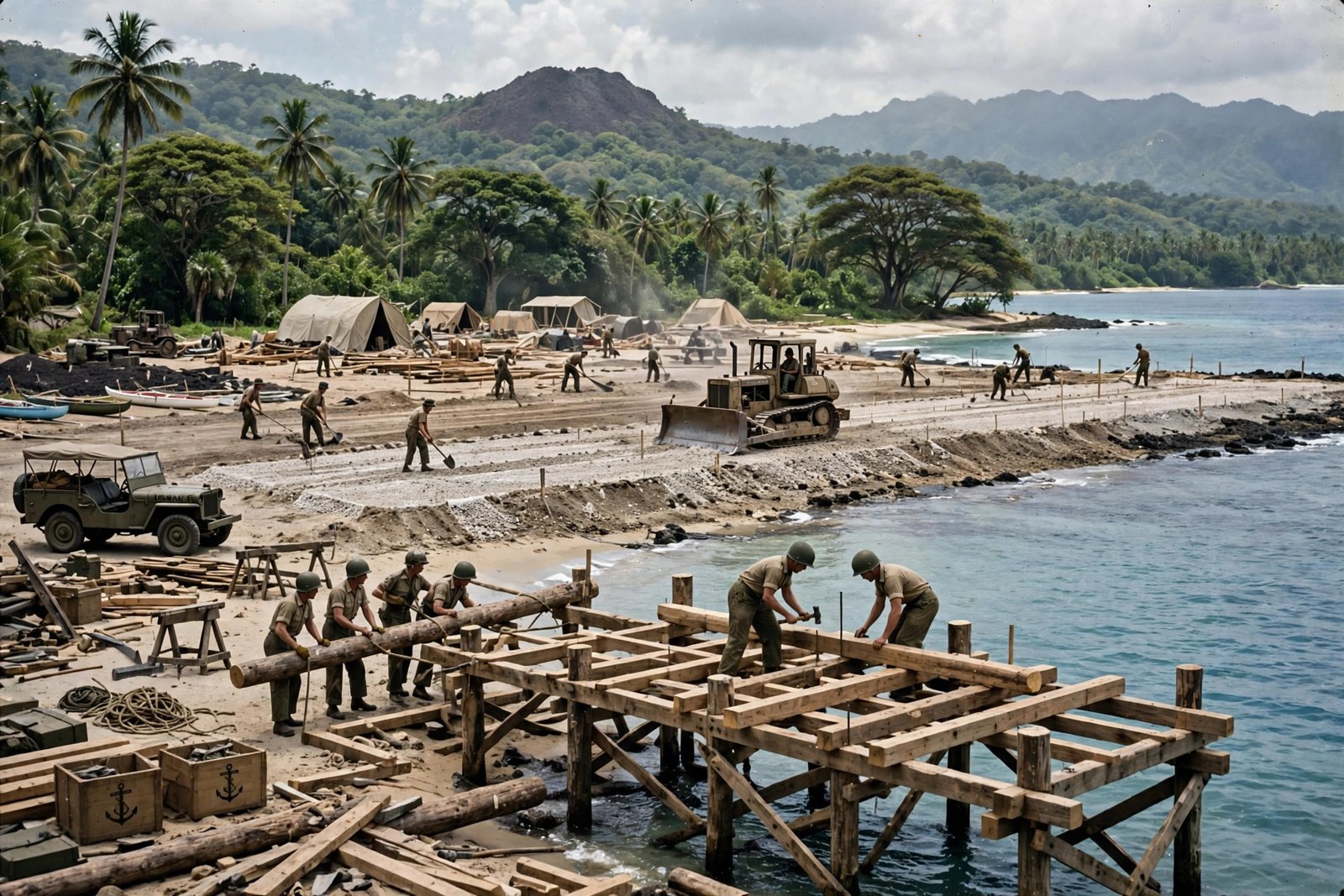
The US Navy Seabees stories that have lasted for more than eighty years all begin with the same unlikely idea: send skilled builders into a war zone and ask them to build while under fire. Carpenters, electricians, welders, mechanics, and heavy-equipment operators traded their civilian tool belts for Navy uniforms, and then went to work on islands, beaches, and deserts where there was often no safe place to build at all. Their official motto, Construimus, Batuimus, means We Build, We Fight, and it was not a slogan for a poster. It was a job description.
What makes these builders so memorable is not one famous battle. It is the pattern that repeats across generations: a runway appears where there was only jungle the week before, a hospital rises from coral and canvas, a road opens through mud that stopped everyone else, and a small team stays behind to keep it all working. The Seabees, whose name comes from the initials CB for Construction Battalion, became one of the most respected and most depended-upon forces in the United States Navy. This guide looks at how they began, where they served, what daily life was like, and why their work still matters today.
How the Seabees Were Born
Before World War II, the United States Navy relied heavily on civilian contractors to build bases overseas. That system worked in peacetime, but it broke down quickly once war began. Under international law at the time, civilian workers captured by an enemy could face harsh treatment, and they were not trained or armed to defend themselves. After the attack on Pearl Harbor on December 7, 1941, the need for a new solution became urgent. The Navy needed builders who were also sailors, men who could pick up a rifle when they had to and return to a bulldozer as soon as the shooting stopped.
The answer came in early 1942, when Rear Admiral Ben Moreell, the Navy’s chief of civil engineering, proposed the creation of Naval Construction Battalions. The first battalions were formed from experienced tradesmen, many of them older than the average recruit and already skilled in their crafts. They were given basic military training, but their real value was what they already knew how to do. A man who had built bridges in civilian life did not need to be taught how to pour concrete. He needed to learn how to do it quickly, in difficult conditions, and sometimes while the work itself was a target.
The Seabees adopted the bee as their symbol, a fitting choice for a force known for hard work, teamwork, and a sting when provoked. Their early training took place at camps in the United States, where they learned to build airfields, roads, camps, fuel storage, and port facilities from whatever materials were available. Speed mattered as much as skill. In the Pacific, the difference between an airfield finished in days rather than weeks could decide whether aircraft could support the next landing, and whether wounded sailors and Marines could be evacuated in time.
US Navy Seabees Stories From the Pacific Islands
Some of the most powerful US Navy Seabees stories come from the Pacific theater, where island-hopping placed enormous demands on engineers. Each new island had to become a base almost overnight. There were no existing roads, no warehouses, and often no fresh water system. Seabees landed with the assault forces, sometimes on the same beaches, and began clearing ground while fighting was still going on nearby. They built airstrips out of crushed coral, laid steel matting over mud, and turned jungle clearings into places where planes could land, refuel, and take off again.
At Guadalcanal, one of the first major campaigns, Seabees helped repair and expand Henderson Field, a vital airstrip that allowed American aircraft to challenge Japanese air power in the Solomon Islands. The work was done under frequent air attack and with limited equipment. Runways were patched, lengthened, and kept in service through rain, mud, and bombardment. Without that field, the campaign would have been far harder to sustain. Similar work followed across the Pacific, from the Gilberts and Marshalls to the Marianas, where new bases supported the long advance toward Japan.
Another part of the Pacific story is less often told, but just as important: building the ports, hospitals, and supply depots that kept whole fleets moving. Ships needed fuel, ammunition, food, and repair facilities, and none of those things existed on a remote atoll until someone built them. Seabees constructed docks, fuel farms, warehouses, and water systems, often using prefabricated parts and improvised methods. Their work allowed the Navy to operate far from home for months at a time, and it gave Marines and soldiers a place to rest, recover, and prepare for the next operation.
Building Under Fire at Guadalcanal and Beyond
Building under fire is a phrase that sounds dramatic until you consider what it actually required. A construction crew cannot simply stop when an air raid begins and then pick up exactly where it left off. Concrete sets, trenches fill with water, and a half-finished runway is of little use to anyone. Seabees learned to work in shifts, to protect equipment, to camouflage sites, and to repair damage as soon as it happened. They also learned to defend their own positions, manning weapons and standing watch alongside combat troops.
The famous image of a Seabee holding both a rifle and a tool captures this dual role well. These men were not combat infantry by training, but they were expected to fight when their work site was attacked. That expectation shaped their culture. Pride came not only from finishing a project, but from finishing it on time, under pressure, and without leaving a job half done because conditions were difficult. Many veterans later said that the hardest part was not the danger alone, but the combination of danger, exhaustion, heat, disease, and the constant knowledge that other lives depended on their work being finished.
The same spirit carried into later campaigns in Europe. Seabees helped prepare for amphibious landings by building pontoon causeways, floating roadways, and other structures that allowed vehicles and supplies to move from ships to shore. At Normandy, these efforts supported the massive D-Day landings in June 1944. The work was technical, dangerous, and largely invisible to the public, which is one reason Seabee history is sometimes overlooked. Yet without causeways, piers, and beach facilities, even the best-planned landing could stall at the waterline.
US Navy Seabees Stories From D-Day to Korea and Vietnam
Later US Navy Seabees stories show the same force adapting to very different wars. In Korea, Seabees supported amphibious operations, including the landing at Inchon in 1950, and built airfields, bridges, and camps in harsh weather and rugged terrain. In Vietnam, they built roads, airfields, hospitals, and base camps, often in remote areas where supply lines were fragile. They also took part in civic action projects, building schools, clinics, wells, and other facilities for local communities, work that reflected a broader understanding of what construction could do in a conflict zone.
One of the most important lessons from Vietnam was the value of small, mobile teams. Seabee Teams, small detachments sent to work closely with local communities and military units, became a hallmark of that era. These teams combined building skills with medical support and community outreach, showing that a construction battalion could do more than pour concrete. That model has influenced later humanitarian and disaster-relief missions, where the ability to arrive quickly, assess needs, and build something useful is often more valuable than heavy equipment alone.
Readers who enjoy true military history may also want to explore other stories of service and sacrifice on this site, including the Green Berets and the Navajo Code Talkers, whose courage changed the course of campaigns in very different ways. Like the Seabees, these service members remind us that victory often depends on skills that do not make headlines, from language and intelligence to engineering and sheer endurance.
The Can Do Spirit in Modern Missions
In recent decades, Seabees have continued to serve in Iraq, Afghanistan, and in disaster-relief operations around the world. Their tasks have included building forward operating bases, repairing infrastructure, clearing debris after hurricanes and earthquakes, and providing clean water and power in places where both were scarce. The phrase Can Do, long associated with the Seabees, describes an attitude as much as a capability: find a way, use what you have, and keep going until the job is done.
Modern Seabee work also reflects changes in technology. Today’s battalions use advanced surveying tools, heavy machinery, and modular construction methods that would have seemed like science fiction to the first battalions in 1942. What has not changed is the basic challenge. Construction in a deployed environment still means working with limited supplies, difficult ground, tight deadlines, and real risk. It still requires teamwork, because no single trade can build a base alone. Carpenters, electricians, plumbers, equipment operators, and builders must coordinate every step, just as they did on Pacific islands eighty years ago.
Humanitarian missions deserve special attention, because they show a side of military service that the public rarely sees. After major storms, Seabees have helped clear roads, restore power systems, repair schools, and rebuild community facilities. After earthquakes, they have helped set up shelters and medical sites. This work does not involve combat, but it demands the same speed and resourcefulness. For families returning to a damaged town, a repaired bridge or a working water pump can matter more than any speech about recovery.
What Life Was Like for a Seabee
Daily life for a Seabee was often a mix of hard physical labor, long hours, and close friendship. Work began early and continued in heat, rain, dust, or cold, depending on the deployment. Meals were simple, sleep was often interrupted, and mail from home was treasured. Yet veterans frequently describe their battalions as families. Men who had come from different states, backgrounds, and trades learned to depend on each other completely, because a mistake on a job site could injure a friend, and a delay could endanger a whole unit.
Many Seabees were older than other recruits when they joined, and they brought civilian experience with them. That experience gave battalions a practical, problem-solving culture. If a part was missing, someone figured out how to make it. If a plan did not fit the ground, someone redrew it on the spot. Officers and enlisted builders often worked side by side, and respect was earned by skill and reliability rather than rank alone. That culture helped explain why Seabee units could improvise so effectively, and why so many veterans went on to successful careers in construction, engineering, and public service after the war.
The story of the Tuskegee Airmen offers a useful parallel here. Like the Seabees, the Tuskegee Airmen had to prove themselves against low expectations, and they did so through skill, discipline, and results. Their achievements, and those of the Seabees, remind readers that American military history is full of units whose excellence was built quietly, project by project and mission by mission, long before the public fully recognized it.
Why These Stories Still Matter
- They show how wars are really won: battles matter, but so do runways, ports, hospitals, and supply lines.
- They honor skilled trades: carpenters, welders, and mechanics were as essential as pilots and riflemen.
- They teach resilience: the best response to a shortage or a setback was to improvise and keep building.
- They connect to today: disaster relief, infrastructure repair, and humanitarian construction still need the same skills.
There is also a personal lesson in Seabee history that applies far beyond the military. Most of us will never build an airfield under fire, but we all face projects that seem impossible with the time and materials available. The Seabee answer was never to wait for perfect conditions. It was to start, to adapt, to ask for help from people with different skills, and to keep working until something useful stood where nothing had stood before. That mindset is worth remembering in any career, community project, or family challenge.
Today, the legacy of the Seabees is preserved at the U.S. Navy Seabee Museum in Port Hueneme, California, and in memorials, reunions, and family stories across the country. Veterans groups, museums, and historians continue to collect photographs, letters, and oral histories, because many of the most vivid details live in personal memory rather than official reports. If your family includes a Seabee veteran, recording his or her story, even in simple form, is one of the best ways to keep this history alive for the next generation.
If these stories moved you, take a moment to share this article with someone who loves American history, a veteran, or a young person considering a trade. Explore more true stories of service on ENG Post, leave a comment about a builder or veteran in your own family, and remember the simple motto that carried so many through the hardest jobs: we build, we fight, and we finish what we start.