
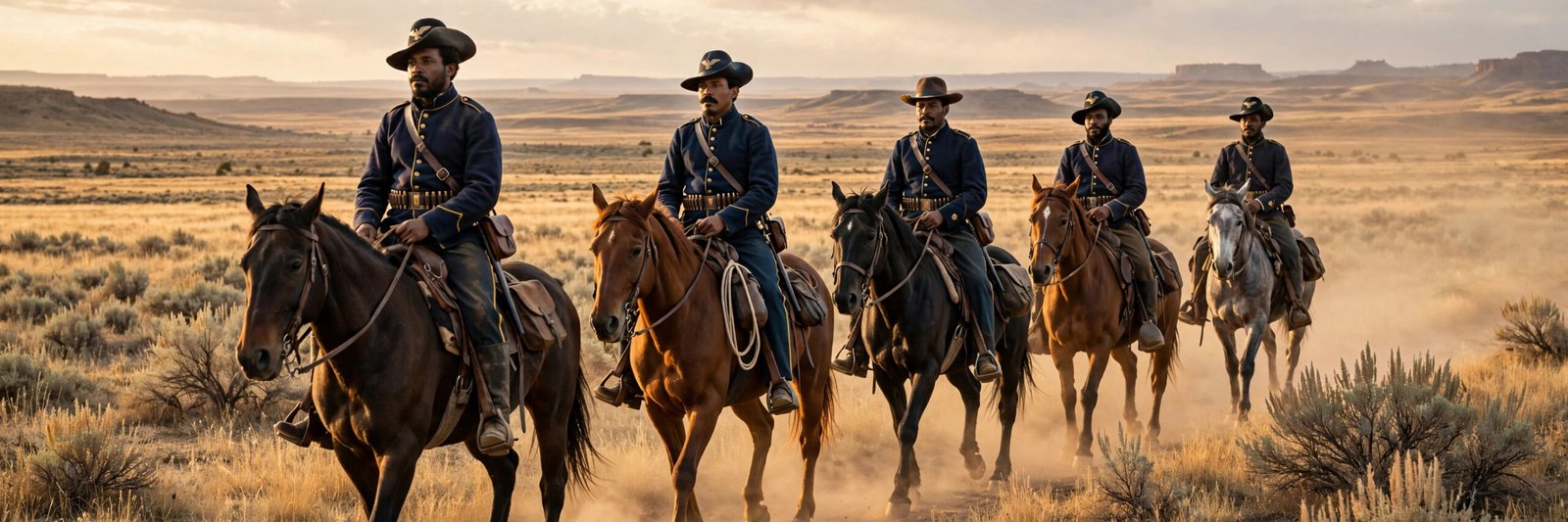
They rode out of the most turbulent chapter in American history as free men in blue uniforms, trading the chains of slavery for the weight of a cavalry carbine. The buffalo soldiers true story begins in the summer of 1866, when a war-weary nation asked its newest citizens to do one of the hardest jobs on earth: bring order to the western frontier. What followed was one of the most remarkable records of courage, discipline, and endurance in American military history — the story of men who served a country that had only just begun to recognize their humanity, and who earned a legendary name along the way.
Most Americans have heard the name Buffalo Soldiers, often from the famous song, but fewer know the real men behind it. These were not characters from a novel. They were flesh-and-blood soldiers — former slaves, freedmen, and free Black men from the North — who volunteered for grueling service in some of the most unforgiving country on the continent. Their regiments compiled one of the finest service records of the frontier era, and the buffalo soldiers true story deserves to be told with the facts it earned.
Who Were the Buffalo Soldiers?
In July 1866, Congress passed the Army Reorganization Act, which authorized the creation of six regiments of Black enlisted men to serve in the regular peacetime Army: the 9th and 10th Cavalry and the 38th, 39th, 40th, and 41st Infantry. Three years later, in 1869, the four infantry regiments were consolidated into two — the 24th and 25th Infantry. These four regiments — the 9th and 10th Cavalry and the 24th and 25th Infantry — are the units history remembers as the Buffalo Soldiers.
The men who filled the ranks were, in many cases, veterans of the Civil War who had fought in the United States Colored Troops. Others were men born into slavery who saw the Army as a path to steady pay, dignity, and a new life. They enlisted for five-year terms at a time when the pay was thirteen dollars a month, the rations were plain, and the posting was often hundreds of miles from anything resembling civilization. Despite the hardship, the regiments had no trouble finding volunteers, and their reenlistment rates were among the highest in the Army — a quiet testimony to the pride these men took in the uniform.
The 10th Cavalry was organized at Fort Leavenworth, Kansas, under Colonel Benjamin Grierson, a Civil War cavalry officer who believed deeply in the capabilities of his men and defended them against prejudice throughout his career. The 9th Cavalry was organized in New Orleans, Louisiana. From the start, the enlisted ranks were Black while nearly all of the officers were white, a reflection of the era. That would slowly change — most famously with officers like Henry Ossian Flipper, the first Black graduate of the United States Military Academy at West Point, who was commissioned in 1877 and served with the 10th Cavalry, and Charles Young, the third Black West Point graduate, who would rise to become the highest-ranking Black officer in the Army of his generation.
It is worth noting that a woman also served among these ranks. Cathay Williams, born into slavery, disguised herself as a man and enlisted in the 38th Infantry — one of the regiments later consolidated into the 24th — making her the first documented Black woman to serve in the United States Army. Her story is a reminder that the buffalo soldiers true story includes figures history nearly forgot, and that courage in these regiments wore many faces.
How the Buffalo Soldiers Got Their Name
One of the most common questions about these regiments is also one of the hardest to answer with certainty: where did the name Buffalo Soldiers come from? The honest answer is that historians still debate it, and no single origin has ever been proven beyond doubt. What follows are the explanations most often given, and each of them says something about how these soldiers were seen.
The most widely repeated account holds that Native American tribes of the Plains — the Cheyenne are most often named — gave the Black cavalrymen the name. According to this telling, the tribes compared the soldiers’ dark, curly hair to the fur of the buffalo, an animal they revered. In this version of the story, the name was a mark of respect: the buffalo was sacred, powerful, and brave, and calling the soldiers after it was an honor.
Another explanation points to the buffalo-hide coats the soldiers wore during the brutal Plains winters. A third suggests the name came from the soldiers’ reputation in battle — that, like the buffalo, they fought fiercely and refused to back down. Whatever the true source, the soldiers themselves embraced the name. They wore it with pride, and it became one of the most storied nicknames in American military history.
The uncertainty around the name is a good lesson in how frontier history works: much of it was never written down at the time, and legends grew in the gaps. When you read a confident claim about the nickname’s origin, remember that the careful version is that the origin is debated — and that the respect the name carried is not debated at all.
Life on the Western Frontier
For roughly twenty-five years, the Buffalo Soldiers were the backbone of the Army’s presence in the West. They were posted to some of the most remote and punishing country in America: the deserts and mountains of Texas, New Mexico, and Arizona; the plains of Kansas; and the northern reaches of the Dakotas and Montana. Their duties went far beyond fighting. They built forts, roads, and telegraph lines. They strung wire across empty country. They escorted wagon trains, guarded mail routes, protected settlers and railroad crews, and mapped vast stretches of territory that had never been properly surveyed.
The conditions were brutal. Soldiers rode for weeks through desert heat and winter blizzards, often on broken-down horses, eating hardtack and salt pork, drinking alkaline water, and sleeping on the ground. Their equipment was frequently secondhand — cast-off gear passed down from white regiments. Their pay was low, their promotions were slow, and they faced open racism from some of the very settlers they were assigned to protect, as well as from some fellow soldiers. Yet the Buffalo Soldiers compiled one of the finest disciplinary records in the frontier Army. Their desertion rates were low, their reenlistment rates were high, and their commanders consistently praised their steadiness under fire.
They saw real combat, too. The 9th and 10th Cavalry fought in campaigns against the Apache, Comanche, Kiowa, and Cheyenne, serving under commanders in some of the most famous — and most tragic — conflicts of the Indian Wars. The 10th Cavalry served in the Southwest during the long campaigns against the Apache. The 9th Cavalry ranged across Texas and New Mexico. These were grinding, dangerous campaigns fought in terrible terrain against skilled and determined opponents, and they demanded exactly the qualities the Buffalo Soldiers possessed: endurance, discipline, and nerve.
There is a quieter part of the buffalo soldiers true story that deserves attention as well. These regiments were also nation-builders. The forts they raised, the roads they cut, and the maps they drew became the infrastructure of the American West. Long after the last shots of the Indian Wars faded, the work of their hands remained in the ground itself.
A Buffalo Soldiers True Story From the Spanish-American War
If the frontier made the Buffalo Soldiers, Cuba made them famous. When the United States went to war with Spain in 1898, the 9th and 10th Cavalry and the 24th and 25th Infantry shipped out to fight in what became known as the Spanish-American War — and their conduct in Cuba became one of the most celebrated chapters of the buffalo soldiers true story.
The regiments landed in Cuba in the suffocating heat of a Caribbean summer, part of the American expeditionary force sent to drive Spain from the island. They were thrown into some of the heaviest fighting of the war, including the battles around Santiago. At Kettle Hill and San Juan Hill in July 1898, the 10th Cavalry fought alongside Theodore Roosevelt’s Rough Riders, the volunteer cavalry regiment that would make Roosevelt a national hero. The Black regulars of the 9th and 10th fought with distinction in the uphill assaults, taking ground under heavy Spanish fire.
The conditions in Cuba were as deadly as the enemy. Tropical disease — yellow fever, malaria, dysentery — ravaged the American force, killing far more men than Spanish bullets did. The Buffalo Soldiers endured the same fevers and the same shortages of food and medicine as everyone else, and they kept fighting. Their officers’ after-action reports praised their courage in terms that left no room for the prejudice of the era: these men had stood their ground and advanced when ordered, and the nation owed them a debt.
The war also produced one of the era’s notable ironies. The same nation that sent Black soldiers to liberate Cuba from Spanish colonial rule still denied those soldiers full equality at home. The Buffalo Soldiers returned from Cuba as heroes and went back to segregated barracks. That contradiction — valor abroad, injustice at home — would follow Black American servicemen through two world wars, and it is part of why their story still resonates today. For more on how later generations of Black soldiers carried that same torch, read about the Tuskegee Airmen, whose true story of courage in World War II echoes the Buffalo Soldiers’ own.
Medal of Honor Heroes
The United States military’s highest decoration for valor is the Medal of Honor, and the Buffalo Soldiers earned it the hard way. More than two dozen Medals of Honor were awarded to soldiers of the 9th and 10th Cavalry and the 24th and 25th Infantry across the Indian Wars and the Spanish-American War — a remarkable total that speaks to the regiments’ long record of extraordinary service.
Among the recipients was Sergeant Emanuel Stance of the 9th Cavalry, who earned the Medal of Honor for his actions against the Kickapoo in Texas in 1870, making him one of the earliest Black soldiers to receive the nation’s highest award for combat valor. Others earned the medal in the grinding frontier campaigns of the 1870s and 1880s and in the Cuban fighting of 1898. Each citation tells its own story of a soldier who, in the chaos of battle, did something beyond what duty required — rescuing comrades under fire, holding a position against overwhelming odds, or leading a charge when the outcome was anything but certain.
It is important to be honest about the record, too. For decades, the heroism of Black soldiers was under-recognized by a military establishment shaped by the prejudices of its time. Some acts of valor that would have brought white soldiers instant acclaim went unrewarded, or were rewarded only after long delays. The medals the Buffalo Soldiers did receive, therefore, represent only part of the courage these regiments actually displayed. The full measure of their bravery lives in regimental histories, in pension records, and in the family stories passed down through generations.
The tradition of distinguished Black military service did not end with the frontier. Decades later, another group of Black soldiers would earn everlasting fame for their courage under fire — the Navajo Code Talkers, whose true story of service in the Pacific shows the same devotion to duty that defined the Buffalo Soldiers.
The Buffalo Soldiers True Story Lives On: Legacy and Honor
The Buffalo Soldiers’ era as frontier regiments eventually came to an end. The 9th and 10th Cavalry were deactivated during World War II, in 1944, as the horse cavalry gave way to mechanized warfare. But the legacy of these regiments outlived their colors. In 1948, President Harry S. Truman signed Executive Order 9981, ordering the desegregation of the United States Armed Forces — a milestone on the road to the equality the Buffalo Soldiers had earned in blood but never fully received in life.
Today, their memory is honored in stone and ceremony. A monument to the Buffalo Soldiers stands at Fort Leavenworth, Kansas, where the 10th Cavalry was born. The Charles Young Buffalo Soldiers National Monument in Wilberforce, Ohio, preserves the home of Colonel Charles Young and tells the broader story of the regiments. Reenactors and historical societies keep the uniforms, the drills, and the stories alive at events across the country, and the Buffalo Soldiers’ tale is taught in classrooms as an essential chapter of the American West.
The name has entered American culture in ways the original troopers could never have imagined — most famously in music — but the real legacy is simpler and more profound. The Buffalo Soldiers proved, in the hardest school imaginable, that courage has no color. They served with honor when honor was not returned. They built the West with their hands and defended it with their lives. And they did it all while carrying a name given to them by their adversaries, wearing it not as an insult but as a badge of pride.
That is the heart of the buffalo soldiers true story: not myth, not legend, but the documented record of ordinary men who did extraordinary things. Their regiments stood the test of desert, mountain, and battlefield, and their example still challenges America to live up to the ideals they served. To place their service in the longer sweep of the nation’s military history, you might also explore the true story of the Battle of Gettysburg — the great Civil War clash that, just a few years before the Buffalo Soldiers’ regiments were formed, set the stage for the freedom they would defend.
Remembering Their Courage
The next time you hear the name Buffalo Soldiers, think past the song and picture the reality: young men riding out of Fort Leavenworth into an unknown West, building forts with their hands, standing their ground at San Juan Hill, and coming home to a country that was still learning how to thank them. Their story is one of the bravest chapters in American history — and it is true.
If these stories of courage move you, keep exploring. ENG Post brings you more real accounts of American bravery every day, from the frontier to the modern battlefield. Share this article with someone who loves history, and join the conversation about the heroes America should never forget.