
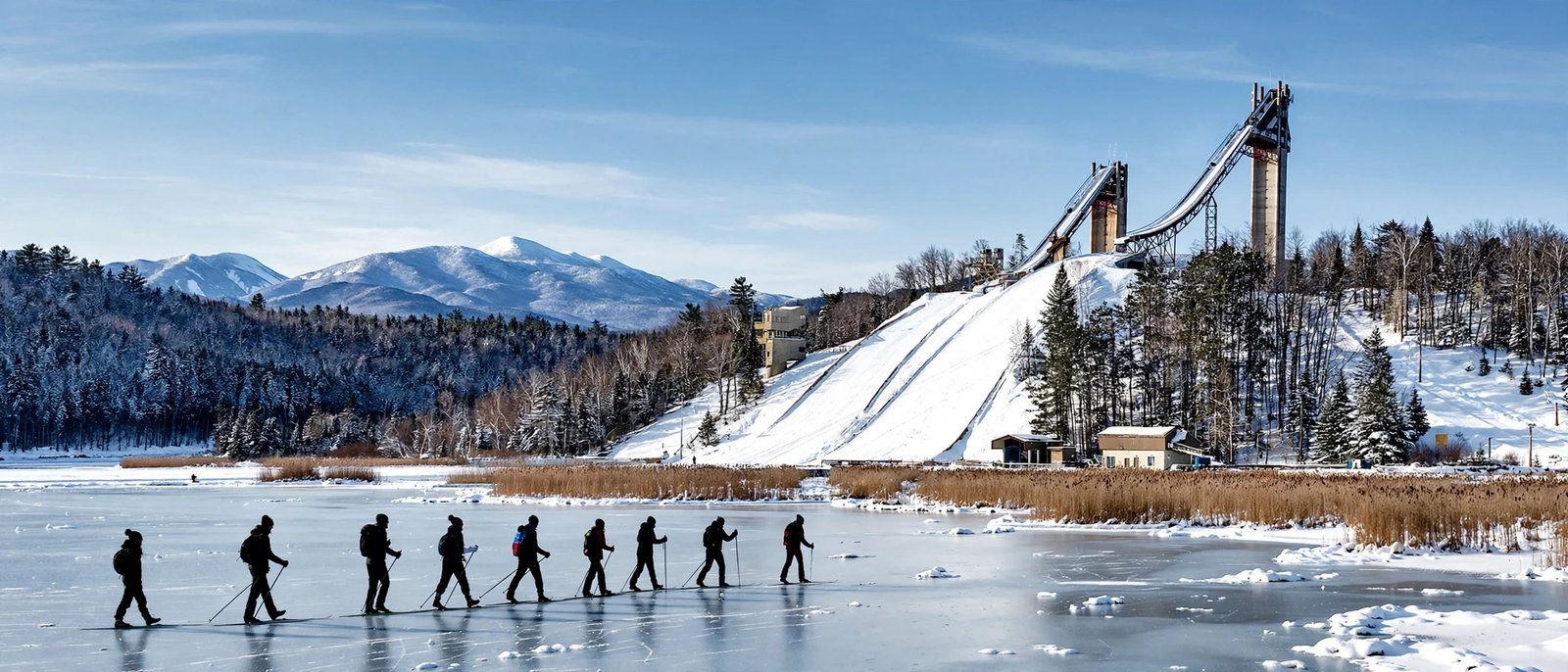
Could the Olympic flame return to the Empire State? The conversation around a possible New York 2042 Winter Olympics bid has moved from daydream to serious study — and it is one of the most intriguing sports stories developing in America right now. In June 2026, New York Governor Kathy Hochul announced the creation of an 88-member exploratory committee tasked with evaluating whether New York City and Lake Placid could — and should — pursue the 2042 Winter Olympic Games. This is not a bid. It is not a promise. It is an exploration: a careful, official look at what it would take for New York to chase the world’s biggest winter sporting event.
The idea carries a certain magic. Lake Placid, the tiny Adirondack village that hosted the Winter Games in 1932 and again in 1980 — the “Miracle on Ice” Games — could once again welcome the world. New York City, which has never hosted the Olympics in any season, could finally join the club. But between the dream and the reality lies a long road of studies, decisions, and international competition. Here is what is actually happening, what is verified, and what remains unknown.
What Is Happening With the New York 2042 Winter Olympics Bid?
Let us start with the facts that are on the record. In June 2026, Governor Kathy Hochul announced an 88-member exploratory committee to evaluate the possibility of bringing the 2042 Winter Olympics to New York. The concept pairs New York City with Lake Placid — the metropolis providing the global stage and the Adirondack village providing the mountain venues and winter sports heritage.
The committee held its first meeting on Monday, October 19, 2026. That is how recent this story is: the formal evaluation process has only just begun. An exploratory committee’s job is to ask hard questions before anyone commits to anything. Can the venues work? What would the costs look like? What does the public think? What would the International Olympic Committee require? These are the questions the committee exists to study — and the answers are not in yet.
It is essential to frame this correctly: nothing has been decided. This exploratory effort is, at this stage, an exploration of a possibility — not a plan. There is no formal bid, no submission to the IOC, and no guarantee the Games would come to New York even if a bid were eventually filed. Anyone telling you the 2042 Games are “coming to New York” is getting ahead of the facts. What is real is the process — and the process has started.
Lake Placid: The Village That Made Olympic History Twice
If there is a heart to this story, it beats in Lake Placid. This small village in New York’s Adirondack Mountains has hosted the Winter Olympics twice: first in 1932, and then in 1980. The 1980 Games are the stuff of legend — the “Miracle on Ice,” when the underdog United States men’s hockey team defeated the mighty Soviet squad in one of the most famous upsets in sports history. Ask any American sports fan of a certain age where they were that night, and they will tell you.
Lake Placid’s Olympic credentials did not end in 1980. The village has continued to host international winter sports competitions in the decades since, keeping its facilities and its traditions alive. The ski jumps, the bobsled track, the speed skating oval — these are not museum pieces but living venues. That continuity is rare among former Olympic hosts and is one of the genuine assets any New York winter bid would bring to the table.
There is something poetic about the idea of the Games returning to the site of the Miracle on Ice more than sixty years later. Olympic bids often lean on emotion, and few places in winter sports can match Lake Placid’s emotional resume. But sentiment alone does not win bids — the modern Winter Olympics are vastly larger and more complex than the Games of 1932 or even 1980, and any bid would have to show how a village of a few thousand people could anchor an event built for the twenty-first century. That is presumably where New York City enters the picture.
Why a New York 2042 Winter Olympics Bid Is Being Explored
So why is New York doing this now? The honest answer is that we know the process has begun, but the full reasoning will emerge as the committee does its work. Still, some of the likely motivations are easy to see. The Olympic movement has been encouraging bids that reuse existing venues rather than building everything from scratch — a shift meant to control costs and avoid the infamous “white elephant” stadiums of past Games. A New York bid built around Lake Placid’s existing winter sports infrastructure fits that philosophy naturally.
There is also the matter of timing and precedent. The upcoming Winter Games are already spoken for: the 2030 Winter Olympics are awarded to the French Alps, and the 2034 Games are set for Salt Lake City, Utah. That makes 2042 the next realistic opening on the calendar — far enough away to plan properly, close enough to work toward. Exploratory committees think in these long horizons because Olympic bids do; the decision about 2042 will be made years before the torch is lit.
And then there is the simple power of the New York brand. New York City is the media capital of the world, a global tourism magnet, and a city that stages massive events routinely. Pairing that with Lake Placid’s winter sports soul creates a narrative no other American bid could easily match: the biggest city in America meets the most storied winter sports village in America. Whether that narrative can become a workable plan is exactly what the committee is studying.
How Olympic Host Selection Actually Works
Understanding this exploration requires understanding how Olympic hosts are chosen these days. The old system — cities spending fortunes on lavish bid campaigns, followed by a dramatic IOC vote — has been replaced by a quieter, more continuous process. The International Olympic Committee now works through ongoing dialogue with interested regions, studying feasibility over time rather than staging winner-take-all contests.
In practical terms, this means there is no single “bid deadline” moment to watch for in the headlines. Instead, regions express interest, engage with the IOC’s future host commission, develop their concepts, and eventually the IOC may enter what it calls “targeted dialogue” with a preferred candidate. It is a slower, less theatrical process — which is precisely why an exploratory committee formed in 2026 makes sense for Games sixteen years away. The timeline is long by design.
What this also means is that New York would not be bidding in a vacuum. Other regions around the world may be exploring 2042 as well, and the IOC weighs factors like venue plans, climate reliability, public support, and legacy. None of those evaluations have happened yet for New York. The committee’s work is step one of a very long staircase.
What We Know — and What We Do Not Know
In a story this early, separating fact from speculation matters. Here is an honest accounting:
- Verified: Governor Kathy Hochul announced an 88-member exploratory committee in June 2026 to evaluate a New York City and Lake Placid bid for the 2042 Winter Olympics.
- Verified: The committee held its first meeting on Monday, October 19, 2026.
- Verified: Lake Placid hosted the Winter Olympics in 1932 and 1980, the latter famous for the “Miracle on Ice.”
- Verified: The 2030 Winter Games are awarded to the French Alps and the 2034 Games to Salt Lake City.
- Verified: New York City has never hosted the Olympic Games.
- Not yet known: Whether the committee will recommend pursuing a bid at all.
- Not yet known: What the venues, costs, or timelines would look like — no official figures have been released.
- Not yet known: How the public feels — no official polling tied to this effort has been published.
If you see specific cost estimates, venue lists, or poll numbers attached to this story, treat them with skepticism unless they come from the committee or the governor’s office. At this stage, the only authoritative sources are the official announcements — and those announcements describe an exploration, not a plan.
Could New York Actually Host? The Big Questions
Even without official details, it is fair to ask what a New York winter bid would need to solve. Geography is the first puzzle. Lake Placid sits in the Adirondacks, roughly a five-hour drive from New York City. Modern Olympics have stretched across regions before, but connecting a global metropolis with a mountain village would require serious thinking about transportation, athlete villages, and logistics.
Winter conditions are the second question. The Adirondacks get real winter — that much is certain — but the Winter Olympics demand reliable snow and cold across a multi-week window, and climate trends have made winter reliability a live issue for every potential host worldwide. Any serious bid would need to address this head-on.
Then there is the question of public support. Recent Olympic bids around the world have lived or died on whether local residents actually want the Games. Costs, disruption, and legacy are debated fiercely wherever bids are proposed. New York’s committee will have to gauge that sentiment honestly — and history suggests New Yorkers will have opinions. The fact that the effort is starting with study rather than salesmanship is, in itself, a promising sign.
Finally, there is competition. Salt Lake City’s successful path to 2034 showed that American winter bids can win, but it also means the United States would be asking the Olympic movement to return to America relatively soon. How the IOC weighs that is anyone’s guess — and it is the kind of strategic question an 88-member committee exists to chew on.
New York’s Big-Event Track Record
One thing New York does not lack is experience with the world’s biggest stages. The New York area is about to host the final of the 2026 FIFA World Cup at MetLife Stadium — the single most-watched sporting event on the planet. The city stages the US Open tennis championship, the New York City Marathon, and countless global summits and spectacles every year. If there is a city on earth that knows how to move millions of people and point cameras at them, it is this one.
That track record cuts both ways, of course. New Yorkers have also seen what mega-events cost in disruption, and the city’s infrastructure — its airports, its transit, its hotels — would face an Olympic-scale stress test. But the raw capability is undeniable. For more on the soccer spectacle heading to the region, see our look at World Cup 2026 viral moments to expect in the USA.
What Happens Next
The committee has just begun its work, so the near-term story is one of meetings, studies, and deliberation — not the stuff of highlight reels, but the necessary foundation of anything real. Watch for the committee’s findings and recommendations: those will determine whether this exploration becomes an actual bid effort or concludes that the timing is not right.
Beyond that, the timeline stretches years into the future. The IOC’s process for 2042 will unfold gradually, and New York’s posture will evolve with it. For now, the right way to follow this story is with curiosity and patience — and a healthy skepticism toward anyone claiming to know the ending already.
One more note for the travelers dreaming already: the Adirondacks are worth visiting whether or not the Olympics ever come. Lake Placid’s Olympic sites are open to visitors, the Miracle on Ice rink still stands, and the region’s winter landscape is spectacular on its own terms. If you are planning an American road adventure, our Route 66 road trip guide is a great place to start dreaming — and for practical travel considerations, check the safest states in America.
Conclusion: A Dream Worth Studying
This story is, right now, a story about possibility — nothing more, nothing less. An 88-member committee is asking whether the Empire State could bring the Winter Games back to Lake Placid and, for the first time, to New York City. The first meeting has happened. The questions are on the table. The answers will come in time.
There is something admirable about doing this the right way: study first, decide later. Whether the outcome is a historic bid or a polite conclusion that the moment is not right, the process itself is good governance — and good drama. The Miracle on Ice taught the world that the most unforgettable Olympic moments are the ones nobody saw coming. Perhaps, sixteen years from now, the story will come full circle in the Adirondacks.
Want to follow this story as it develops? Bookmark ENG Post and share this article with the sports fans in your life. We will keep covering the road to 2042 — the facts, the milestones, and the moments — as they actually happen.