
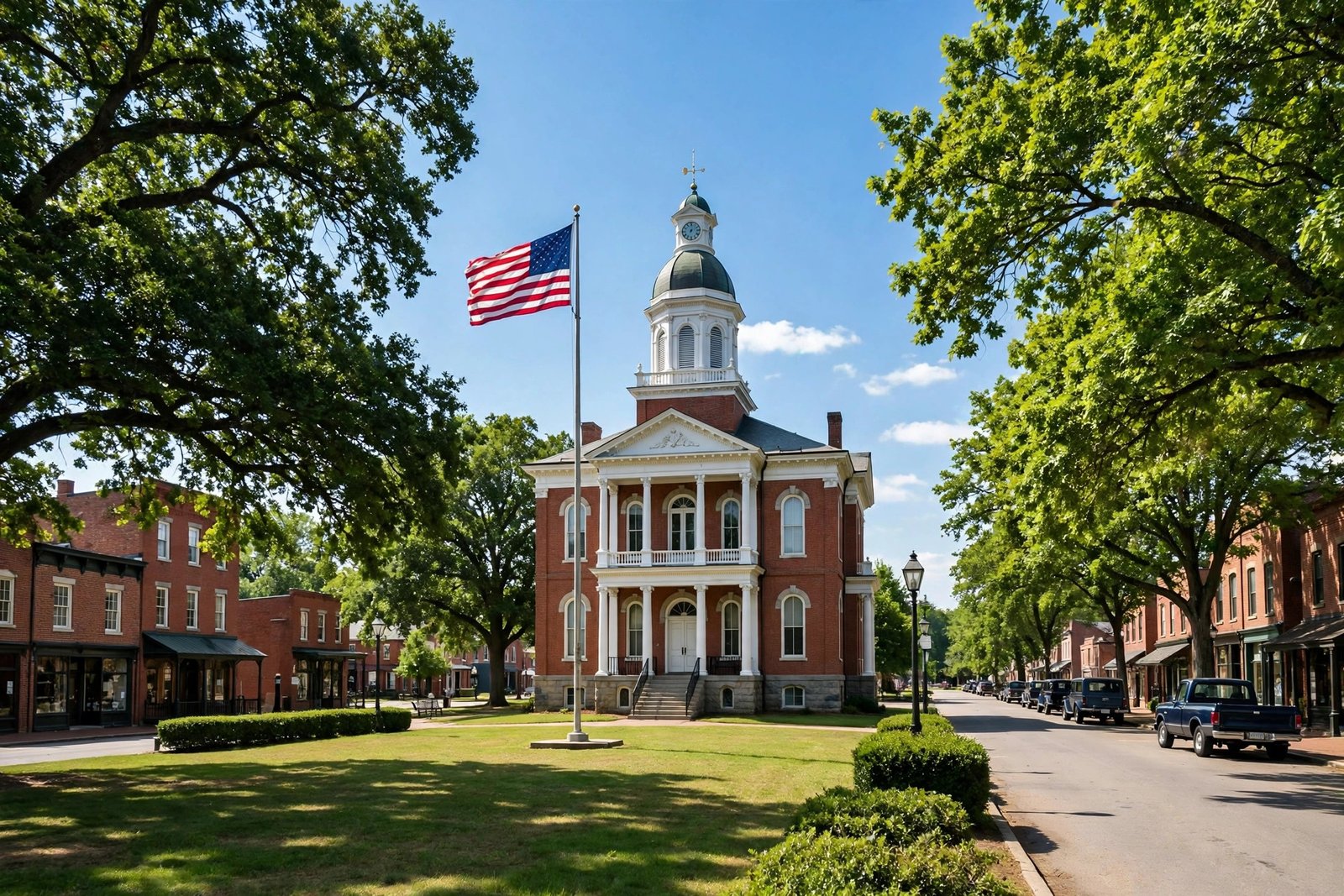
So, how many counties in USA are there? The official answer is 3,143 counties and county equivalents spread across the 50 states and the District of Columbia. That single number surprises a lot of people, because counties are the quiet workhorses of American local government. They run elections, maintain roads, operate courts, and keep the records of everyday life, yet most of us only think about them when we pay property taxes or serve on jury duty.
In this guide, we break down how that count is reached, why the total is not a perfectly round number, and which states have the most and fewest counties. You will also learn what a county equivalent is, how county governments differ from state to state, and a few record-breaking counties worth knowing about.
How Many Counties in USA: The Official Count
The United States Census Bureau counts 3,143 counties and county equivalents in the United States. That total covers the 50 states plus the District of Columbia. It is the figure most reference sources use, and it is the best answer to give when someone asks how many counties in USA exist today.
Why the odd, specific number? Because the United States does not have one uniform county system. Each state organizes its local government differently, and a handful of places are counted as county equivalents even though they do not carry the name county. Louisiana, for example, is divided into parishes rather than counties. Alaska uses boroughs and census areas. Virginia has independent cities that function separately from any county. When you add all of these together, you get 3,143.
It also helps to know what a county actually is. A county is a geographic and political subdivision of a state, created to bring government closer to the people. Counties typically handle law enforcement through a sheriff’s office, local courts, property records, public health services, road maintenance, and elections. In some states, counties are powerful and busy. In others, especially in New England, towns and cities do most of the work and counties play a smaller role.
What Counts as a County Equivalent?
Not every entry in the 3,143 total is called a county, and that is where the count gets interesting. The Census Bureau uses the term county equivalent for places that function like counties even though they have a different name or structure.
- Parishes in Louisiana: Louisiana is divided into 64 parishes, a legacy of its French and Spanish colonial past and its Catholic heritage. A parish does the same work a county does elsewhere.
- Boroughs and census areas in Alaska: Alaska has organized boroughs, similar to counties, plus large census areas in the parts of the state that are not part of any organized borough.
- Independent cities: Virginia has 38 independent cities that are not part of any county, and they are counted as county equivalents. Baltimore in Maryland and St. Louis in Missouri are also independent cities.
- District of Columbia: Washington, D.C. itself is treated as a county equivalent for statistical purposes.
Connecticut is a special case. The state abolished county governments in 1960, but its eight historic counties still exist as geographic divisions used for statistics. More recently, Connecticut replaced those counties with nine planning regions for census purposes. That is a good reminder that the map of American local government is always evolving, even if slowly.
Which States Have the Most and Fewest Counties?
County counts vary wildly from state to state, and the differences usually come down to history and size. Texas leads the nation by a wide margin with 254 counties. When Texas was settled in the 19th century, counties were deliberately kept small so that residents could travel to the county seat and back home in a single day by horseback. The result is a state with more counties than any other, many of them rural and sparsely populated.
Georgia comes in second with 159 counties, another legacy of the horse-and-buggy era, when small counties made government reachable. Virginia follows with 95 counties plus its independent cities. Kentucky has 120 counties, and Missouri has 114 counties plus the independent city of St. Louis.
At the other end of the scale, Delaware has just 3 counties: New Castle, Kent, and Sussex. Hawaii has 5 counties, and Rhode Island has 5 as well. Small states simply never needed many counties, and in New England, strong town governments reduced the need for county government altogether.
Here is a quick look at the extremes:
- Most counties: Texas, with 254
- Second most: Georgia, with 159
- Fewest counties: Delaware, with 3
- Small-state totals: Hawaii and Rhode Island, with 5 each
The Biggest, Smallest, and Most Populous Counties
The range of American counties is enormous. San Bernardino County in California is the largest county by land area in the contiguous United States, covering more than 20,000 square miles. That is larger than several states, including New Jersey, Connecticut, and Delaware. If you want a sense of scale, check out our guide to how many national parks are in the USA — many of them sit inside giant western counties like San Bernardino.
The smallest county by land area is Kalawao County in Hawaii, which covers only about 13 square miles on the island of Molokai. It was historically home to a leprosy settlement, and today it has one of the smallest populations of any county in the country.
Population tells a different story. Los Angeles County in California is the most populous county in the nation, home to roughly 10 million people — more than the populations of most states. Cook County, Illinois, which includes Chicago, is the second most populous, followed by Harris County, Texas, which includes Houston, and Maricopa County, Arizona, which includes Phoenix.
On the other end, the least populous counties are tiny rural places. Loving County in Texas and King County in Texas (not to be confused with King County, Washington, home of Seattle) each have only a few hundred residents. In these counties, the sheriff, the judge, and the county clerk may all know most residents by name.
Why the Number of Counties Changes Over Time
The total of 3,143 is not fixed forever. Counties have been created, merged, and dissolved throughout American history, and the count continues to shift, if only slightly. New counties are rare today, but they do happen. In 2008, for example, voters in part of Fulton County, Georgia, created the city of Milton and later debated new county formations. In Alaska, boroughs continue to organize and change boundaries.
Mergers happen too. When a city and its surrounding county consolidate into a single government, the county may disappear as a separate entity. Louisville and Jefferson County in Kentucky merged in 2003, and Nashville and Davidson County in Tennessee merged decades earlier. In these cases, the county name survives, but the government structure changes.
County boundaries also shift for practical reasons: to correct survey errors, to follow natural features like rivers, or to settle disputes between neighboring counties. The Census Bureau updates its county list regularly, which is why the official count can move by one or two from year to year.
What Do Counties Actually Do?
County government touches everyday life more than most people realize. While the exact responsibilities vary by state, counties commonly handle:
- Law enforcement and courts: The county sheriff’s office patrols unincorporated areas, runs the county jail, and provides court security. County courts handle criminal cases, civil disputes, divorces, and probate matters.
- Records: The county recorder or clerk keeps property deeds, marriage licenses, birth and death records, and business registrations.
- Roads and infrastructure: In rural areas especially, counties maintain roads, bridges, and drainage systems outside city limits.
- Public health and safety: County health departments run clinics, inspect restaurants, manage emergency services, and respond to disease outbreaks.
- Elections: Counties usually administer elections, from registering voters to counting ballots — a responsibility that spans time zones across the country, as our guide to how many time zones the USA has shows.
- Social services: Many counties run programs for seniors, veterans, children, and families in need.
In states where counties are weak, such as much of New England, towns and cities take on many of these roles instead. In the South and West, counties tend to be stronger and more central to daily government.
Counties and American Identity
Counties are also part of American culture. People identify with their county, whether it is a place like Orange County, California, made famous by television, or a rural county where Friday night football is the main event. County fairs, county courthouses, and county sheriffs all feature in the national imagination, and for good reason: for much of American history, the county was the most visible level of government in daily life.
Counties also preserve history. County courthouses hold deeds that trace land ownership back generations. County archives contain the marriage licenses of ancestors and the records of old court cases. For genealogists and local historians, the county is often the first stop.
It is worth remembering that American geography is full of these counting questions. Just as people ask how many counties in USA there are, they also ask about national parks, time zones, and national symbols. If you enjoy these facts, you may like our collection of facts about the US national anthem, another piece of Americana with a story that surprises most readers.
How Many Counties in USA: Finding Your Own County’s Story
Curious about your own county? The easiest way to learn more is to visit your county government’s official website. There you can usually find the county’s founding date, its population, its county seat, and a list of services. The Census Bureau’s website also lets you look up quick facts for any county in the country.
A few questions worth asking about your county:
- When was it founded, and what was it named after?
- What is its county seat, and why was that town chosen?
- How has its population changed over the decades?
- What landmark or historic site is it best known for?
You might be surprised by what you find. Many counties are named after presidents, generals, Native American tribes, or geographic features, and their stories often mirror the larger story of the United States.
Conclusion
So, how many counties in USA are there? The answer is 3,143 counties and county equivalents, from the 254 counties of Texas to the 3 counties of Delaware, from the vast deserts of San Bernardino County to the tiny shores of Kalawao County. Each one is a small piece of the American experiment in local self-government, and together they form the layer of government closest to daily life.
Next time you vote, pay a local fee, or visit a county courthouse, take a moment to appreciate the county system. It may not be glamorous, but it is one of the oldest and most durable parts of American democracy. Share this guide with someone who loves American geography, and explore more USA facts here on ENG Post.