
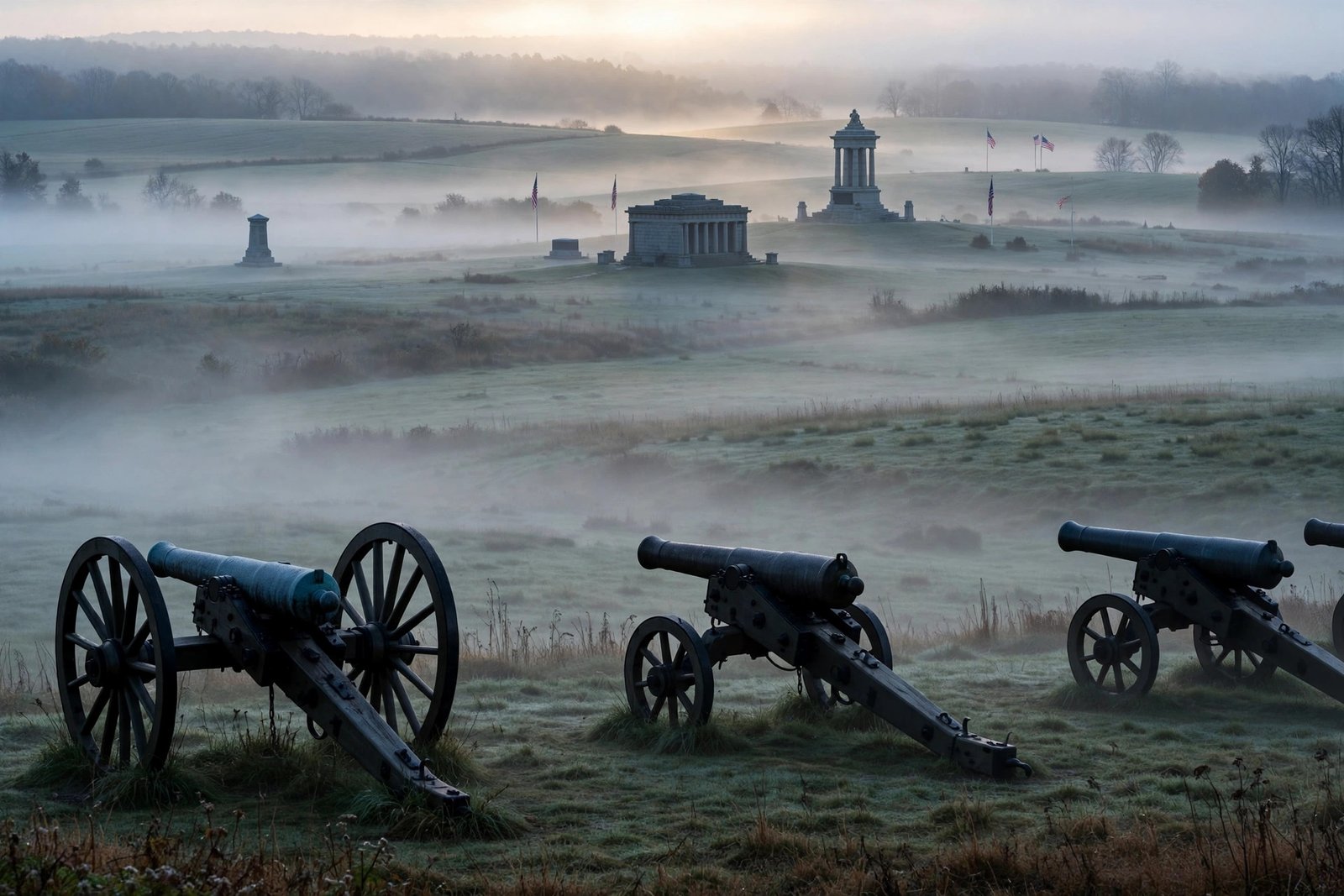
The Gettysburg battle true story is one of the most dramatic in American history: three days of brutal fighting in a small Pennsylvania town that decided the fate of the Civil War. From July 1 to July 3, 1863, the Union Army of the Potomac under Major General George G. Meade and the Confederate Army of Northern Virginia under General Robert E. Lee clashed in what became the bloodiest battle ever fought on American soil. Around 51,000 soldiers were killed, wounded, or missing, and the Confederate defeat marked the turning point of the war.
What makes the Gettysburg battle true story so compelling is that neither army planned to fight there. It was a meeting engagement, a collision neither commander fully intended, that grew into a struggle for high ground, for survival, and ultimately for the future of the United States. Here is what actually happened, day by day, based on the documented historical record.
Gettysburg Battle True Story: Day One (July 1, 1863)
In the summer of 1863, Robert E. Lee took the war to the North for the second time. His Army of Northern Virginia, roughly 71,000 strong, marched through Maryland and into Pennsylvania, hoping to win a decisive victory on Union soil, relieve war-torn Virginia, and pressure the North toward a negotiated peace. The Union Army of the Potomac, about 93,000 men, shadowed him. Just three days before the battle, on June 28, President Lincoln replaced its commander, Joseph Hooker, with Major General George Gordon Meade, a Pennsylvanian who had never commanded an army in battle.
The fighting began almost by accident on the morning of July 1. A Confederate division under Major General Henry Heth, marching east along the Chambersburg Pike toward Gettysburg, ran into dismounted Union cavalry under Brigadier General John Buford holding the ridges west of town. Buford’s troopers, fighting on foot with breech-loading carbines, held off the Confederate advance long enough for Union infantry to arrive.
Major General John Reynolds, commanding the Union I Corps, rode forward to direct the defense and was shot and killed early in the fighting, one of the highest-ranking Union officers to die in the war. His corps, joined by the XI Corps, fought hard along McPherson Ridge and Seminary Ridge through the morning. But by afternoon, Confederate reinforcements, including Lieutenant General Richard Ewell’s corps arriving from the north, overwhelmed the Union line. Outnumbered and outflanked, the Union troops fell back through the streets of Gettysburg to the high ground south of town: Cemetery Hill, Cemetery Ridge, and Culp’s Hill.
That retreat, chaotic as it looked, may have saved the Union army. The high ground the Federals occupied that evening was superb defensive terrain, and Meade, arriving that night, resolved to fight there. Lee, against the advice of his senior lieutenant James Longstreet, who favored maneuvering around the Union flank, decided to attack the position the next day. For more stories of early America, see our account of the lost colonies of America.
Day Two (July 2, 1863): Little Round Top
July 2 was the longest and most desperate day of the battle. Lee ordered Longstreet to assault the Union left flank, while Ewell demonstrated against the Union right. Longstreet’s attack did not get underway until late afternoon, giving Union engineers and reinforcements precious hours to strengthen the line.
The fighting raged across the southern end of the battlefield: through the Peach Orchard, where Union General Daniel Sickles had controversially moved his III Corps forward of the main line against orders; through the bloody Wheatfield, which changed hands multiple times; and through Devil’s Den, a jumble of massive boulders that became a sharpshooters’ nightmare.
The most famous action of the day unfolded on Little Round Top, a rocky hill anchoring the far left of the Union line. Colonel Joshua Lawrence Chamberlain’s 20th Maine Infantry held the extreme flank. When Confederate Alabamians pressed up the slope again and again, the Mainers ran low on ammunition. Rather than retreat and expose the entire army’s flank, Chamberlain ordered a downhill bayonet charge that swept the Confederates off the hill. The stand on Little Round Top became one of the legendary small-unit actions of the war, and it kept the Union left from collapsing.
On the Union right that evening, Ewell’s Confederates stormed Culp’s Hill and East Cemetery Hill in fierce twilight fighting but could not break through. By nightfall, the Union line, though bent, held everywhere. Both armies had suffered terribly, and Lee, convinced the Union center must be weakened after two days of flank attacks, planned a massive frontal assault for July 3.
Gettysburg Battle True Story: Day Three (July 3, 1863)
The third day opened with renewed Confederate attacks on Culp’s Hill at dawn, which the Union defenders repulsed after hours of grinding combat. Then, around midday, the battlefield fell eerily quiet as both sides prepared for what was coming.
At about 1 p.m., some 150 Confederate cannon opened the heaviest artillery bombardment of the war, pounding the Union center on Cemetery Ridge for nearly two hours. Union artillery chief Henry Hunt ordered his guns to go silent to conserve ammunition, a deception that convinced Confederate commanders the Union batteries were destroyed.
Then came Pickett’s Charge. Roughly 12,500 Confederate infantrymen, including the divisions of George Pickett, James Pettigrew, and Isaac Trimble, stepped out of the woods on Seminary Ridge and marched across nearly a mile of open farmland toward the Union line. Union artillery tore gaps in their ranks; as they closed, massed Union infantry fire cut them down by the hundreds. A small number, led by Brigadier General Lewis Armistead, actually breached the Union line at a bend known as the Angle, planting battle flags briefly among the Union guns before being killed or captured. Armistead himself was mortally wounded at the head of his men.
The assault collapsed. Of the men who marched across that field, roughly half were killed, wounded, or captured, and Pickett’s division alone lost well over half its strength. The stone wall at the Angle is remembered as the high-water mark of the Confederacy, the farthest point the rebellion ever reached. Lee rode out to meet the survivors and took personal responsibility for the defeat. To understand another pivotal American turning point, read our true story of the first Thanksgiving.
The Aftermath: Counting the Cost
When the guns fell silent, the fields around Gettysburg held a staggering toll. Modern estimates place total casualties at around 51,000 men killed, wounded, captured, or missing over the three days, roughly 23,000 Union and 28,000 Confederate. It remains the bloodiest single battle of the Civil War and of all American military history. Thousands of wounded lay in makeshift field hospitals in barns, churches, and farmhouses for weeks afterward.
On July 4, as rain soaked the battlefield, Lee began his long retreat toward Virginia, his wagon train of wounded stretching for miles. Meade, criticized then and since for not pursuing more aggressively, followed cautiously. The same day, far to the west, the Confederate fortress of Vicksburg, Mississippi, surrendered to Ulysses S. Grant after a 47-day siege, giving the Union control of the Mississippi River. The twin disasters of Gettysburg and Vicksburg broke the strategic initiative of the Confederacy; Lee would never again mount a major invasion of the North.
Gettysburg did not end the war, nearly two more years of brutal fighting lay ahead, but historians widely regard it as the turning point. The Army of Northern Virginia never recovered its full offensive power, and the victory gave the Northern public and Lincoln’s administration renewed confidence that the Union would prevail.
Why Gettysburg Still Matters
Gettysburg’s place in American memory was sealed on November 19, 1863, when President Abraham Lincoln traveled to the town to dedicate the Soldiers’ National Cemetery. His Gettysburg Address, just 272 words long and delivered in about two minutes, reframed the war as a struggle for the survival of democracy itself, opening with the immortal line “Four score and seven years ago” and closing with the resolve that “government of the people, by the people, for the people, shall not perish from the Earth.”
Today, Gettysburg National Military Park preserves some 6,000 acres of the battlefield, with more than 1,300 monuments, markers, and memorials, one of the largest collections of outdoor sculpture in the world. Visitors can walk Little Round Top, stand at the Angle where Pickett’s Charge broke, and tour the cemetery where Lincoln spoke. The park’s museum and cyclorama bring the battle’s scale to life for more than a million visitors each year.
The true story of Gettysburg endures because it is, at its core, a human story: of Buford’s outnumbered cavalrymen buying time on a July morning, of Chamberlain’s Mainers holding a rocky hill with empty rifles, of Armistead’s doomed breakthrough at the stone wall, and of a president who found in a cemetery dedication the words to define a nation’s purpose. Three days in a Pennsylvania crossroads town changed the course of American history, and the ground there still remembers. For another defining moment of the American story, explore our Pearl Harbor true story.