
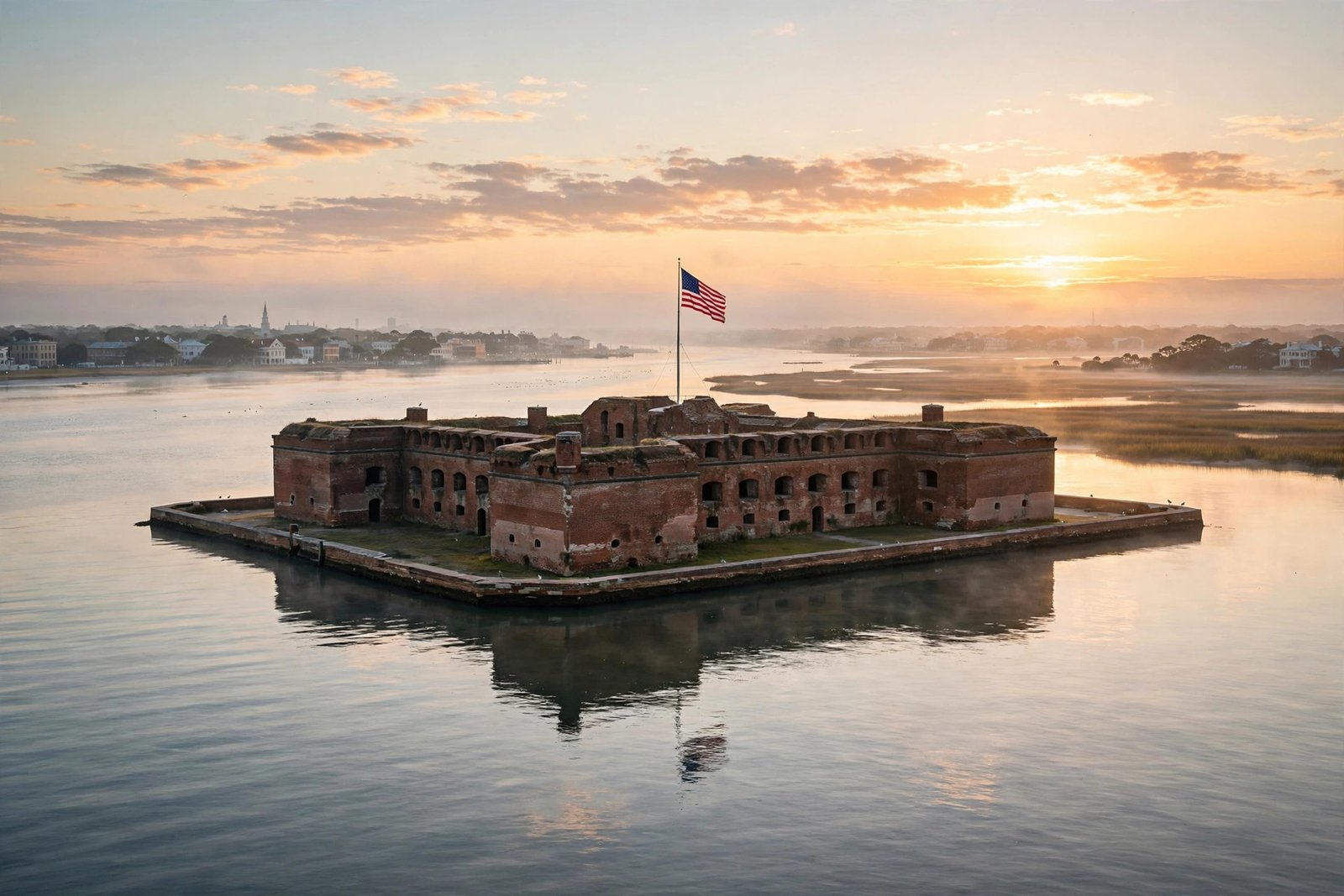
Fort Sumter history begins long before the first shots of the Civil War, on a man-made island in Charleston Harbor, South Carolina. Today the fort is a quiet place of brick walls, cannon, and harbor views, reached only by boat. But in April 1861, this small island fortress became the stage for the opening act of the bloodiest war in American history, and its story still draws visitors who want to stand where the nation split apart.
To understand why a half-finished fort mattered so much, you have to understand Charleston itself. By 1860, Charleston was one of the great cities of the South, a busy port built on trade in rice, cotton, and enslaved labor, and a center of the movement for Southern independence. When South Carolina became the first state to secede from the Union in December 1860, the fate of the federal forts guarding its harbor suddenly became the most urgent question in America. Fort Sumter was the largest and most important of those forts, and whoever held it held a powerful symbol.
Fort Sumter History Before the First Shots
To understand Fort Sumter history, it helps to start with the fort’s construction. After the War of 1812 exposed how vulnerable America’s coastal cities were to attack from the sea, the United States began building a chain of masonry forts to guard its harbors. Work on Fort Sumter began in 1829, on an artificial island built from granite and sand at the entrance to Charleston Harbor. The fort was named for Thomas Sumter, a general of the American Revolution known as the Fighting Gamecock.
Building the fort was slow, difficult work. The island had to be created before the walls could rise, and the project stretched on for decades. By 1860, the fort was still not fully complete, but its five brick walls were imposing enough, designed to hold more than 130 cannon and a large garrison. It was meant to work together with nearby Fort Moultrie on Sullivan’s Island and other harbor defenses to control every ship entering or leaving Charleston.
The crisis came quickly at the end of 1860. South Carolina seceded from the Union on December 20, 1860, and state leaders demanded that federal forces hand over the harbor forts. On the night of December 26, 1860, Major Robert Anderson, the Union commander in Charleston, made a bold decision. Under cover of darkness, he moved his small force of fewer than 100 soldiers from the vulnerable Fort Moultrie to the stronger, island-bound Fort Sumter. The move outraged South Carolina’s leaders, who saw it as a hostile act, but Anderson believed Sumter was the only position he could defend. From that night on, the fort was effectively besieged, surrounded by hostile batteries and cut off from easy resupply.
Fort Sumter History: April 12, 1861
The most famous chapter of Fort Sumter history opened in the early hours of April 12, 1861. President Abraham Lincoln, who had taken office just weeks earlier, faced an impossible choice. Fort Sumter was running low on food, and Anderson had warned that his men would soon be starved out. Lincoln decided to send a relief expedition carrying food, but no troops or weapons, and he notified South Carolina’s governor in advance that the mission was peaceful. Confederate leaders in Charleston, under the command of Brigadier General P. G. T. Beauregard, demanded the fort’s surrender instead.
When Anderson refused to surrender, Confederate batteries ringing the harbor opened fire at about 4:30 a.m. on April 12, 1861. The bombardment lasted for about 34 hours, with cannon fire pouring into the fort from Fort Johnson, Fort Moultrie, Cummings Point, and floating batteries. Inside Sumter, Anderson’s men returned fire, but they were badly outnumbered and outgunned, with far fewer working cannon and dwindling ammunition. Fires broke out inside the fort, and the situation grew hopeless.
On April 13, Anderson agreed to evacuate. Remarkably, no soldiers on either side were killed during the bombardment itself, though the war that followed would claim hundreds of thousands of lives. The surrender terms allowed Anderson’s men to leave with honor, firing a salute to the American flag as they departed. The identity of who fired the very first shot of the bombardment is still debated by historians, a reminder that even famous moments can carry uncertainty. What is not debated is the effect: the attack on Fort Sumter electrified the North, and within days Lincoln called for volunteers, four more states seceded, and the Civil War had truly begun.
There is a personal twist to the story that visitors often find moving. Beauregard, the Confederate commander who ordered the bombardment, had once been a student of Anderson at the United States Military Academy at West Point. Teacher and student now faced each other across Charleston Harbor, a symbol of how the war divided friends, families, and the nation itself. For another story of a Civil War battlefield and the men who fought there, read our account of the true story of the Battle of Gettysburg.
The War Years: A Fort Turned to Rubble
After the surrender, Fort Sumter became a Confederate stronghold, and for the rest of the war it was one of the most fought-over pieces of ground in America. Union forces, determined to retake Charleston, bombarded the fort for months at a time, especially during 1863 and 1864. The massive brick walls that had once stood three stories tall were gradually pounded into rubble, until the fort was little more than a low, shapeless mass of broken masonry.
Yet the Confederate garrison refused to give up. Soldiers lived in bombproof shelters carved into the ruins, enduring shelling, disease, and shortages, and they held the harbor entrance even as the fort itself crumbled around them. Union attempts to take Charleston by sea, including a major naval attack in April 1863, failed to break through the harbor defenses. The city and its forts became a symbol of Confederate endurance, even as the wider war turned against the South.
The end came not with a dramatic assault but with evacuation. In February 1865, as Union General William T. Sherman’s army marched through South Carolina toward Charleston, Confederate forces abandoned the city and its forts. Union troops reoccupied Fort Sumter that same month, raising the flag over the ruins of the place where the war had started. The harbor that had once been closed to the Union was open again, but the city and the fort lay in ruins, and the nation faced the enormous task of rebuilding.
The Flag Returns: April 14, 1865
One of the most emotional moments in Fort Sumter history came on April 14, 1865, exactly four years after the surrender. Major General Robert Anderson, now retired from active command, returned to Fort Sumter to raise the same American flag his men had lowered in 1861. Thousands of people gathered for the ceremony, including formerly enslaved men and women who had come to witness the moment. Speeches celebrated the preservation of the Union and the end of slavery, and the flag rose over the battered fort as bands played and crowds cheered.
The joy of that day was cut short within hours. That same evening, April 14, 1865, President Lincoln was assassinated at Ford’s Theatre in Washington, D.C., by John Wilkes Booth. The news reached Charleston in the days that followed, turning celebration into mourning. The coincidence of dates is one of history’s cruel ironies: the flag returned to Sumter on the very day the president who had guided the nation through the war was killed. For more on the symbols and landmarks of the American story, see our history of the Liberty Bell and the United States Capitol building.
After the War: Rebuilding and New Service
After the Civil War, Fort Sumter was rebuilt, though never to its original towering height. The lower walls that visitors see today reflect the postwar reconstruction, when the fort was repaired and modernized for new kinds of coastal defense. Later batteries were added around the Spanish-American War era, and the fort remained in military use through the First World War and into the Second World War, when it served as part of Charleston’s harbor defenses once again.
Over time, the fort’s military role faded, and its historical importance took center stage. In 1948, Fort Sumter became a national monument, and today it is part of Fort Sumter and Fort Moultrie National Historical Park, managed by the National Park Service. The park preserves both the island fort and Fort Moultrie on Sullivan’s Island, telling the full story of Charleston’s harbor defenses from the American Revolution through the Second World War.
Archaeologists and historians continue to study the site, uncovering artifacts from the bombardment and the long siege that followed. Exhibits at the fort and at the mainland visitor center in Charleston explain how the fort was built, how the bombardment unfolded, and how ordinary soldiers on both sides endured years of war. The story is told with care, honoring the soldiers who fought there while being honest about the cause of the war, which was rooted in slavery and the fight over its future in America.
Visiting Fort Sumter Today
Today, Fort Sumter history is preserved in a place that is both a museum and a memorial. The fort can only be reached by boat, which is part of the experience. Ferries operated in partnership with the National Park Service depart from Liberty Square in downtown Charleston and from Patriots Point in Mount Pleasant. The ride across the harbor offers beautiful views of the city skyline, passing ships, and often dolphins, and it gives visitors a sense of why controlling this harbor mattered so much.
Once on the island, visitors can walk the fort’s walls, see cannon and exhibits, and join ranger-led programs that explain the bombardment and the war that followed. The museum inside the fort displays artifacts, including the original flag flown in 1861, and tells the story of the soldiers and civilians caught up in the conflict. Plan for at least two to three hours for the full ferry trip and visit, and book tickets in advance during busy seasons, since ferries can fill up.
- Getting there: by ferry only, from Liberty Square in Charleston or Patriots Point in Mount Pleasant.
- Best time to visit: spring and fall offer mild weather; summer is hot and humid, so bring water and sun protection.
- What to bring: comfortable shoes, sunscreen, a hat, and a camera for harbor views.
- Combine with: Fort Moultrie on Sullivan’s Island, the Charleston Museum, and a walking tour of historic downtown Charleston.
- Good to know: there are no food services on the island, so eat before you board the ferry.
Visitors with limited mobility should note that the ferry and fort are accessible, though the island’s surfaces include uneven brick and gravel paths. Check the National Park Service website for current schedules, accessibility details, and any closures before you travel.
Why Fort Sumter Still Matters
Fort Sumter matters because it marks a turning point. Before April 1861, many Americans still hoped that the crisis over secession could be resolved without war. After the bombardment, that hope was gone, and the nation faced four years of conflict that would reshape everything: ending slavery, redefining citizenship, and testing whether a democratic republic could survive a civil war. Standing on the island, it is easier to grasp how quickly history can turn, and how decisions made by a handful of people in Charleston Harbor changed the lives of millions.
The fort also matters because it reminds us that history is made by ordinary people in extraordinary moments. The soldiers inside Sumter in April 1861 were not famous men; they were a small garrison, far from home, running out of food, facing impossible odds. Their decision to hold the fort, and Anderson’s decision to surrender rather than sacrifice his men needlessly, are part of why the story endures. So is the later story of the enslaved people who fled to Union lines, the Black soldiers who later served in the harbor defenses, and the freed men and women who celebrated the flag’s return in 1865.
Conclusion
That is why Fort Sumter history still matters today, more than 160 years after the first shots. The fort is not just a ruin in Charleston Harbor; it is the place where the American story took its most painful turn, and where it began, slowly and at great cost, to bend toward freedom. If you visit Charleston, make the ferry trip to the island. Walk the walls, look out over the harbor, and imagine the morning of April 12, 1861, when cannon fire announced that the nation was at war with itself. Then explore more American history stories on ENG Post, and plan your own journey into the past.