
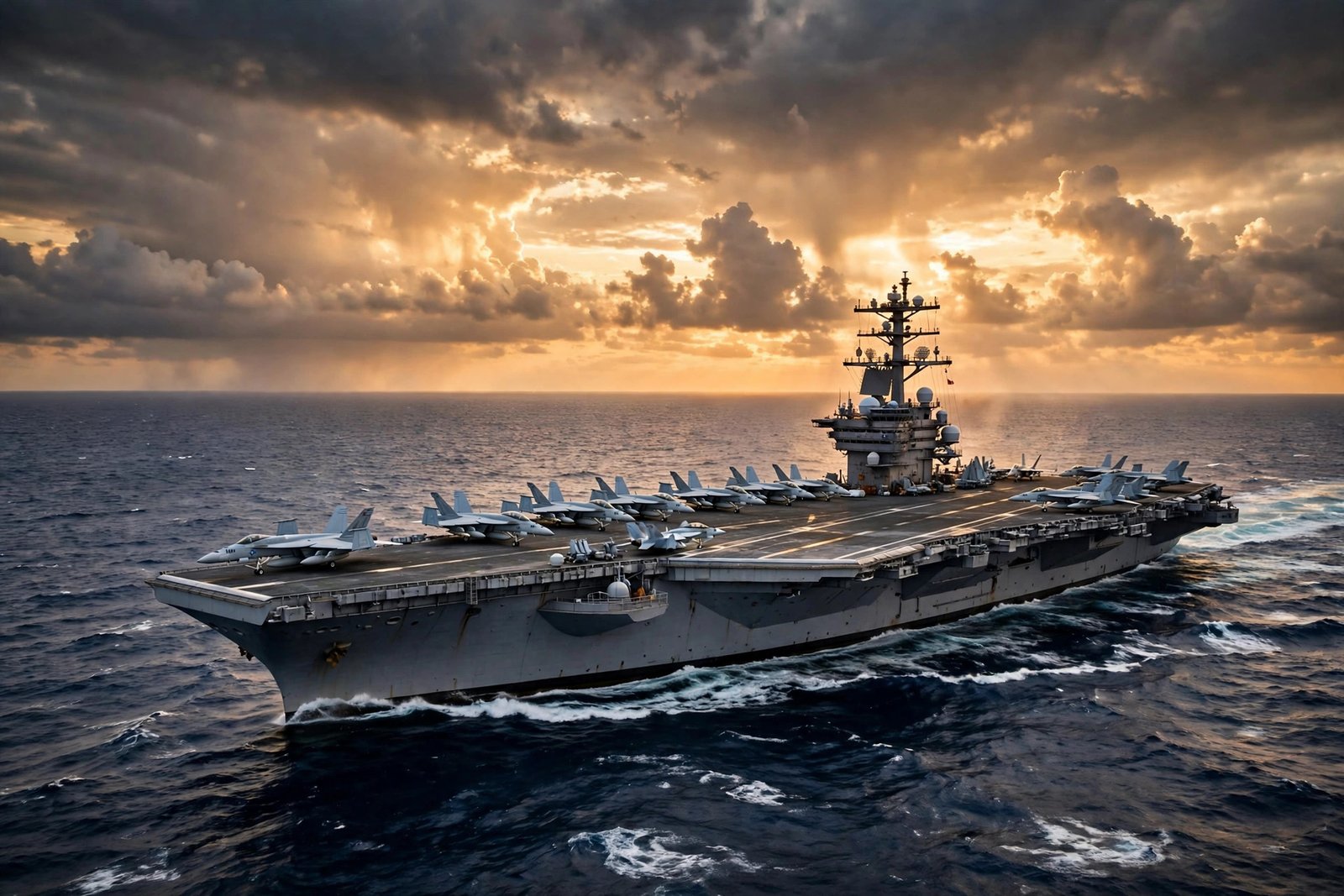
An American aircraft carrier is a floating city, an air base, and a statement of power all at once. It is longer than three football fields, carries thousands of sailors, and launches fighter jets from a deck that pitches and rolls on the open ocean. For more than 80 years, these ships have shaped how the United States responds to crises, supports allies, and projects power far from home.
This article explains how aircraft carriers work, why the United States operates so many of them, and what makes the modern carrier force different from the ships of the past. Whether you are curious about naval technology, American military history, or global politics, the story of the carrier is a good place to start.
What Is an Aircraft Carrier?
An aircraft carrier is a warship designed to carry, launch, and recover aircraft at sea. Unlike a land air base, which is fixed in one place, a carrier can move to where it is needed, bringing its air wing with it. That mobility is the whole point. A carrier strike group can arrive off a coastline, launch patrols and strikes, and stay on station for weeks or months without asking another country for a base.
A modern American carrier typically carries 60 to 90 aircraft, including fighter jets, early-warning aircraft, electronic-warfare aircraft, and helicopters. Together, these aircraft can defend the ship, strike targets at distance, watch the surrounding sea and sky, and rescue pilots and civilians when needed. The flight deck is a carefully choreographed workplace, where colored shirts mark different jobs, from aircraft handlers to fuel crews to safety officers.
Below deck, the ship is a small town. It has kitchens that serve thousands of meals a day, medical and dental facilities, gyms, chapels, shops, and laundry services. It makes its own fresh water and generates its own power. A carrier is not just a weapon, it is a self-contained community that can operate independently for long periods.
A Short History of Aircraft Carriers
The first aircraft carriers appeared in the early 20th century, when navies began experimenting with launching aircraft from ships. Early carriers were often converted from other ships, with flat decks added on top. The idea was simple but revolutionary: a ship could carry its air power with it, rather than relying on shore bases or short-range seaplanes.
During World War II, carriers became decisive. In the Pacific, battles were often fought by aircraft launched from carriers, with the opposing fleets far beyond sight of each other. Ships such as USS Enterprise became famous, and the lessons of that war shaped naval thinking for decades. Carriers were no longer support vessels. They were the center of the fleet.
After the war, the jet age changed carrier design again. Jets were faster and heavier, so decks, catapults, and arresting gear had to become stronger. The introduction of the angled deck made landing safer, because an aircraft that missed the arresting wires could take off again instead of crashing into parked planes. Nuclear propulsion, introduced in the 1960s, removed the need for frequent refueling and gave carriers far greater endurance.
Through the Cold War and into the twenty-first century, American carriers supported operations around the world, from the Mediterranean to the Persian Gulf to the western Pacific. Each generation of ship learned from the last, adding better radar, stronger defenses, and aircraft with longer range and sharper sensors.
The Nimitz Class: The Workhorse Fleet
For much of recent history, the backbone of the American carrier fleet has been the Nimitz class. Named after Fleet Admiral Chester W. Nimitz, these nuclear-powered ships entered service beginning in the 1970s, and the class eventually grew to ten ships. Each one is a huge, long-lived platform designed to operate for decades with periodic refueling and modernization.
A Nimitz-class carrier carries an air wing of fighter jets, early-warning aircraft, electronic-warfare aircraft, and helicopters. Together, these aircraft can defend the ship, strike targets at distance, watch the surrounding sea and sky, and rescue pilots and civilians when needed. The flight deck is a carefully choreographed workplace, where colored shirts mark different jobs, from aircraft handlers to fuel crews to safety officers.
Life aboard a Nimitz-class ship is demanding. Crews work long shifts, often around the clock during flight operations. Space is tight, privacy is limited, and the rhythm of life is set by the launch schedule. Yet sailors often describe a strong sense of pride and teamwork, because every launch and recovery depends on dozens of people doing their jobs exactly right.
Even as newer ships arrive, the Nimitz class remains important. These carriers have decades of operational experience, and their crews carry knowledge that cannot be replaced quickly. They also show how durable good design can be when a ship is maintained and upgraded over a long service life.
The Ford Class: The Next Generation
The newest generation of American aircraft carrier, led by USS Gerald R. Ford, commissioned in 2017, is designed to launch more sorties per day, with less crew, using new technology that had never been fitted to a carrier before.
Two of the best-known innovations are the Electromagnetic Aircraft Launch System and advanced arresting gear. Instead of steam catapults, electromagnetic launchers push aircraft off the deck with more precise control, which is gentler on airframes and easier to adjust for different aircraft weights. The new arresting gear recovers landing aircraft more smoothly and with less maintenance.
The Ford class also features a redesigned island, the tall structure on the side of the deck, placed further aft to improve flight-deck flow and visibility. Its radar and combat systems are more integrated, and its nuclear reactors produce more electrical power, leaving room for future systems as technology changes. That growth margin matters, because a carrier built today may still be serving in fifty years.
Like any first-of-class ship, USS Gerald R. Ford faced testing and adjustment as its new systems matured. That is normal for a complex warship, and it is part of why navies build a class over many years rather than all at once. The lessons learned from the first ship shape the ships that follow.
How Aircraft Carriers USA Project Power
To understand how aircraft carriers USA project power, it helps to look beyond the carrier itself. A carrier almost never sails alone. It travels as part of a carrier strike group, surrounded by cruisers, destroyers, and often a submarine, with supply ships following behind. Each escort has a job: defend against air and missile threats, hunt submarines, and protect the group from surface threats.
The air wing is the carrier’s main striking arm. Fighter aircraft can defend the group and reach targets far inland. Early-warning aircraft watch for threats at distance and coordinate the air picture. Electronic-warfare aircraft can jam enemy sensors. Helicopters hunt submarines, move supplies, and rescue people. Together, they give the strike group reach and awareness that no single ship could achieve alone.
Range is the other key advantage. A carrier can move hundreds of miles in a day, repositioning its air power without asking another country for a base. In a crisis, that speed matters. A carrier already at sea can arrive before land-based aircraft can be deployed, and it can stay on station for weeks or months, supported by replenishment ships.
Deterrence works best when it is credible. A carrier strike group shows that a country can sustain complex operations far from home. That credibility depends not just on the ship, but on training, logistics, and the willingness to use the capability carefully. Power, in this context, is as much about discipline and readiness as it is about size.
Life Aboard: A Floating City
It is common to call a carrier a floating city, and the comparison holds up. A large carrier can carry around five thousand people when the air wing is embarked. It has kitchens that serve thousands of meals a day, medical and dental facilities, gyms, chapels, shops, and laundry services. It makes its own fresh water and generates its own power.
Daily life is organized around watches and flight operations. Some sailors work on the flight deck, in loud and dangerous conditions, wearing protective gear and following strict hand signals. Others work below deck, maintaining engines, reactors, electronics, and weapons systems. Still others plan missions, analyze weather and intelligence, or keep the ship supplied and clean.
Despite the scale, life aboard is personal. Sailors celebrate birthdays far from home, video-call family when connectivity allows, and form close friendships in small berthing spaces. Mail, morale events, and port visits break up long deployments. For many young Americans, a carrier is their first experience of living and working in a large, diverse team under real pressure.
That human side is worth remembering when we talk about national power. Ships do not sail themselves. Every capability described in this article depends on people who train for years, accept long separations from family, and perform under stress.
Why the United States Operates Eleven Carriers
Readers often ask why the United States operates eleven carriers when no other country operates nearly as many. The answer is partly about geography and partly about commitments. The United States has interests and allies in multiple oceans at once, and carriers take time to build, maintain, and refit. At any given moment, some ships are in maintenance, some are training, and some are deployed.
Having eleven ships makes it possible to keep carriers available in key regions while others are being repaired and preparing for deployment. It also provides depth: if one ship is unavailable, another can step in. That reliability is important to allies who plan exercises and operations around American carrier presence.
Building and operating carriers is expensive, and that cost is a regular subject of public debate in the United States. Supporters argue that no other system offers the same combination of mobility, endurance, and visible presence. Critics argue that new weapons and uncrewed systems may change the balance. Both views reflect a real question: how should a country invest in defense as technology changes?
What is clear is that carriers have adapted before. They survived the arrival of missiles, jets, and satellites by changing aircraft, defenses, and tactics. Whether they adapt again will depend on how well future ships combine crewed aircraft, drones, and new sensors. The history of aircraft carriers USA suggests adaptation, not sudden disappearance.
Carriers, Drones, and the Future
Uncrewed aircraft are already changing naval aviation. Drones can fly long surveillance missions, refuel other aircraft, and take on tasks that are dull, dirty, or dangerous for human pilots. Future carrier air wings are likely to mix crewed fighters with uncrewed systems, each doing what it does best.
That mix will require new training, new deck procedures, and new ways of planning missions. It will also raise questions about autonomy, communication links, and control. Navies will need to test these systems carefully at sea, where weather, salt, and limited bandwidth make everything harder than on land.
Future carriers may also carry new defenses, including directed-energy systems and improved missiles, as threats evolve. The basic idea, however, is likely to remain: a mobile airfield that can move, adapt, and sustain operations far from home. The ship of the future may look different, but its purpose will be familiar.
For the United States, the challenge is to keep building ships that can serve for half a century while technology changes every decade. That means designing in room for growth, testing new systems early, and listening to the sailors who operate them every day.
What This Means for Readers
You do not need to be a naval expert to appreciate what carriers represent. They are a reminder that American power is not abstract. It is built, maintained, and crewed by real people, in real places, under real conditions. When you see a photo of jets launching from a deck at sunset, you are seeing the result of thousands of small decisions and careful routines.
American power takes many forms, from industry and agriculture to culture and technology. If you enjoyed this look at naval strength, you may also like our explainer on American agricultural power, and for a very different kind of American story that captured attention, see our piece on a viral baseball moment. Together, they show how broad the American story can be.
Next time you hear that a carrier strike group has moved to a new region, you will know what that means: a floating airfield, a trained crew, and a set of choices by leaders who believe presence matters. Whether you see that as reassuring or as a warning depends on your perspective, but the capability itself is impossible to ignore.
What do you think is the most important role of an aircraft carrier today: deterrence, crisis response, humanitarian help, or something else? Share this article with a friend who loves history or technology, and let us know your view. For more explainers on American places, history, and power, keep exploring ENG Post, where every story is written to help you understand the United States a little better.