
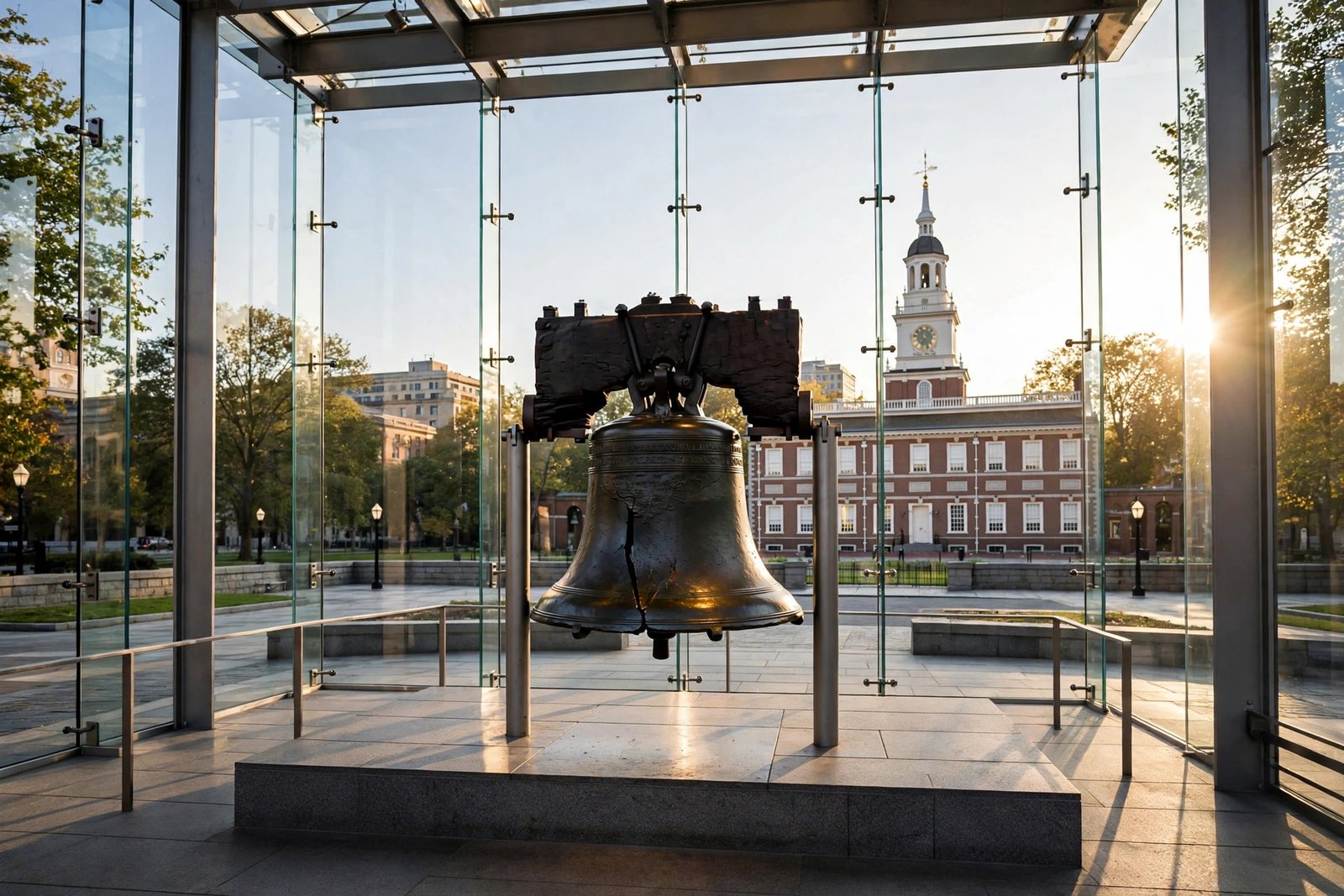
Walk into the Liberty Bell Center in Philadelphia and you will see it right away: a great bronze bell, silent for nearly two centuries, with a jagged crack running down its side. Millions of people visit it every year, yet most of them leave without knowing the strangest parts of its story. Some of the most surprising Liberty Bell facts involve a bell that cracked before it ever rang properly, a secret wartime hiding place, and a name the bell did not earn until long after the Revolution. This is the real story behind America’s most famous bell.
Liberty Bell Facts: How the Bell Was Made
In 1751, the Pennsylvania Assembly ordered a bell for the Pennsylvania State House in Philadelphia, the building we now call Independence Hall. The order was meant to mark the 50th anniversary of William Penn’s Charter of Privileges, the document that granted religious freedom and self-government to the colony in 1701. The Assembly wanted a bell worthy of the occasion, so it ordered one from the Whitechapel Bell Foundry in London, the most famous bell maker in the world at the time.
The bell arrived in Philadelphia in 1752, and the trouble started immediately. When workers tested it, the bell cracked on the very first strike. A bell that was supposed to ring out over the city could not ring at all. The Assembly had two choices: send it back to London or fix it at home. They chose to fix it at home, and two Philadelphia founders, John Pass and John Stow, took on the job.
Pass and Stow melted the bell down and recast it not once but twice. Their first attempt in 1753 also failed to satisfy the city, and their second recasting that same year finally produced a bell that could ring. That 1753 bell is the one on display today. The words “Pass and Stow” are still cast into its surface, along with the year written in Roman numerals, MDCCLIII, and the word “Philada,” a short form of Philadelphia.
The bell weighs about 2,080 pounds. It stands about 3 feet tall and measures about 12 feet around the lip. Its metal is mostly copper, about 70 percent, and tin, about 25 percent, with small amounts of lead, zinc, arsenic, gold, and silver mixed in. The exact recipe was part of the founders’ craft, and modern analysis has confirmed the blend. It is a heavy, beautiful piece of 18th-century metalwork, even if its tone was never as sweet as the city had hoped. Visitors often notice that the bell looks smaller than they expected, yet up close its size and weight are impossible to miss.
The State House where the bell hung is now Independence Hall, part of Independence National Historical Park. If you enjoy visiting the places where American history happened, you will find more of them in our guide to national parks and USA facts, which covers the historic sites protected across the country.
The Famous Crack: What Really Happened
No one knows the exact moment the Liberty Bell cracked. That is one of the first things to understand about it. There is no diary entry or newspaper report that says, “On this day, at this hour, the bell split.” Instead, the crack most likely grew slowly, over years of ringing, as small flaws from the original casting widened a little with every strike.
Tradition links the crack to a sad day in 1835, when the bell tolled for the funeral of Chief Justice John Marshall. According to the story, the bell cracked while ringing for Marshall’s death. Historians treat this as tradition rather than proven fact, because the records do not confirm it. What the records do show is that by the 1840s the bell had a visible crack, and the city had to decide what to do about it.
The final blow came on February 22, 1846, when the bell was rung to mark George Washington’s birthday. During that ringing, the crack spread badly. Workers tried a repair method called stop drilling, which means drilling small holes at the ends of a crack to keep it from growing further. The repair did not restore the bell’s voice. After 1846, the bell was retired from service and never rung again.
Today the crack is the bell’s most famous feature. It runs from the lip of the bell up through its body, and it is wide enough to see clearly from several feet away. The crack is the reason the bell is silent, and it is also the reason the bell is so powerful as a symbol. A perfect bell would be just another old bell. A cracked bell that survived war, fire, and two centuries of American history is something else entirely.
Liberty Bell Facts About the Inscription and Its Meaning
Look closely at the bell and you will see a line of text cast around its crown: “Proclaim LIBERTY Throughout all the Land unto all the Inhabitants Thereof.” The words come from the Bible, Leviticus 25:10, which describes a year of jubilee, a time when debts were forgiven and enslaved people were set free. The Assembly chose the verse for the 50th anniversary of Penn’s charter, and the word LIBERTY is cast in larger letters than the rest.
The choice turned out to be far more meaningful than anyone in 1751 could have known. A quarter century later, the bell hung in the same building where the Declaration of Independence was debated and signed. The verse about proclaiming liberty to all the inhabitants of the land became, almost by accident, the perfect motto for a new nation built on the idea of freedom.
The bell carries other inscriptions as well. It reads, “By Order of the Assembly of the Province of Pensylvania for the State House in Philada.” Notice the spelling: “Pensylvania” with a single letter N, which was an accepted spelling of the time. The names “Pass and Stow” and the Roman numerals MDCCLIII mark the Philadelphia founders and the year of the successful recasting. These Liberty Bell facts show that the bell was not made for the American Revolution at all. It was made for a colonial anniversary, decades before independence, and history caught up with it later.
Where the Bell Has Traveled
For a bell that now sits in one spot, the Liberty Bell has done a surprising amount of traveling. Its first great journey was a secret one. In September 1777, British troops occupied Philadelphia during the Revolutionary War. American leaders feared the British would seize the city’s bells and melt them down to make cannon. So the State House Bell was taken down, loaded onto a wagon, and hidden in Allentown, Pennsylvania, beneath the floor of the Zion Reformed Church. It stayed there until the British left Philadelphia in June 1778, and then it was brought home.
In the 1800s, the bell began traveling in public. In 1885, it went by train to New Orleans for the World’s Industrial and Cotton Centennial Exposition, and crowds turned out along the route to see it pass. Its most famous journey came in 1915, when it traveled across the country to the Panama-Pacific International Exposition in San Francisco. The train trip took days, and at every stop, people gathered to see the bell. It was the first time many Americans outside Philadelphia had ever seen it in person.
After the 1915 tour, the bell returned to Philadelphia and stayed put. For decades it hung in Independence Hall itself, where visitors could see it in the building where American independence was declared. In 2003, it moved to its current home, the Liberty Bell Center on Independence Mall, a glass building designed so the bell can be seen from the street, with Independence Hall visible behind it. The move gave the bell more room, better protection, and space for exhibits that tell its full story.
The Bell’s Role in American History
Here is a surprise for many visitors: during the American Revolution, nobody called it the Liberty Bell. It was simply the State House Bell. The name we know today came much later, in the 1830s, when abolitionists adopted the bell as a symbol of freedom. The inscription about proclaiming liberty to all the inhabitants of the land spoke directly to their cause, the end of slavery. An 1839 anti-slavery gift book titled “The Liberty Bell” helped spread the name, and within a few years, the new name had stuck.
The bell’s power as a symbol only grew from there. In 1915, supporters of women’s suffrage created a replica called the Justice Bell and toured it through Pennsylvania to argue that women deserved the vote. The replica was a copy of the Liberty Bell, but with one deliberate difference: its clapper was chained so it could not ring, a symbol of the silence of women who had no voice in government. When the 19th Amendment gave women the vote in 1920, the Justice Bell’s clapper was finally unchained.
The most famous story about the bell is also the one historians are most careful about. Tradition says the bell rang out on July 4, 1776, to announce the Declaration of Independence to the people of Philadelphia. There is no contemporary record that confirms this. What the tradition does support is that the bell rang on July 8, 1776, when the Declaration was read publicly for the first time in the State House yard. The July 4 story is legend, and it is a good reminder that the bell’s legend is sometimes larger than its documented history. Both matter, but they are not the same thing.
By the 20th century, the bell had become one of the most recognized symbols of American freedom in the world. In 1976, for the American Bicentennial, the bell appeared on the bicentennial Eisenhower dollar, shown against the moon. Its image has appeared on stamps, coins, posters, and monuments, and it has been borrowed by movements for freedom far beyond the United States. Few objects in American history carry so much meaning in so little metal.
Visiting the Liberty Bell Today
Seeing the Liberty Bell is free. The Liberty Bell Center is open daily on Independence Mall in Philadelphia, and visitors pass through security screening before entering. Inside, exhibits explain the bell’s history, from its casting in London to its role in the movements for abolition and suffrage. Then you step into the chamber where the bell itself stands, and you can walk around it and see the crack up close.
A few tips make the visit better. Arrive early in the morning or later in the afternoon, when the lines are shortest, especially in spring and summer. Combine the visit with Independence Hall, which stands just across the street and requires a timed ticket for most of the year. Give yourself at least an hour for the Bell Center alone, and more if you want to read every exhibit. The bell is at its most striking in the late afternoon, when the light comes through the glass walls of the center and falls across the bronze.
Philadelphia is also a great starting point for a longer trip through American history. If you catch the travel bug after your visit, our guide to Route 66 history traces the most famous road in the country and the small towns that grew up along it.
Common Myths vs. Real Liberty Bell Facts
The Liberty Bell has collected more myths than almost any other object in American history. Here is how the most common ones stack up against the evidence.
- Myth: The bell rang on July 4, 1776, to announce independence. Fact: This is legend. No contemporary record confirms a July 4 ringing. Tradition holds that it rang on July 8, when the Declaration was first read in public.
- Myth: The crack happened in one dramatic moment. Fact: The crack almost certainly developed gradually over years of ringing, and it widened badly during the 1846 ringing for Washington’s birthday.
- Myth: The bell was always called the Liberty Bell. Fact: It was the State House Bell until abolitionists gave it the name in the 1830s, more than 50 years after the Revolution.
- Myth: The bell is made of gold and silver. Fact: It is mostly copper and tin, with only small amounts of gold, silver, and other metals in the mix.
- Myth: The bell still rings on special occasions. Fact: It has not rung since 1846. It is a museum object now, and its silence is part of its story.
- Myth: The bell never left Philadelphia. Fact: It was hidden in Allentown during the Revolutionary War and later toured the country by train, including a famous 1915 trip to San Francisco.
Separating myth from fact does not make the bell less interesting. If anything, the true story is stranger and richer than the legends. A bell that cracked on its first ring, was saved from enemy soldiers by being hidden under a church floor, and was renamed by people fighting slavery is a better story than a simple tale of a bell ringing on the Fourth of July.
Conclusion: Why the Liberty Bell Still Matters
The Liberty Bell matters because it is more than an old piece of bronze. It is a witness to the whole American story: a colonial anniversary, a revolution, a civil war over slavery, a fight for women’s votes, and two and a half centuries of people looking to it as a symbol of freedom. Its crack is not a flaw in the story. It is the story. The bell broke, it was repaired, it broke again, and it survived anyway, just as the country it symbolizes has survived its own cracks and repairs.
If you visit Philadelphia, go see it for yourself. Read the inscription, look at the crack, and think about the generations of Americans who stood in the same spot. Then keep exploring: the story of the bell is one chapter in a much bigger American story, and you can read more of it in our story about bald eagles in the USA, another great American symbol that came close to disappearing and then came back. Share this article with someone who loves American history, and tell us in the comments which fact surprised you most.