
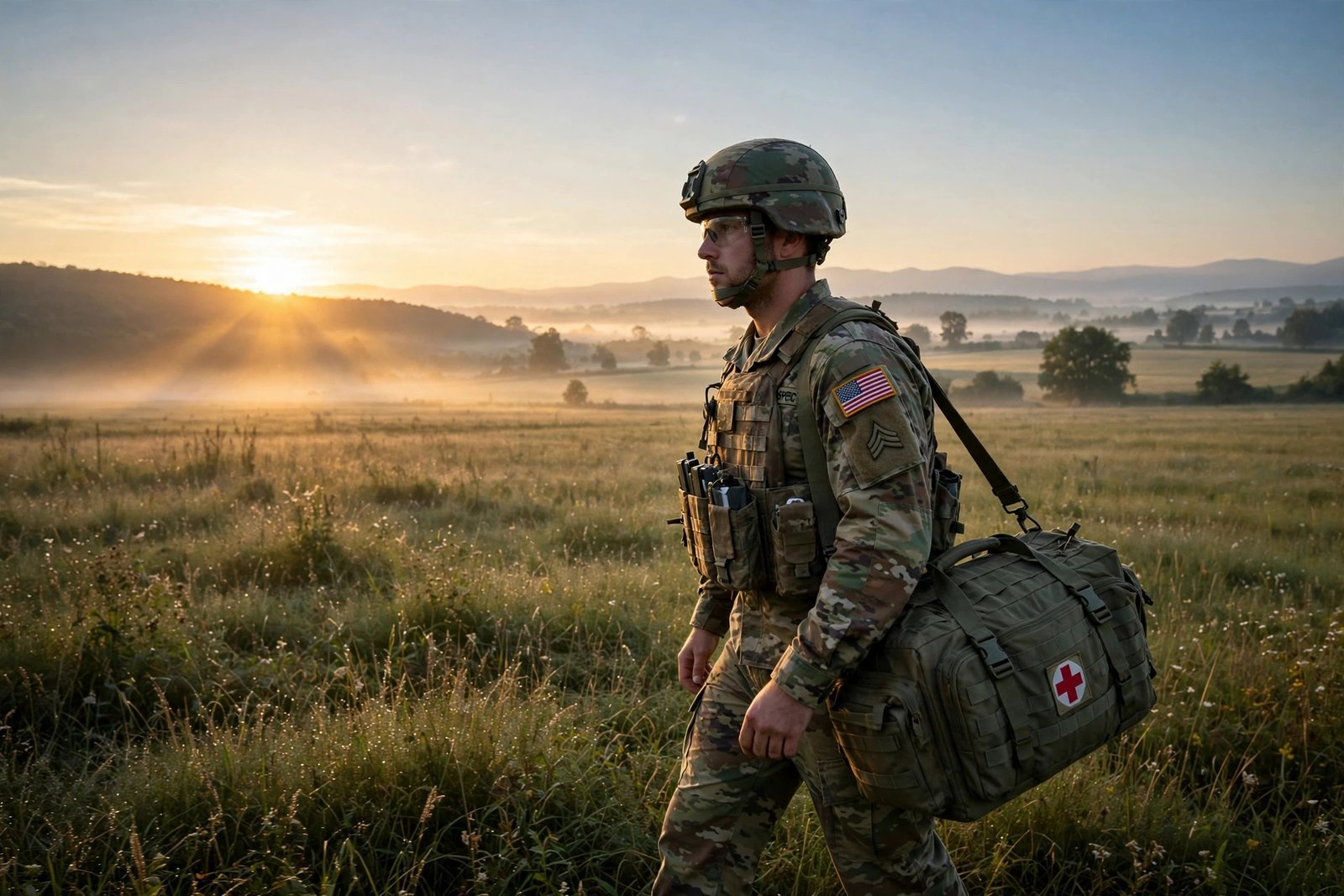
Picture a battlefield at night, lit only by flares and the flash of distant guns. Somewhere in the smoke, a wounded soldier calls out for help. The person who runs toward that voice, carrying nothing but a medical bag and extraordinary nerve, is an Army medic. US Army medics true stories have been told and retold for generations because they capture something rare: courage shown not by taking a life, but by saving one, often at terrible personal risk.
Medics are the soldiers other soldiers trust with their lives. They are usually the first medical help a wounded service member ever sees, and sometimes the only help available for hours. Their stories matter because they remind us that heroism on a battlefield does not always look like a charge or a captured hill. Sometimes it looks like a steady pair of hands, a calm voice, and a refusal to leave someone behind.
What US Army Medics Actually Do
An Army medic, known today by the military occupational specialty 68W, or healthcare specialist, is trained to deliver emergency medical care in combat conditions. That training covers bleeding control, airway management, treating shock, splinting fractures, and evacuating casualties under fire. In garrison, medics also staff clinics, support training exercises, and help keep whole units healthy and ready.
On deployment, a medic is typically embedded with an infantry platoon or company, living, marching, and fighting alongside the same soldiers they may one day have to treat. That closeness is part of what makes the bond between medics and their fellow soldiers so strong. A medic knows the people in their unit by name, by hometown, and by habit, and those soldiers know that if they are hit, the medic will come.
Medics work under rules shaped by the Geneva Conventions, which protect medical personnel who are exclusively engaged in medical duties. In practice, however, combat medics have often found themselves in the middle of the fighting, and many have picked up weapons or defended their patients when the situation demanded it. Their job is dangerous precisely because they must move toward the wounded while everyone else is seeking cover.
US Army Medics True Stories From World War II
World War II produced some of the most famous US Army medics true stories, and for good reason. The war was fought on a scale that put medics in every theater, from the beaches of Normandy to the jungles of the Pacific. Medics landed with the first waves on D-Day, treated the wounded on open beaches under fire, and carried casualties through hedgerows, mountains, and island battlefields where evacuation could take hours or even days.
In the Pacific, island fighting made the medic’s job especially brutal. There were often no safe rear areas, and field hospitals themselves could come under attack. Medics learned to work in foxholes, in caves, and on exposed ridgelines, improvising litters from ponchos and poles when stretchers ran out. Their presence gave infantrymen something priceless: the knowledge that if they fell, someone would try to reach them.
One of the most documented stories from this era is that of Desmond Doss, a conscientious objector who served as a medic precisely because his faith would not allow him to carry a weapon or take a life. His story is covered in more detail below, but he was far from the only medic whose actions became legend. Across the war, Army medics earned a reputation for running toward gunfire, and many received decorations for valor, including the Medal of Honor, the nation’s highest military award.
Desmond Doss and Hacksaw Ridge
Desmond Doss was a Seventh-day Adventist from Virginia who believed that his faith forbade killing, but not serving. When he was drafted, he refused to carry a weapon and refused to train on the Sabbath, positions that drew ridicule and pressure from fellow soldiers and even some officers. He insisted, however, that he could serve his country as a medic, and he eventually deployed with the 307th Infantry Regiment of the 77th Infantry Division.
In May 1945, during the Battle of Okinawa, Doss’s unit fought to take the Maeda Escarpment, a steep ridge nicknamed Hacksaw Ridge. The fighting was savage, and after American troops were forced back from the top of the ridge, many wounded men were left behind on the exposed crest. Doss stayed. Working alone and under enemy fire, he treated wounded soldiers and lowered them one by one down the face of the escarpment using a rope-supported litter, so they could be carried to safety.
According to his Medal of Honor citation, Doss saved approximately 75 men that day, a figure that has become part of his legend. The citation also records that he was wounded himself during the battle, yet continued to care for others. On October 12, 1945, President Harry S. Truman presented Doss with the Medal of Honor, making him the first conscientious objector to receive the award. His story later inspired books and the film Hacksaw Ridge, but the documented record alone is remarkable enough: a man who would not carry a rifle became one of the most decorated medics in American history.
Doss’s story matters beyond the numbers. It shows that courage in uniform takes many forms, and that a soldier’s convictions, far from being a weakness, can be the very thing that steadies him when others might break. His fellow soldiers, who had once mocked him, came to trust him completely, and that transformation is part of why his story still resonates.
US Army Medics True Stories From Korea and Vietnam
The Korean War changed battlefield medicine in lasting ways. The mobile army surgical hospital, made famous by the MASH units, brought surgery closer to the front lines than ever before, and helicopters began evacuating wounded soldiers from the battlefield to those hospitals. Medics on the ground were the first link in that chain, stabilizing casualties and calling in the helicopters that gave so many men a chance they would not have had in earlier wars.
In Vietnam, the helicopter evacuation system matured into the Dustoff missions that are now part of military legend. Dustoff crews, often including medics, flew unarmed helicopters into landing zones that were still under fire to pick up the wounded. Army medics on the ground marked landing zones, loaded casualties under fire, and sometimes flew with them, continuing treatment in the air. The speed of evacuation in Vietnam, combined with advances in field treatment, meant that soldiers who reached a hospital alive had a better chance of survival than in any previous American war.
It is important to be honest about what we know and what we do not. Many individual medic stories from Korea and Vietnam were never fully written down, and some famous anecdotes have grown in the retelling. What is documented beyond doubt is the pattern: medics repeatedly exposed themselves to fire to reach the wounded, and their work, together with helicopter evacuation, transformed survival rates on the battlefield. The general picture is one of sustained, everyday bravery, not just a few famous moments.
The Training Behind the Courage
Modern Army medics complete intensive training that combines classroom instruction with realistic field exercises. They learn anatomy, trauma care, and the use of field medical equipment, and they practice treating simulated casualties in conditions designed to mimic the stress and confusion of combat. Much of their training follows the principles of tactical combat casualty care, which prioritizes stopping massive bleeding, securing the airway, and getting the casualty evacuated quickly.
Training also emphasizes composure. A medic must think clearly while others are panicking, make triage decisions when resources are limited, and keep working when the situation is grim. Instructors often say that the hardest part of the job is not the medicine but the mindset: the willingness to move toward danger, again and again, because someone needs help.
- Bleeding control: tourniquets, pressure dressings, and wound packing are practiced until they are second nature.
- Airway and breathing: medics learn to recognize and treat airway blockages and chest injuries in the field.
- Evacuation: calling for medical evacuation, preparing landing zones, and loading patients safely under pressure.
- Preventive care: medics also guard against disease, dehydration, and heat injury, which have historically caused as many casualties as enemy fire.
Why Medics Inspire Such Loyalty
Ask veterans what they remember about their medic, and the answer is rarely about medical technique. It is about presence. Soldiers remember the medic who checked on them when they were sick, who shared rations, who stayed up through the night with a wounded friend, and who never made them feel like a burden. That loyalty runs both ways: medics often describe their unit as family, and many say the hardest part of their service was losing someone they could not save.
This bond also explains why medic stories travel so well beyond the military. Civilians may not know the details of a battle, but they understand the image of a person who risks everything to help a stranger. It is a universal story, and it is why US Army medics true stories continue to be shared in books, films, documentaries, and family conversations decades after the events themselves.
There is another reason these stories endure. Medics represent the idea that even in war, compassion has a place. Their mission is explicitly to preserve life, and that mission gives their courage a different character from other forms of battlefield bravery. They are honored not for what they destroyed, but for what they saved.
How to Honor Army Medics Today
Honoring Army medics does not require grand gestures. The most meaningful tributes are often the simplest: learning their stories accurately, sharing them with younger generations, and supporting the veterans and military families in your own community.
- Visit a military museum or memorial and look for the medic exhibits, which are often quieter than the combat displays but just as powerful.
- Support organizations that help wounded veterans and their families, and consider volunteering with a local veterans group.
- Teach children the story of Desmond Doss as an example of courage guided by conscience.
- On Veterans Day and Memorial Day, remember the medics alongside the infantrymen, pilots, and sailors they served with.
- Read firsthand accounts and unit histories, which preserve details that popular retellings sometimes lose.
For more American heroism, read the story of the Navajo Code Talkers, whose unbreakable code helped win the Pacific War, and explore how American families keep the spirit of service alive through traditions like those in our American Christmas traditions guide and the true story of the first Thanksgiving.
Conclusion: Courage That Saves Lives
The true stories of US Army medics remind us that the bravest person on a battlefield is often the one carrying a bag of bandages instead of a weapon. From Hacksaw Ridge to the helicopter landing zones of Vietnam and the combat outposts of more recent wars, medics have shown up, again and again, for soldiers who had no one else to call. Their legacy is measured not in ground taken, but in lives brought home.
If this story moved you, share it with someone who should hear it, and take a moment to learn the name of a medic from your own community’s history. Their courage deserves to be remembered accurately, honored sincerely, and passed on. Which medic story inspires you most? Tell us in the comments, and explore more true American stories here on ENG Post.