
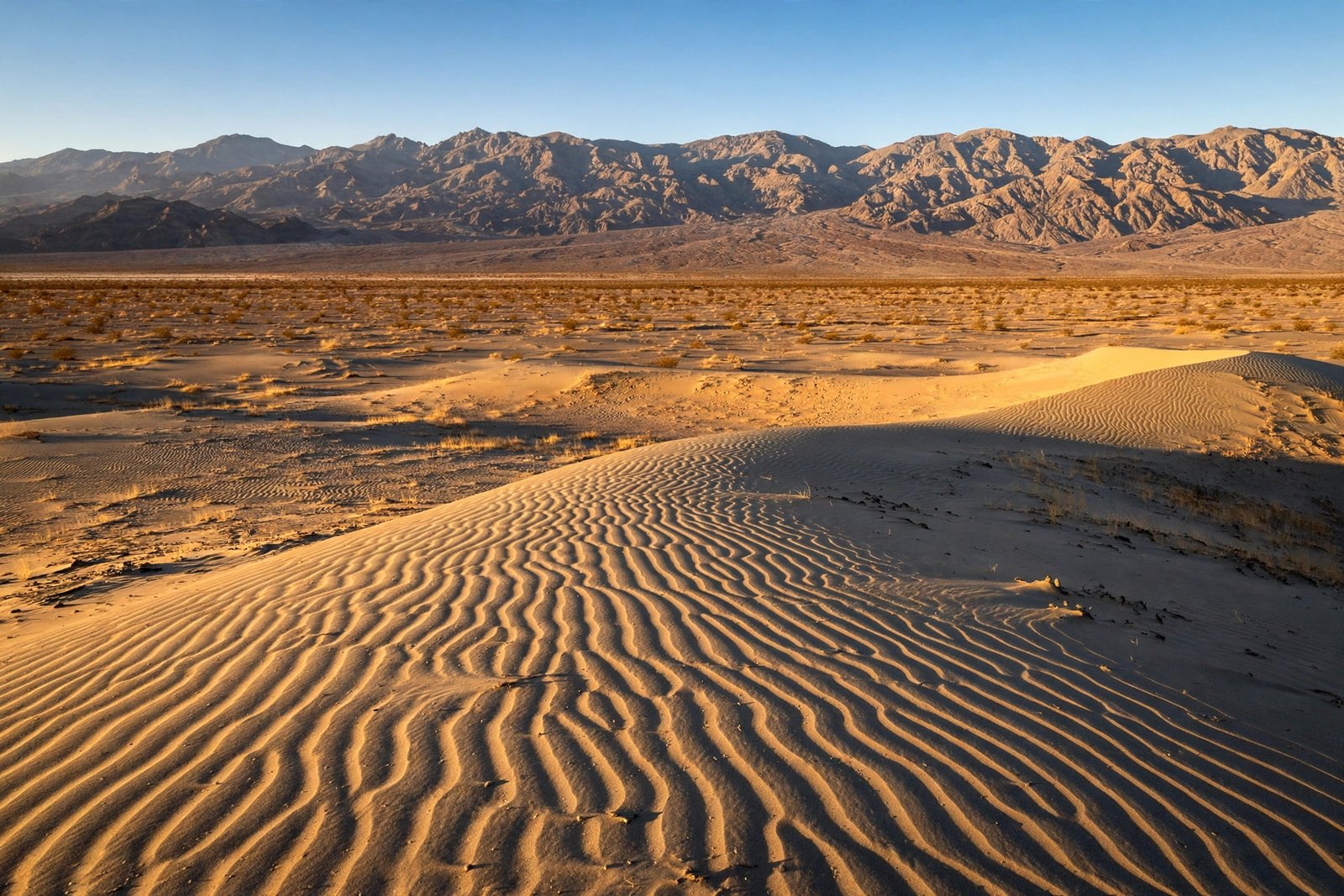
Few places on Earth collect superlatives the way this desert does. The most amazing death valley facts read like a trivia champion’s dream list: the hottest air temperature ever reliably recorded on the planet, the lowest point in North America, and some of the driest, darkest, and most dramatic landscapes in the United States. Yet for all its fearsome reputation, Death Valley is also one of America’s most beautiful national parks, a place of wildflower blooms, rippling sand dunes, and night skies so dark the Milky Way can cast a faint shadow.
Sitting in eastern California near the Nevada border, roughly a two-hour drive west of Las Vegas, Death Valley National Park protects more than 3.4 million acres of desert wilderness. In this guide we will walk through the essential death valley facts every curious traveler should know, from the legendary 134-degree day to the salt flats of Badwater Basin, plus honest advice on when to visit and how to explore safely.
Death Valley Facts: The 134-Degree World Record
Let us start with the number that made Death Valley famous. On July 10, 1913, a weather observer at Furnace Creek, then known as Greenland Ranch, recorded an air temperature of 134°F (56.7°C). The World Meteorological Organization recognizes it as the highest air temperature reliably measured anywhere on Earth, and it has stood for more than a century.
Honesty matters here, so here is the full story: a number of modern meteorologists have questioned that 1913 reading, suggesting the thermometer or the observer may have been at fault during an exceptional regional heat wave. The debate is genuine and ongoing among climate historians. But as of today, no verified reading has beaten it, and the record officially stands, which is exactly why Death Valley is called America’s hottest place.
For context on just how extreme summer gets here: July is the park’s hottest month, daytime highs routinely climb past 120°F, and overnight lows in midsummer can stay above 90°F. In a strange twist, the coldest temperature ever recorded in the valley, 15°F on January 8, 1913, came in the very same year as the all-time heat record.
- Hottest reliably recorded temperature on Earth: 134°F (56.7°C), Furnace Creek, July 10, 1913
- Typical July high: around 116°F at Furnace Creek
- Average annual rainfall: under 2 inches at the valley floor
- Coldest recorded temperature: 15°F, January 8, 1913
How Death Valley Got Its Frightening Name
The name dates to the California Gold Rush. In the winter of 1849-1850, a group of pioneers known as the Bennett-Arcane party became lost while trying a shortcut to the gold fields and wandered into the valley. According to long-told park lore, as the survivors finally climbed out over the mountains, one of them turned back toward the shimmering basin and said, “Good-bye, Death Valley.”
Here is the legend-versus-fact part: despite the dramatic name, historians believe only one member of that original party actually died in the valley. The name stuck anyway, and it has been scaring and fascinating visitors ever since. Long before the ’49ers arrived, the Timbisha Shoshone people had lived in and around the valley for centuries, and their descendants remain connected to this homeland today, including a village at Furnace Creek.
Death Valley Facts About Badwater Basin: The Lowest Point in North America
One of the most mind-bending death valley facts is that you can stand at the lowest point in North America without ever leaving the park. Badwater Basin sits 282 feet (86 meters) below sea level, a vast white salt flat stretching for miles. A small sign on the cliff face high above the parking area marks sea level, so you can look up and grasp just how far beneath the ocean’s surface you are standing.
The basin’s strange name comes from a surveyor whose mule refused to drink from the spring-fed pool at the site, the water being far too salty, hence “bad water.” Today visitors walk out onto the salt flats to see the famous hexagonal salt polygons, formed as salty groundwater rises, evaporates, and cracks into geometric crusts. After rare desert rains, a thin mirror-like lake can briefly cover the flats, creating one of the most photographed scenes in the American desert.
For a different perspective on the same basin, drive up to Dante’s View, an overlook more than 5,000 feet above the valley floor. From there, Badwater’s white salt pan glitters far below like a frozen lake, with the Panamint Mountains rising on the far side.
A Park of Extremes: From 282 Feet Below Sea Level to 11,049 Feet Up
Death Valley is a land of vertical drama. Within the park’s boundaries, elevation swings from Badwater Basin at 282 feet below sea level to the summit of Telescope Peak at 11,049 feet. On a clear winter day, you can stand in snow atop Telescope Peak and gaze down at one of the hottest places on Earth, a contrast found almost nowhere else in America.
The park’s size is another superlative: at more than 3.4 million acres, it is the largest national park in the Lower 48 states. It was first protected as a national monument in 1933 and became a full national park on October 31, 1994, under the California Desert Protection Act.
Why is it so hot and dry? The valley sits in the rain shadow of four mountain ranges, which wring the moisture out of Pacific storms before they arrive. The sinking air then compresses and heats as it drops into the deep basin, a one-two punch that keeps the valley floor among the driest places in North America. Thousands of years ago, during the Ice Age, a vast body of water called Lake Manly filled much of the valley; its ancient shorelines are still visible as terraces on the surrounding mountainsides.
Mesquite Flat Sand Dunes and the Park’s Natural Wonders
Beyond the records and extremes, Death Valley is simply gorgeous. Here are the sights no first-time visitor should miss:
- Mesquite Flat Sand Dunes: rippling dunes near Stovepipe Wells, the most accessible dune field in the park and magical at sunrise and sunset. If you love dunes, you will also enjoy our roundup of the best sand dunes in the USA.
- Artist’s Drive: a 9-mile one-way loop through hills splashed with mineral colors, pinks, greens, and purples, at the viewpoint called Artist’s Palette.
- Zabriskie Point: a maze of golden badlands made famous in films and photographs, best visited at dawn.
- Golden Canyon: a walkable canyon of fluted, rust-colored walls that glow in late afternoon light.
- Devil’s Golf Course: a field of jagged salt formations so rough that, as the old saying goes, only the devil could play golf on it.
- Ubehebe Crater: a massive volcanic crater about half a mile wide and 600 feet deep, carved by an ancient steam explosion.
- Racetrack Playa: a dry lakebed famous for its sailing stones, rocks that slide across the playa leaving long trails behind them. For decades the cause was a genuine mystery; a 2014 scientific study showed that thin sheets of winter ice, nudged by light winds, push the rocks along.
- Scotty’s Castle: the elaborate Spanish-style desert villa of prospector Walter Scott, badly damaged by a flash flood in 2015 and closed for long-term repairs.
Death Valley is also one of the premier stargazing destinations in America. Designated a Gold-Tier Dark Sky Park in 2013, it protects some of the darkest night skies in the country. And in rare wet years, the desert floor erupts in a wildflower superbloom, carpeting the valley in gold and purple. Famous blooms in 2005 and 2016 drew visitors from around the world. For more desert beauty, see our guide to the most beautiful deserts in the USA.
More Fascinating Death Valley Facts
Still curious? Here are a few more verified gems about this remarkable place:
- Borax built its early economy: in the 1880s, the famous 20-mule teams hauled borax out of the valley to the railroad, a 165-mile trek. The ruins of the Harmony Borax Works still stand near Furnace Creek.
- The world’s lowest golf course: the course at Furnace Creek sits 214 feet below sea level, the lowest-elevation golf course on the planet.
- It is enormous: the valley itself runs roughly 140 miles long, and the park could swallow several eastern states’ park systems whole.
- Life finds a way: the park is home to desert bighorn sheep, coyotes, roadrunners, and the tiny Salt Creek pupfish, a fish found nowhere else on Earth.
- A filming legend: the Mesquite Dunes have stood in for distant planets in famous science-fiction films.
When to Visit Death Valley and How to Stay Safe
The single most important of all death valley facts for travelers is this: timing is everything. The best months to visit are November through March, when daytime highs are a pleasant 65-80°F and the desert is comfortable for hiking and sightseeing. Summer visits are possible but demand serious caution; the National Park Service advises against hiking at low elevations after 10 a.m. when temperatures soar past safe limits.
- Water: carry and drink at least one gallon (4 liters) of water per person per day.
- Driving: stay on paved roads in summer, keep your gas tank full, and never rely on cell service, which is unreliable across much of the park.
- Heat safety: travel in a vehicle with air conditioning you trust, watch for signs of heat illness, and check on fellow travelers often.
- Respect the desert: stay on trails, never feed wildlife, and pack out everything you pack in.
Death Valley consistently ranks among America’s most extraordinary parks. See how it compares in our list of the most beautiful national parks in the USA.
Conclusion: America’s Hottest Place Is Cooler Than You Think
From a debated-but-standing world heat record to the lowest point on the continent, the essential death valley facts paint a picture of a place that defies every expectation. It is brutal and delicate, ancient and ever-changing, forbidding in name and unforgettable in person. Add it to your bucket list, aim for the winter months, bring more water than you think you need, and look up at the night sky at least once. Have you visited Death Valley? Share your favorite memory in the comments and subscribe for more USA travel guides.